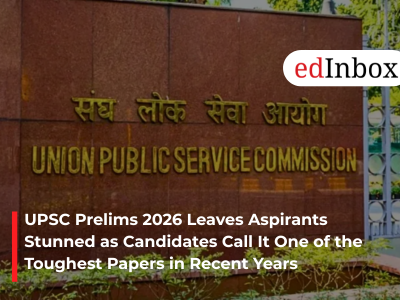
Thousands of UPSC aspirants emerged from examination centres describing the Civil Services Preliminary Examination (UPSC Prelims) 2026 as one of the most challenging and unpredictable papers in recent years, triggering widespread debate across coaching circles and social media platforms.
Candidates reported facing lengthy analytical questions, closely worded answer choices and a noticeable emphasis on conceptual understanding rather than direct factual recall. Many aspirants said the paper demanded significantly more time per question, making time management one of the biggest challenges during the examination.
The UPSC Civil Services Examination, regarded as one of India's most competitive recruitment tests for services such as the IAS, IPS and IFS, attracts lakhs of candidates every year. This year's preliminary examination has generated particularly strong reactions due to its perceived difficulty level and changing question patterns.
Aspirants Cite Lengthy Paper and Time Pressure
One of the most discussed aspects of the examination was the apparent increase in the size of the question booklet. Several candidates claimed that the paper appeared longer than in previous years, with many reporting an increase from around 48 pages to 56 pages.
While the Union Public Service Commission (UPSC) has not issued any statement regarding the paper length, aspirants argued that the additional reading burden affected their ability to manage time effectively during the examination.
Many candidates said they were forced to spend more time understanding questions and evaluating answer choices, leaving less time for revision and calculated attempts.
Shift Towards Analytical Thinking
Initial reactions from aspirants and coaching experts suggest that UPSC Prelims 2026 placed greater emphasis on analytical reasoning, interpretation and conceptual clarity.
Several candidates observed that familiar subjects appeared in unfamiliar formats. Instead of straightforward factual questions, many questions reportedly required deeper understanding and the ability to apply concepts across different topics.
This approach, according to educators, aligns with UPSC's broader trend of assessing comprehension, critical thinking and decision-making rather than testing memorisation alone.
Social Media Flooded With Reactions
Shortly after the examination concluded, social media platforms were flooded with reactions from aspirants discussing the paper's difficulty level. Many candidates described the examination as mentally exhausting, while others compared it with some of the toughest UPSC prelims papers in recent memory. Coaching institutes also began publishing preliminary analyses, with several experts noting that question framing and option elimination appeared more challenging than expected.
However, some educators cautioned against drawing immediate conclusions, noting that perceptions of difficulty often vary among candidates and that a clearer picture will emerge only after detailed analysis and official answer keys become available.
Cut-Off Predictions Still Premature
With the examination now over, discussions have already begun around expected cut-offs and qualifying scores. Experts, however, say it is too early to accurately predict the final cut-off without comprehensive performance data from candidates across the country.
The actual impact of the paper's perceived difficulty will become clearer in the coming weeks as coaching institutes release detailed reviews and aspirants compare responses. For now, one thing is certain: UPSC Prelims 2026 has sparked a national conversation about the evolving nature of India's toughest competitive examination.
Whether the paper ultimately proves to be among the most difficult in recent years will depend on official data and candidate performance. But judging by the immediate reaction from examination centres across the country, this year's prelims has left a lasting impression on aspirants.
UPSC Prelims 2026 Leaves Aspirants Stunned as Candidates Call It One of the Toughest Papers in Recent Years
Typography
- Smaller Small Medium Big Bigger
- Default Helvetica Segoe Georgia Times
- Reading Mode