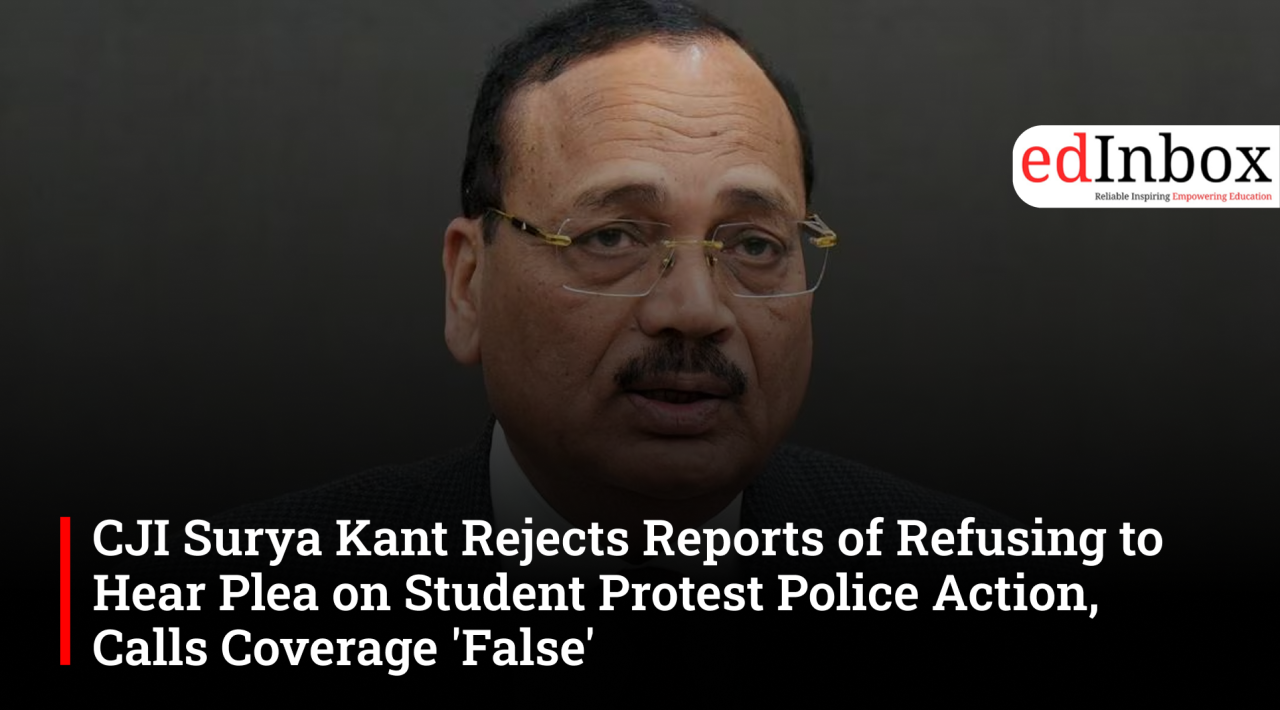
Chief Justice of India (CJI) Justice Surya Kant on Friday rejected media reports alleging that he had refused to hear a plea challenging the alleged police action against student protesters, saying the reports were "completely false" and a misunderstanding of court procedure.
While addressing the issue in the Supreme Court proceedings, CJI stated that there was no writ petition filed before the Court on the issue. He said that the only document received was a letter representation by an advocate, which cannot be considered as a formally instituted writ petition unless it is filed in accordance with the prescribed legal procedure.
Expressing concern over the reports, Justice Surya Kant criticised sections of the media for suggesting that the Supreme Court had declined to hear the matter.
“In the last two days, a completely false statement was made that a matter was filed, and the media is absolutely free from all responsibility, falsely reporting that the Chief Justice refused to list the matter. Till 10 AM this morning, not a single page has been filed. It was one representation… sent by that Mishra or someone. How can I treat the representation as a writ petition? And people start recklessly reporting this,” the CJI said.
The clarification was issued following Advocate Narendra Mishra's oral reference to a letter petition he had submitted to the Chief Justice regarding the police action during the ongoing student protests. The CJI refused to hear the oral mention, reportedly saying to the lawyer, “Don't waste our time, don't waste your time.”
The advocate told the Court that he had videos of the alleged police action, which Justice Surya Kant replied, "We are not interested in videos; we don't have time to watch’’
The controversy arose amid widespread protests by students over allegations of irregularities in examination and recruitment systems. Protestors have been asking for more transparency, accountability and reforms in the education sector, and also demanding the resignation of Union Education Minister Dharmendra Pradhan for the NEET paper leak controversy.
The protests escalated when Delhi Police blocked the 'Sansad Chalo' march by the opposition led by the Congress party. The march led to clashes between protesters and police, causing injuries, detentions and multiple FIRs were registered.
The CJI's comments clearly indicate that as of Friday morning, there was no formal writ petition filed before the Supreme Court challenging the police action and that the Court had not refused to list or hear a writ petition. The clarification also highlights the difference between a letter representation and a duly instituted writ petition in the Supreme Court procedure.
CJI Surya Kant Rejects Reports of Refusing to Hear Plea on Student Protest Police Action, Calls Coverage 'False'
Typography
- Smaller Small Medium Big Bigger
- Default Helvetica Segoe Georgia Times
- Reading Mode