Children are taught to respect teachers, parents, the Constitution, national symbols and those who make positive contributions to society in classrooms. Respect is offered as a value. But worship is traditionally reserved for faith.
This distinction has come to the forefront again after Bihar Transgender Welfare Board approved a plan to construct a temple in honour of Prime Minister Narendra Modi. The proposal, which is yet to be allocated land and approved by the Bihar government, has generated discussions that are not confined to politics.
The more important question for students and teachers might be, is the proposal right or wrong? Rather, it's this: What message does it send to the current generation?
Why is Bihar Transgender Welfare Board building a PM Modi Temple?
The proposed temple is part of a gesture of gratitude to Prime Minister Narendra Modi for what the transgender community members say he has given the transgender community "respect and rights," according to the Bihar Transgender Welfare Board.
This proposal was put forward by the board member Ranjan Singh in the first meeting of the board under the Bihar Social Welfare Department and was reportedly approved unanimously.
The central government's Transgender Persons (Protection of Rights) Act, 2019, was the first significant law that acknowledged transgender rights in India, say board members. They also refer to the setting up of institutional bodies such as Bihar's own Transgender Welfare Board as indicators of representation.
The proposed temple is not just a religious building, but a symbol of gratitude for what they consider to be a pivotal moment in the community's development.
What has changed since the Transgender Persons (Protection of Rights) Act 2019?
With the passing of the 2019 law, India has become the first country in the world to have a central law specifically for the rights of transgender people. The Act bans discrimination on the grounds of:
- Education
- Employment
- Healthcare
- Housing
- Access to public services
It also established provisions for identity certificates, welfare schemes by the governments and institutional bodies to protect the rights of transgender.
After the enactment of the Act, the National Council for Transgender Persons was formed and a few states like Bihar, formed welfare boards for transgender empowerment and social inclusion. These changes are seen as a significant change in the way transgender citizens are recognised by government systems by supporters.
Not Everyone Agrees
The proposal has also reignited debates on the Transgender Persons (Protection of Rights) Act. The legislation had been criticised by several transgender rights groups after it was passed, saying that the process of getting a transgender identity certificate was unnecessarily bureaucratic. Others noted that the law made no mention of reservations in education or public employment, thus failing to fully meet the demands of longstanding reservations for equal opportunities.
The fact that these opinions are different shows that the transgender community is not a monolith. Some view the law as a milestone that deserves to be celebrated, while others feel that the fight for equality is not over.
Beyond Politics: A Classroom Question
The idea is an intriguing one in education. Schools promote the awareness of scientists, social reformers, freedom fighters, teachers and public leaders. They are rewarded with awards, biographies, debates and commemorative events.
But where should society draw the line between respect and reverence?
There are many people who have changed the course of nations through their leadership, reform or social movements. They are remembered, honored and, in some cases, memorialized in statues, museums, memorials and institutions named after them. A temple, however, has a different space in Indian society.
Such changes could, of course, lead young students to ask themselves questions about how democratic societies express gratitude. Is appreciation best shown through stronger institutions and continued social reforms? Or can symbolic gestures be expressions of collective thanks? There may not be one universally accepted answer, but the questions themselves are worth discussing.
What Message are We Passing on to the Next Generation?
Education is not solely through books, as students also learn from observing society. They start to develop their ideas about citizenship, democracy and public service when they witness leaders being praised, criticised, celebrated or commemorated.
Maybe the more significant takeaway is that a leader doesn't need to be appreciated. Democracies flourish when citizens recognize that there are meaningful contributions, even when they have opposing views.
The more important question is how that appreciation is manifested. Do we promote the importance of ideas, institutions and public service to the detriment of individuals? Or are we slowly creating a culture in which personalities are growing bigger than the principles they stand for? These are questions that all generations will face at some point.
Note that the temple is not yet constructed. The Bihar Transgender Welfare Board has approved the proposal in-house, but construction can be started once the land is allotted by the Bihar government and the required administrative clearance is obtained.
It would be one of the rare cases in India where a place of worship is made for a sitting Prime Minister!
A Conversation Worth Having
It has already begun a more expansive public discussion, whether or not the proposed temple is ever built. For students, teachers and parents, the question is not about their political leanings but about their civic values.
While India continues to honour leaders who have an impact on society, the most important takeaway for the next generation is the difference between respecting public service and putting people beyond public scrutiny.
Admiration can inspire in a democracy. Likewise, careful questioning can be an educational experience. For education, the challenge is to make sure that future citizens understand the importance of both and can differentiate between respecting and worshipping.
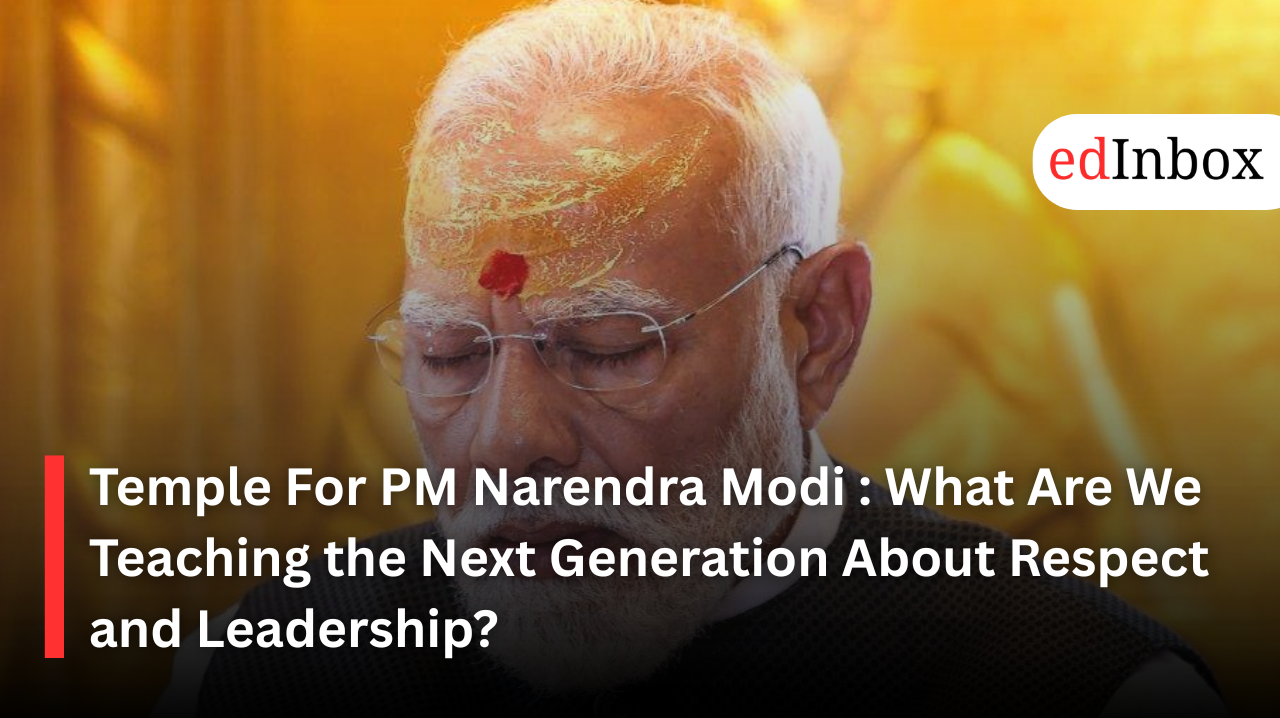
Temple For PM Narendra Modi: What Are We Teaching the Next Generation About Respect and Leadership?
Typography
- Smaller Small Medium Big Bigger
- Default Helvetica Segoe Georgia Times
- Reading Mode