How safe is a student the moment they step outside the school gate? We often speak about safe schools, secure campuses and responsible education, but a student's journey does not end when the classroom bell rings. For thousands of children and young people who travel by school buses, public transport and private commercial vehicles every day, the road between home and campus can be just as important as what happens inside the classroom.
The recent case involving a 16-year-old Class 11 student in the Delhi-NCR region is deeply disturbing not only because of the alleged sexual assault, but because of the circumstances that allowed a vulnerable teenager to enter a vehicle without knowing where it was actually going. According to the police complaint and reports, the girl had left her home after being scolded by her mother over her studies and was travelling to meet her cousin in Noida. Heavy rain and poor visibility reportedly caused her to get off at the wrong location. What happened afterwards raises questions that go far beyond one criminal investigation.
Who is supposed to help when a Student Is Lost?
Imagine being 16, alone, caught in heavy rain, unsure of where you are and trying to reach someone you trust. You spot a bus and think it will get you closer to your destination. You ask. It is told to you that it is going in that direction. You get inside… Now, it should not be a time when you, a student, needs to wonder if the person helping them is being honest!
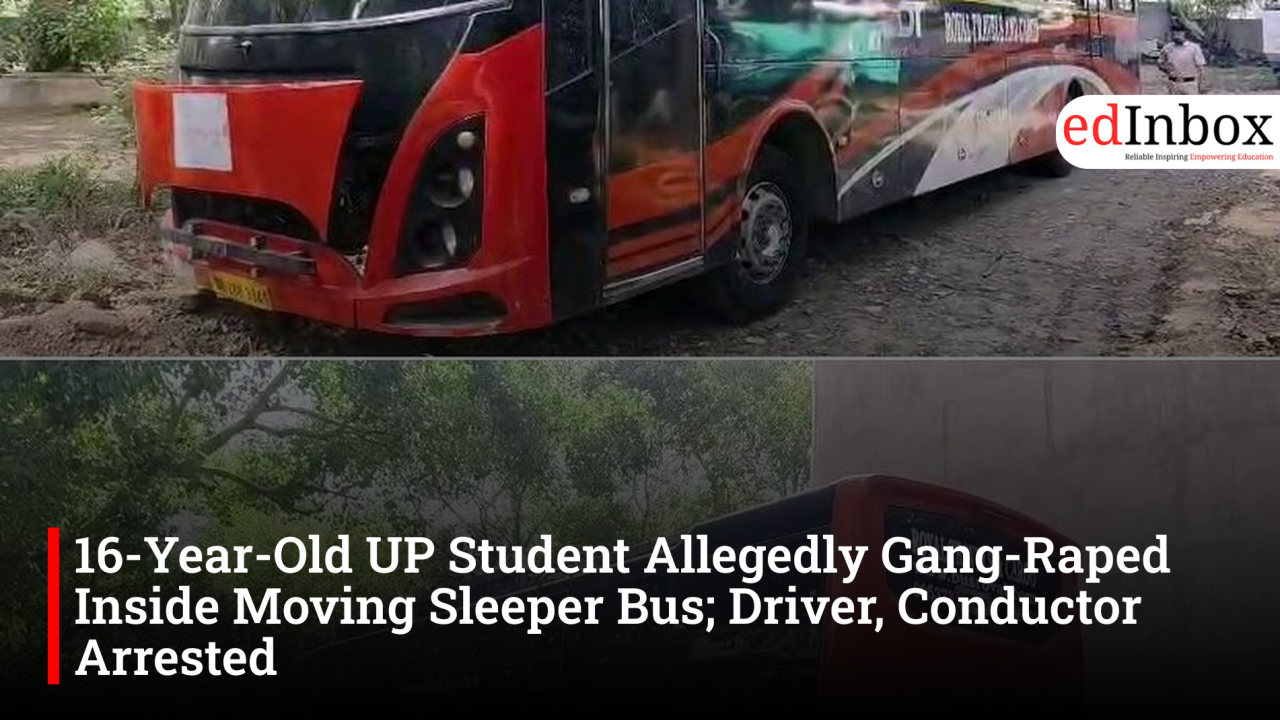
According to the teenager's complaint, she boarded what appeared to be an empty sleeper bus after being told that it was heading towards Noida Sector 63. The bus was said to be on a different route, and she later claimed that the driver and conductor sexually assaulted her on the bus. The police then tracked and caught the two accused. The allegations will be heard in court, but the circumstances raise serious questions about transport safety.
Why was there no immediate mechanism to identify where the bus was going? How did a minor get into a seemingly empty commercial vehicle without any visible safeguard in between? And if there were safety systems in place, were they working?
These are not questions to be asked only after something bad has happened. We, as a country, must address this as soon as possible, and prevent inhuman activities from ruining the lives of students and women.
Student Safety doesn't stop at the school gate!
Schools devote huge amounts of time to talking about attendance, exams, discipline, uniform, academic achievement, etc. However, how much focus is placed on the commute students make before and after school?
A student can leave home at 7 am, spend six or seven hours in an institution and come home in the evening. At that time, safety is the responsibility of families, schools, transport operators, drivers and conductors, authorities and the community.
The problem is that if something goes wrong, the responsibility will be divided. The school can state that the student was already off campus. The transport operator may point towards the driver. The authorities can investigate following the incident. Families might ask themselves if there was one more thing they could have done to prevent the incident. And the one who faced misery would be left questioning why did they even go. Student safety is not a job that starts at the school gate and ends at the school gate; it is a country’s responsibility.
Do Bus Safety Rules Work Outside Papers?
Over the years, India has implemented various safety measures for public and commercial transportation. However, a rule that is written in a notification is not the same as a rule enforced on the road.
The questions raised in this case are not just about whether a specific bus was equipped with a specific safety feature, but about whether a specific bus was equipped with any safety feature. They concern the effectiveness of the entire system.
Is there adequate verification of drivers and conductors? Are vehicles being monitored as needed? Are emergency systems effective? Do authorities know where a vehicle is located right away? Can passengers call for help from the outside of the vehicle? Are commercial buses inspected regularly? But do infractions lead to action?
If you don't know the answer to these questions, then the problem is not just that there are no rules. It's an implementation problem.
The Sleeper Bus Question Needs an Honest Debate
Intercity sleeper buses are becoming more popular due to their ability to provide privacy and comfort for passengers on long trips. However, privacy in a moving vehicle can pose a safety issue if visibility is limited.
Heavy curtains, closed berths and minimal contact with the outside world may make it more difficult for other passengers, pedestrians or authorities to see what is going on inside.
But that doesn't mean that sleeper buses are necessarily unsafe. Nor does the fact that there were curtains prove that they played a role in this particular crime. However, the incident should make regulators and operators question whether the design of these vehicles offers sufficient protection, especially for children or women travelling alone. No comfort should be at the expense of accountability.
Moverover, the bigger question is of the ones in charge of the bus, i.e. the driver and the conductor. They must all be examined, trained, and meet certain requirements to take the job. If this is not done, we’ll again be left teaching potential victims how to avoid being a victim, how to stay caged, how to live with constant fear. Apparently , it would be as if we are teaching men that ‘a lion will surely kill, just try to stay alive else the mistake will be yours.’
What have we learned from Nirbhaya?
It is hard not to make a comparison with the Nirbhaya case of 2012. That case changed the discourse on sexual violence in India and led to the changes in the criminal law and public consciousness. But after over a decade, the uncomfortable question remains: have we created enough systems to make public transport truly safer, or have we simply improved our ability to react after the crime has happened?
Each major tragedy results in pledges of increased surveillance, increased checks and increased enforcement. However, national outrage cannot be the basis of safety. A working safety system should operate on a normal rainy night, on a normal road, in the absence of any supervision, and 24/7 so that no student, no girl, no citizen faces what that 16 year old student or Nirbahaya or others have faced.
If 2026 has the same safety concerns for women as 1926, have we really progressed as a country?
Students Don’t Need Warning to “Be Careful”
Children and young people are often advised not to go anywhere alone, not to talk to strangers, not to get into an unfamiliar car and to let family members know where they are going. These precautions may be helpful, but there is a risk in leaving safety up to the individual.
It is not the responsibility of a 16 year old to have the experience of an expert adult transport professional to stay safe during a heavy rain.
Parents can educate children on emergency procedures. Schools can give instructions on what to do if students get stranded. Increased verification and monitoring by transport companies. Authorities have the ability to check vehicles and enforce safety regulations. Technology can provide location tracking and emergency communication.
Safety is only effective when these layers are all functioning, not when we rely on a child to make up for a failure in the system.
16-Year-Old UP Student Allegedly Gang-Raped Inside Moving Sleeper Bus; Driver, Conductor Arrested
Typography
- Smaller Small Medium Big Bigger
- Default Helvetica Segoe Georgia Times
- Reading Mode