The government has decided to provide quantum teaching laboratories in a total of 100 engineering colleges across the country, with each getting financial support of Rs 1 crore, as part of a bigger initiative towards strengthening India's research capabilities in this area.
The Secretary of DST, Professor Abhay Karandikar, made the announcement on Monday at an event held at the Indian Institute of Technology Bombay.
The initiative is to build capacity for undergraduate minor programmes in Quantum technology, said Karandikar. He also said that more than 500 proposals have already been received and only 100 will be selected.
MAJOR PUSH UNDER NATIONAL QUANTUM MISSION
He added that the National Mission on Interdisciplinary Cyber Physical Systems and the National Quantum Mission also saw significant progress, where IIT Bombay is playing a leading role in both.
He discussed the new areas the Technology Innovation Hub at the institute is engaging with: startups, new technologies, and research on Indian-language large language models.
He informed that all four hubs under National Quantum Mission, namely IISc Bengaluru, IIT Madras, IIT Delhi, and IIT Bombay are demonstrating very good progress. But IIT Bombay's quantum sensing hub stands apart in the group.
NEW FABRICATION FACILITIES ANNOUNCED
During his visit to the Indian Institute of Technology Bombay on Monday, Union Minister for Science and Technology Dr Jitendra Singh announced the setting up of two major quantum fabrication and central facilities under the National Quantum Mission.
These would be established at IIT Bombay and IISc Bengaluru with an investment of Rs 720 crore in total.
Along with that, two other smaller facilities will also be set up at IIT Delhi and IIT Kanpur. Singh explained this would contribute to the indigenization of fabrication for quantum computing chips and quantum sensors, reducing reliance on foreign infrastructure while allowing for faster development cycles.
BOOST TO CRYOGENICS AND QUANTUM ENGINEERING
Singh also sought to increase the infrastructure in cryogenics in the country and added that liquid helium is a critical resource for MRI systems, research with advanced materials, and cryo-electron microscopy. The new facility comprises a helium recovery system that is expected to bring the cost of cryogenic experiments down by about one-tenth of the current expenses. He said the facilities would be made available to academia, industry, MSMEs, startups and strategic sectors for prototyping, technology development and small-scale production. Singh said that IIT Bombay's work had exemplified the potential impact of collaboration between academia, government and industry in furthering next-generation science and technology.
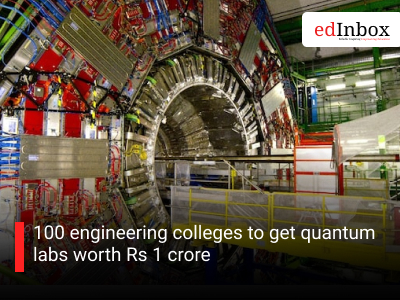
100 engineering colleges to get quantum labs worth Rs 1 crore
Typography
- Smaller Small Medium Big Bigger
- Default Helvetica Segoe Georgia Times
- Reading Mode