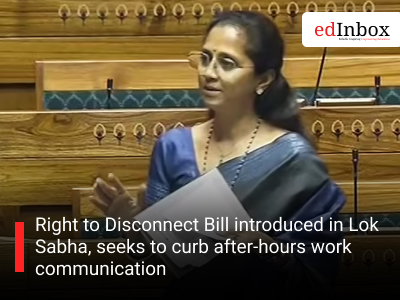
In a significant move aimed at restoring work-life balance for millions of employees, the Right to Disconnect Bill, 2025 was introduced in the Lok Sabha on Saturday by NCP MP Supriya Sule. The private member’s bill proposes to give workers the legal right to ignore work-related calls, emails and messages after office hours and on holidays, thus address the growing culture of digital overwork in India.
The bill comes at a time when constant connectivity, long working hours and rising stress levels have become common concerns across sectors such as IT, media, finance, startups and corporate services. If passed, the legislation would set up an Employees' Welfare Authority that will be responsible for laying down guidelines to protect employees from after-hours communication and resolving disputes between workers and employers.
Introducing the bill, Sule said the legislation "seeks to advance a better quality of life and a healthier work-life balance by lessening burnout caused by today's digital culture." She also posted a video of the moment on social media platform X and emphasized the need for legal safeguards in a time when boundaries between professional and personal life have become increasingly blurred.
But the bill still has a long way to go, since, as a private member’s bill, it is unlikely to be passed into law without backing by the government. Most private member’s bills in India, after all, are either debated, diluted, or ultimately set aside. But political observers argue this proposal has managed to restart an important national conversation about employee rights, mental health, and workplace well-being.
On the same day, Sule also introduced two other private bills, the Paternity and Paternal Benefits Bill, 2025, seeking paid paternal leave, and another, the Code on Social Security Amendment Bill, 2025, aiming at recognizing gig workers as a separate class of workers with minimum wages and social security.
A day earlier, Congress MP Shashi Tharoor moved yet another private member bill to amend the Occupational Safety, Health and Working Conditions Code, 2020, to check long working hours and legally reinforce the right to disconnect. Quoting data, Tharoor said that over 51 per cent of India’s workforce works more than 49 hours a week, while 78 per cent experience burnout, linking excessive workload to deteriorating physical and mental health. While the Right to Disconnect Bill’s eventual fate is still uncertain, experts say its introduction marks an important turn in the way India is beginning to address the question of work culture in the digital era. Even without becoming law, the bill is likely to inform corporate policy, forcing organizations to implement healthier ways of communication and giving employees’ personal time respect.
Right to Disconnect Bill introduced in Lok Sabha, seeks to curb after-hours work communication
Typography
- Smaller Small Medium Big Bigger
- Default Helvetica Segoe Georgia Times
- Reading Mode