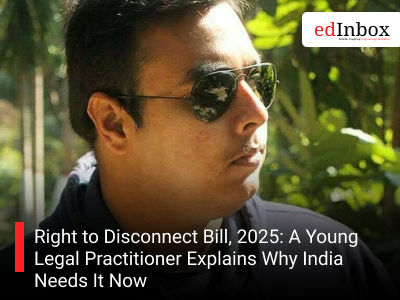
As a young legal practitioner stepping into a world that is always “online”, I see first-hand how blurred the line between work and personal life has become. Emails arrive at midnight, WhatsApp messages replace formal office memos, and “urgent” calls disrupt family time, meals, and even sleep. In this context, the proposed Right to Disconnect Bill, 2025 is not just timely — it is necessary.
Introduced as a private member’s bill by NCP MP Supriya Sule, the proposed law seeks to give employees a legal right to ignore work-related calls, emails, and messages beyond official working hours and on holidays. At its heart, the bill aims to protect an individual’s mental peace, health, and dignity in the digital workplace.
Why the Right to Disconnect is Essential
India’s work culture has long glorified long hours and “hustle”. But the reality today is different. Employees are facing burnout, anxiety, sleep disorders and depression due to round-the-clock digital engagement. The constant expectation of availability is not only unhealthy, but also unsustainable.
According to recent discussions in Parliament, over 51% of Indians work more than 49 hours a week, and nearly 78% report symptoms of burnout. This is alarming. We cannot build a productive economy on exhausted minds.
From a legal standpoint, the Right to Disconnect strengthens fundamental rights such as:
1. Right to life and personal liberty (Article 21)
2. Right to health and well-being
3. Right to privacy in the digital age
Work should not become a 24/7 obligation simply because technology allows it.
Comparative Study: How Other Countries Handle It
India is not alone in dealing with this issue. Several countries have already implemented similar laws:
France (2017)
France became the first country to officially recognise employees’ right to disconnect. Companies with more than 50 employees must set clear after-hours communication norms.
Spain and Italy
Both countries provide workers with the right to switch off digital devices after working hours without facing penalties.
Philippines
A similar Right to Disconnect law was proposed to protect workers, especially those in the BPO and IT sectors. These countries have not seen a drop in productivity. In fact, studies show that well-rested employees are more focused, efficient, and loyal to their organisations.
Advantages
* Protects mental health and reduces burnout
* Improves productivity and employee efficiency
* Strengthens work-life balance
* Creates healthier workplace culture
* Supports gender equality by protecting family time
* Encourages employers to plan work better
Perceived Disadvantages
* May be difficult to implement in emergency-based sectors
* Global companies operating across time zones might face challenges
* Initial resistance from corporate leadership
However, most of these concerns can be addressed by clear exceptions for emergencies and industry-specific regulations. The benefits far outweigh the challenges.
A Step Towards a Humane Work Culture
From a legal and human point of view, the Right to Disconnect is not an “anti-work” law — it is a pro-human law. It recognises that employees are not machines. They are individuals with families, health, emotions, and lives beyond screens.
Even if the bill does not pass immediately — as private member’s bills often struggle — its introduction has already sparked a crucial national conversation. It puts pressure on companies to self-regulate and respect personal boundaries.
As India aspires to become a global economic powerhouse, it must also become a global example of sustainable work culture. The Right to Disconnect Bill is not a luxury — it is a necessity for the future of work in India.
By Abhishek Choudhary
Advocate, District Judges’ Court – Chinsurah, Hooghly
Ex‑Alumni, Department of Law, Hooghly Mohsin College
Abhishek is a dedicated legal professional with a strong foundation in litigation and court proceedings at the District Judges’ Court in Chinsurah. After completing his law degree at Hooghly Mohsin College, he continued to expand his expertise by pursuing the Company Secretary (CS) qualification, blending corporate governance knowledge with his judicial experience.
In addition to his advocacy work, Abhishek offers tax consultancy services, helping businesses and individuals navigate the complexities of Indian tax law. His dual focus on legal practice and taxation enables him to provide comprehensive advice that bridges compliance with strategic planning.
Passionate about continuous learning, Abhishek remains actively involved in both the legal and corporate sectors, contributing to the professional community while assisting clients in achieving their objectives efficiently and ethically.)