
The deaths due to heart attacks among people below age 30 have increased by 40% between 2018 and 2022, growing from 2,371 to 3,329.
In the same period, the numbers for those over 30 climbed from 23,392 to 29,081. Figures like these naturally compel us to fear heart attacks. But do we really need to live in fear? Is it possible to live without constantly worrying about one?
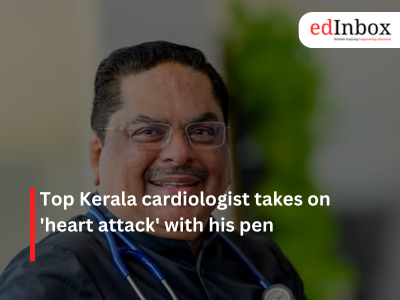
Yes, says Dr George Thayil, the founding head of the department of cardiology at Lourdes Hospital in Kochi. He explains how in his book 'Heart Attack: Bhayappedathe Jeevikkam', which has just been released by DC Books.
For Dr Thayil, writing about the heart never gets old. He has authored more than half a dozen well-informative books in the field of health. In ‘Heart Attack’, he offers insights into how people can protect their hearts.
He noted that these treatments are mostly so expensive that they sometimes break the financial backbone of a family.Even as the World Heart Federation, Unesco, and the World Health Organization repeat at regular intervals that the emphasis needs to shift from cure to prevention in heart disease, few hospitals actually follow this lofty ideal.
Many patients and their families are unable to meet the exorbitant expenses of the cardiac examinations and treatments. "An angioplasty, for instance, costs between Rs 1.5 and Rs 3 lakh, and a bypass surgery between Rs 3 and Rs 5 lakh," says Dr Thayil.
This motivated him to pen a book imparting crucial knowledge on how to keep the heart healthy. The book covers most of the aspects touching on the heart and heart-related diseases in an interesting manner.
Each chapter is titled as a question, to which every one of us has had doubts about sometime or another. Questions such as: What is the heart made of and how does it work? Why do I have chest pain? Will an ECG detect heart disease? Must one begin to take care of the heart early in life?
In one chapter, Dr Thayil brings to light how deaths related to overworking, otherwise known as ‘Karoshi syndrome’, are an emerging concern.
The term 'Karoshi' is Japanese for deaths or incapacitation due to overwork. It is closely associated with cardiovascular and cerebrovascular events, that is, stroke and heart attack, which get induced by extreme stress and unending hours of work.
Dr Thayil considers that the syndrome is a consequence of prolonged work hours, stress related to occupation, poor work-life balance, and societal pressures. The global concern eventually moved the governments to introduce preventive measures. Among people exhibiting Karoshi syndrome, the risk of heart attack rises by 13 per cent, while susceptibility to stroke increases by 33 per cent.
Top Kerala cardiologist takes on 'heart attack' with his pen
Typography
- Smaller Small Medium Big Bigger
- Default Helvetica Segoe Georgia Times
- Reading Mode