With more AI-generated content, deepfakes, and an ever-changing information ecosystem, the newsroom is being taken to task over and over again on the very basics. A profession uniquely anchored on eyewitness accounts and editorial judgment now faces unprecedented technological disruptions. Central to all this disruptive transformation is one irrevocable question: how do journalists safeguard truth when technology convincingly concocts it?
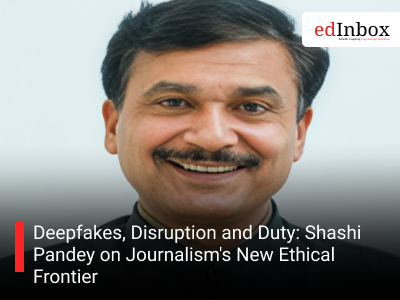
In a conversation with the EdInbox team, long-time media educator and researcher Dr. Shashi Pandey reflects upon these shifting realities-from newsrooms to academic institutions across the country. A clear understanding of practice and pedagogy makes him reflect on the changing face of the role of the journalist, the future of media education, and the growing pressures facing India's regional media landscape.
This opinion by Dr. Pandey warns and teaches all at the same time, underlining one simple fact: while the tools might change, that moral core of journalism does not. During this phase of algorithmic chaos, misinforming, and speed-driven publishing, his perspective brings to the consciousness of young journalists the mission of the profession that has never altered-to verify and question-serving the public with integrity.
For the media students of today, who have to negotiate an increasingly complex digital world, his words are less a piece of advice but rather a framework for ethical survival.
Q.1 After over two decades in newsrooms and academia, how do you view the role of a journalist in the time of AI-driven content and deepfakes?
From years of work in newsrooms and academia, I am consistently convinced that, yes, in a deep fakes-AI-generated content world, journalists will be ever more indispensable. Uppermost would be the use of credibility and verification in a manipulated image world. Digital forensics, metadata analysis, and AI-detection tools would have to combine with old-fashioned reporter checking. Ethical clarity on fairness, timely error correction, and transparency about human and AI inputs is necessary. In spite of changed technology, accurate and verified information with great vigilance remains the first imperative of journalism.
Q.2 Most of the students today prefer digital platforms rather than traditional print. How does media education adapt itself to prepare students for a multimedia first industry?
To this end, a more digital-first approach to media education would comprise digital storytelling, video production, data journalism, and analytics of social media. Learners would want to engage their audience, fact-check information, and platform-specific content strategies. Teaching models themselves would focus more on practical labs, newsroom simulations, and group and tool-based learning. Indeed, this is an assurance that the students turn out work-ready, adaptable, and successful professionals across a multitude of digital platforms.
Q.3 In your opinion, considering the shrinking newsroom and growing demand for hyper-local, what do you think are some of the real challenges regional media face today?
Today's regional media is in a constant fight for survival-as newsrooms shrink, finance is insecure, and the demand keeps growing for faster hyperlocal pieces of news. With fewer reporters, accuracy and depth are difficult to ensure in the reports. There is so much competition from these rapidly moving digital platforms that regional outlets struggle hard to handle linguistic diversity and local sensitivities. They are relevant only when field reporting is enhanced, investments are made in digital skills, and the development of long-term revenue models keeps the wheels of high-quality regional journalism in motion.
Q.4 Having worked on outreach and community-based initiatives with NAAC, how would you like to train students in this programme to get stories of social relevance?
Field trips, community-based reporting, and collaborative projects teach students of journalism to tell stories with social impact. Through NAAC-style outreach, students experience outreach to diverse groups to identify real needs within the communities and directly work on some local issues. They learn responsible journalism in producing stories that amplify the voices of the most marginalized and build a high potential for social impact through practical training in ethical fieldwork, ground reporting, and solution-oriented storytelling.
Q.5 Any advice which you could give to young media graduates who want to uphold ethics and credibility when, more often than not, speed overtakes accuracy?
Young graduates working in media outlets should put more emphasis on accuracy rather than speed: verify the sources, recheck all the facts, and refuse to publish information that is not verified. Critical ethical standards will be followed: reports need to be transparent, and mistakes are quickly acknowledged. It requires critical thinking, patience, and digital verification skills. Credibility in an instant-update, competitive news cycle will always be there for the journalist maintaining honesty, fairness, and responsibility.
Deepfakes, Disruption and Duty: Shashi Pandey on Journalism's New Ethical Frontier
Typography
- Smaller Small Medium Big Bigger
- Default Helvetica Segoe Georgia Times
- Reading Mode