
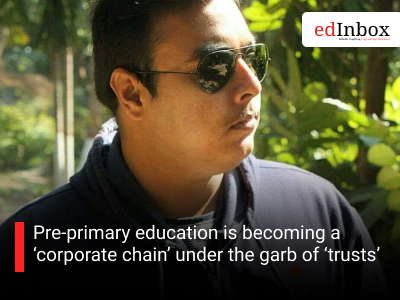
As India’s preschool industry balloons into a high-return franchise market, legal experts are raising alarm over the blurring lines between education, commerce, and trust law. Practicing advocate at District Judges' Court, Adv. Abhisek Chowdhury speaks to Edinbox about how early education has quietly turned into one of India’s most profitable business models,and why the legal grey zone is widening.
Also Read: Pre-Schooling in India at the Crossroads: Business, Regulation and the Homeschooling Question
Q: Preschools today are being marketed like franchise businesses. What has changed?
Chowdhury: The shift began when large chains realised that preschooling sits outside the Right to Education Act. Unlike K–12 schools, preschools are not legally required to operate as non-profit institutions. This opened the door for aggressive franchising. Today, the pitch is simple—invest ₹8–10 lakh and earn up to ₹40 lakh a year. It attracts investors, not necessarily educators.
Behind the colourful classrooms is a full-fledged commercial ecosystem—branding fees, royalty, training charges, curriculum kits, even mandatory purchase of uniforms. The pedagogy is often a tiny part of what franchisees actually pay for.
Q: Many of these chains operate under trusts or societies. Isn’t that contradictory?
Chowdhury: This is where the legal tension lies. A trust cannot “declare profits,” but it can create a surplus—and that surplus can be routed through consultancy, management fees, curriculum development, rent, or outsourced services.
Often, the trust and the private company offering these services share the same promoters. So money moves legally, but the spirit of charitable activity is compromised. As I often say, “It’s not technically illegal. But when a trust functions like a corporate chain, the spirit of the law is being defeated.”
Also Read: Directorate Of Education to enforce age 6 eligibility to enter Class 1
Q: Franchise owners claim they are misled by promises of high ROI. Is that common?
Chowdhury: Very common. People join thinking it’s an assured-return business. Then reality hits—royalties, mandatory upgrades, marketing contributions. Many franchisees tell me the chain earns more than they do.
The success of a preschool today depends heavily on location. In lower or middle-income neighbourhoods, the model collapses. Preschool has become a luxury product, not an educational necessity.
Q: What does this mean for parents?
Chowdhury: Parents now experience preschool admissions the way one shops for premium consumer brands. Fees rival primary schools, often without transparency on teacher salaries or curriculum quality. Many parents tell me, “It feels like corporate pricing for a trust-run school.”
This is deeply problematic because early childhood education is foundational. When it becomes exclusive, we risk widening inequality at the earliest stage of learning.
Q: What regulatory changes do you think are needed?
Chowdhury: India urgently needs:
- Clear licensing standards for preschools
- Transparency rules for trusts running franchises
- Monitoring of fee structures and mandatory purchases
- Minimum qualification and wage norms for teachers
- A national curriculum framework for early years
Right now, preschools exist in a regulatory vacuum, and business interests flourish in that space.
Q: Are we reaching a tipping point?
Chowdhury: Absolutely. Without oversight, the system will keep drifting into a profit-first model—leaving children, our most vulnerable citizens, as mere customers in a franchise economy. Early education must be treated as a public good, not an investment product.
Pre-primary education is becoming a ‘corporate chain’ under the garb of ‘trusts’
Typography
- Smaller Small Medium Big Bigger
- Default Helvetica Segoe Georgia Times
- Reading Mode