India's agriculture stands at a crossroads. As farmers are now increasingly turning to AI technology, climate-resilient crops, and world market connections, its agriculture education is still entrapped in the syllabuses of Green Revolution times. Such increasing irrelevance of education from what happens in class to what happens on the farm has rapidly emerged as one of the most damning factors causing productivity, innovations, or farmer empowerment.
For a 28-year-old Satnam Singh, a resident of Ferozepur in the state of Punjab, the chasm became clear little while after the completion of his BSC in Agriculture and M.Sc in Agronomy. Though he wanted to introduce new methods of agriculture in the lands of his family's farm, as he claimed: "I ended up studying old, outdated textbooks that never helped me in practical ways to address the challenges in the field."
“I have learnt more about modern farming practices from the farmer’s community itself than I did in class,” Iyer said, perhaps echoing the sentiments of every agriculturally-qualified individual in the country.
What is the real problem with the agriculture sector of the country today?
Indian agriculture faces problems of antiquated practices, low productivity, depleted soils, susceptibility to climate, and over-reliance on monsoons. While the literature discussion rages about subsidy and MSP issues, a far more fundamental problem exists in terms of how agriculture is presently taught.
The Indian agricultural education system has failed to keep up with developments in precision agriculture, climatology, biotech, agricultural business, and international trade. This has led to agricultural graduates being inadequately prepared to provide assistance to farmers in dealing with modern conditions.
Effect of Agricultural Education on Farming Practice
In fact, Higher Educational Institutions are one of the关键元素 in the agriculture value chain. Furthermore, without the inclusion of innovative solutions, market intel, risk management, and agri-tech in these university courses, farmers are deprived of new solutions.
This situation continues to create cycles of low productivity, and it also restricts access to new markets and technology for farmers. In some situations, it can be noted that, at a local level, famers have gained more practical skills, creating a reverse flow of knowledge between graduates and famers.
Why Indian Agriculture Education is Outdated?
This, according to experts, was a result of inflexible syllabi, poor methodologies, and the fact that reforms were not made mandatory. Even though many committees have been established that came up with propositions for reforms, many of these reforms were made optional, and institutions continued to teach syllabi that were decades old.
This is according to Avinash Kishore, a Senior Research Fellow at the International Food Policy Research Institute or IFPRI. This is an incestuous loop whereby the educator teaches the students what they taught in class years ago. "In its current form, an economics graduate would know more about markets in agriculture than an agriculture science student," explained Kishore.
Textbooks contribute to the problem. Some popular textbooks are from the 1970s and the early 2000s and fail to address issues like climate change, artificial intelligence-assisted weather forecasting, gene editing, and data analytics, which have become crucial in agriculture worldwide.
New ICAR Guidelines: A Long Overdue Change
Finally, realizing this problem, is the Indian Council of Agricultural Research. The Indian Council of Agricultural Research has made radical proposals, known as the Sixth Deans' Committee Report, to overhaul agricultural education in India.
Important recommendations include:
- Climate-resilient farming and sustainable agriculture
- Integration of AI with machine learning, robotics, and biotechnology
- Compulsory Internship & Enhancement of Skills Module
- Emphasis should be more on the management of agribusinesses,
These reforms will ensure the graduate in agriculture is ready to work, innovation-led, and global.
Which institutions have been able to adapt to modern agriculture developments?
Certain institutions have started the process. TNAU, PAU, and University of Agricultural Sciences, Bengaluru are now offering specialized courses in precision farming, Sustainable Agriculture, and agri-tech innovation.
The Indian Agricultural Research Institute, New Delhi, continues to head the league with highly advanced laboratories, a substantial amount of research, and industry-linked programmes. However, the quality remains patchy. There are huge gaps between the NIRF.rankings, where the small state universities are lagging miles behind in the number of publications, patents, and their impact.
Will the Output of Indian Farm Production Increase Due to Changes in the Curriculum?
“Yes, no question," said experts. Updating curricula with modern research findings in agricultural science could potentially give future generations of agronomists a better handle on some of the most pressing issues currently facing modern agriculture, from water to soil to climate and then marketing."
Experiential training and learn-by-experiment approaches can help convert theoretical knowledge into practical and scalable solutions that make a tangible impact on farm productivity and sustainability.
The Significance of Policymakers in Agricultural Education Reforms
The role of policymakers cannot be overemphasized in terms of budgetary allocation, mandates of universities, and research incentives. Without the correct regulations, the reforms in curriculums face the fear of being random or symbolic.
Support is also required for public-private partnerships, industry labs, and knowledge transfer between the universities and the farming communities—to ensure that innovation is not simply relegated at the campus level.
Balancing Modernization with Traditional Knowledge
However, modernization does not necessarily have to mean separation from tradition. Experts insist that there is a pressing need to integrate traditional knowledge in agriculture with scientific advancements. Hence, there is a challenge to universities to initiate research studies aimed at developing local traditional knowledge while adopting new technology in irrigation, genetic crop development, and even market predictions.
“The sector today encompasses climate science, water relations, gender relations,forestry, and international trade,” explained Pradyuman Kishori, agriculture policy analyst. “But our educational system today regards it as a one-dimensional phenomenon.” One Defining Moment in Indian Agriculture As more students opt to study agriculture abroad because of the degree programs available in agribusiness, food safety, and sustainability, India is losing its talent at a time when its agriculture sector badly needs innovation. With supportive policies and less focus on the accountability of institutions, the transformative curriculum of the ICAR may finally take the agriculture education of India out of the shadows of the Green Revolution. How India will bridge the gap will be the determinant of the future of its students and the adaptability and competency of Indian agriculture in a changing world.
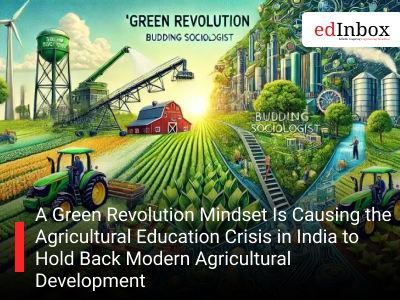
A Green Revolution Mindset Is Causing the Agricultural Education Crisis in India to Hold Back Modern Agricultural Development
Typography
- Smaller Small Medium Big Bigger
- Default Helvetica Segoe Georgia Times
- Reading Mode