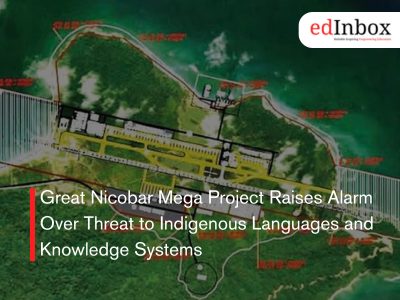
The proposed ₹92,000-crore Great Nicobar mega infrastructure project has sparked fresh concern among educationists, linguists, and anthropologists, who warn that the development could trigger a “linguicide” — the extinction of living indigenous languages — alongside ecological and cultural loss.
Great Nicobar, a UNESCO Biosphere Reserve, is home to the Nicobarese and Shompen communities, among India’s most isolated and ecologically attuned indigenous groups. While environmental and social impacts of the project have been widely debated, experts say its consequences for indigenous languages and education-linked knowledge systems remain dangerously overlooked.
Researchers point out that the Nicobarese language family alone includes six distinct tongues — Pu, Sanenyo, Luro, Mout, Lamongse and Takahanyi Lang — many of which survive with only a handful of speakers. The Shompen language, classified as a linguistic isolate with no known relatives, faces an even greater risk. If lost, it would erase centuries of ecological knowledge, oral history, medicinal science, and cultural memory that are not documented in written form.
Education scholars argue that indigenous languages are not merely communication tools but repositories of place-based learning. From disaster preparedness to biodiversity classification, these languages encode sophisticated systems of environmental understanding. During the 2004 Indian Ocean tsunami, indigenous communities in the Andaman region reportedly survived by interpreting early warning signs embedded in their traditional vocabulary — a powerful example of language as life-saving knowledge.
The Great Nicobar project’s first phase is expected to consume over 166 sq km of land, much of it within protected tribal reserves. This could displace communities from forests, coastlines, and sacred spaces that form the foundation of their cultural education systems, informal learning, and intergenerational knowledge transfer.
Experts caution that forced displacement, demographic influx, and cultural disruption often accelerate language loss. Similar patterns have been observed globally where megaprojects override indigenous educational ecosystems in favour of urban-centric development models.
From an education policy perspective, the issue raises fundamental questions: Can development coexist with indigenous learning systems? How should India balance infrastructure growth with linguistic diversity and knowledge preservation? And what is lost to national education when ancient, ecologically rich languages disappear?
As India pushes toward its Viksit Bharat 2047 vision, scholars argue that safeguarding indigenous languages must be seen not as cultural nostalgia but as an educational imperative — vital for biodiversity conservation, sustainability education, and the preservation of diverse ways of knowing the world
Great Nicobar Mega Project Raises Alarm Over Threat to Indigenous Languages and Knowledge Systems
Typography
- Smaller Small Medium Big Bigger
- Default Helvetica Segoe Georgia Times
- Reading Mode