I had an opportunity to interact with Sir Mark Tully, and each conversation reinforced why he remained one of the most morally anchored voices in journalism. During one such interaction in Goa in 2019, Tully spoke candidly about India’s declining position on the global press freedom index and what he saw as the troubling silence of the Prime Minister when atrocities are committed in the country.
He argued that when such incidents occur, the Prime Minister must speak out decisively, adding that silence distorts political debate and shifts public attention from governance failures to manufactured sensations. Tully was particularly critical of the lack of serious discussion on administrative reforms, noting that there is little public accountability for how government programmes are implemented on the ground. He stressed that governments must be prepared to face journalistic scrutiny, describing criticism by the press as invaluable to democracy, and warned that attempts to control the media are dangerous, calling the steady decline in India’s press freedom ranking deeply alarming.
Reflecting on governance, Tully observed that despite visible policy initiatives, administrative functioning remains pervaded by a lingering colonial mindset. He cited examples from rural India, where welfare schemes are often misdirected, such as Below Poverty Line cards being issued to those who least need them, while genuine beneficiaries are ignored, and complaints to block-level officials are routinely dismissed or met with hostility. For Tully, rural India remained central to understanding the country’s real governance challenges, as corruption, nepotism, and systemic failures are most visible at the grassroots. He repeatedly emphasised that journalism must venture beyond urban narratives to document these realities.
Recounting the personal risks he faced as a reporter, Tully shared an incident from his early career while covering riots in Faisalabad, where he returned to a burning site to file his story, was briefly detained, and overheard Indian journalists discussing his situation before they helped secure his release, allowing him to complete the report. The episode, like much of his career, underscored his belief that truthful reporting often demands courage, persistence, and an unwavering commitment to bearing witness.
Early Life
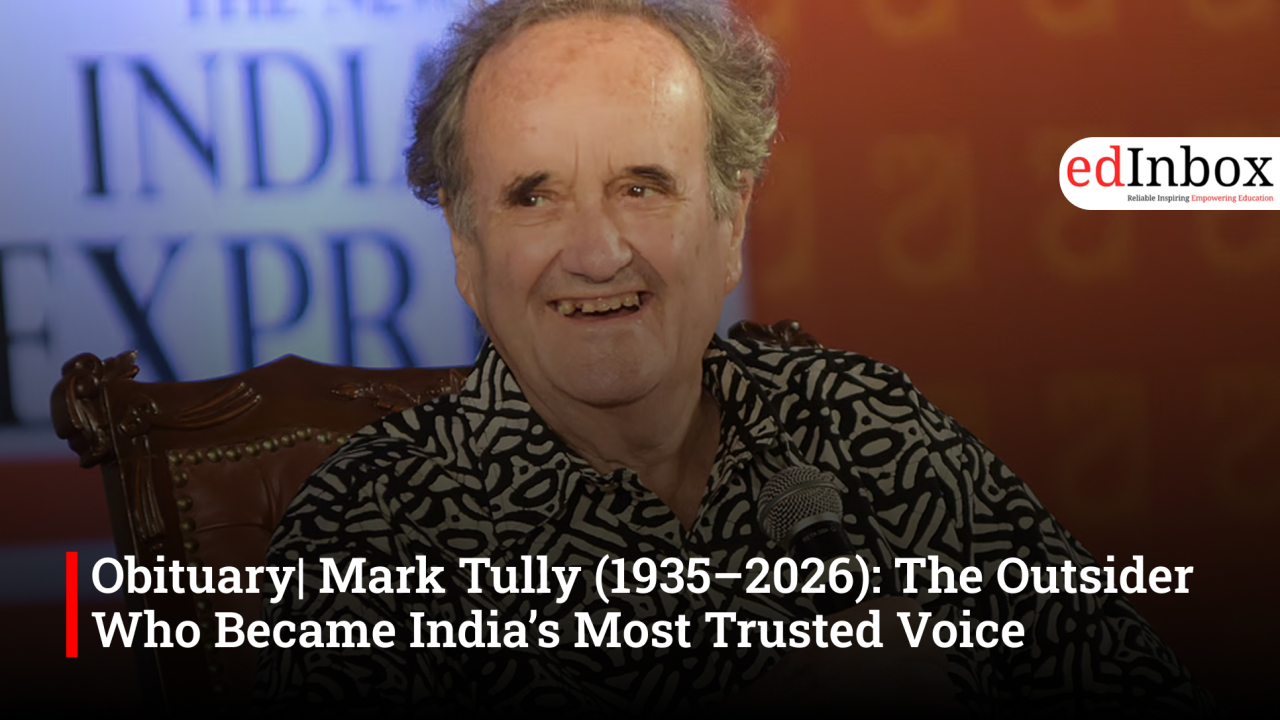
Mark Tully, the legendary BBC journalist often described as the “voice of India”, has passed away, leaving behind a body of work that shaped how the world listened to, argued with, and understood India for more than four decades. For generations of listeners, his measured baritone on the BBC World Service was not merely reporting India—it was interpreting its contradictions with empathy, scepticism, and rare moral clarity.
Born in Kolkata in 1935, the same year the Government of India Act set in motion the final phase of British withdrawal, Tully’s life mirrored the arc of the country he would one day chronicle. Son of a senior colonial-era business executive, he grew up insulated by the privileges and prejudices of the fading Raj. A childhood incident—being slapped by his nanny for learning to count in Hindi—became emblematic of the distance colonial society enforced between itself and India. Tully later referred to himself, half-ironically, as a “relic of the Raj,” fully aware of the contradiction he embodied.
Yet history has a way of reclaiming its own. When Tully returned to India in the early 1960s as Assistant Representative at the BBC’s New Delhi bureau, he encountered a nation that no longer belonged to the empire but to uncertainty, ambition, and democratic churn. Carving a space for the BBC in an airwave landscape dominated by Akashvani and Radio Ceylon was no small task. What distinguished Tully was not speed or sensationalism, but patience—listening longer, asking harder questions, and refusing to simplify India for foreign consumption.
Under his stewardship, the BBC reported on India’s most defining moments: the 1965 and 1971 wars, the birth of Bangladesh, the Emergency of 1975, Punjab’s insurgency, and Operation Blue Star. His journalism was not detached; it was deeply contextual, often uncomfortable, and fiercely independent. During the Soviet invasion of Afghanistan in 1979, when most agencies fled, Tully and colleague Satish Jacob reconstructed the conflict from Delhi airport interviews—an exercise in journalistic ingenuity that later revealed the shadowy movements of Murtaza Bhutto.
Legends followed him. During the Emergency, an alleged broadcast nearly landed him in jail on Indira Gandhi’s orders—until I K Gujral discovered the report was fiction. For 22 years as BBC’s India Bureau Chief, Tully became an institution unto himself. After radio, he turned to documentaries and books, most notably India’s Unending Journey, continuing his lifelong interrogation of power, faith, and democracy.
Knighted in 2002 and awarded the Padma Bhushan in 2005, Sir Mark Tully remained a familiar presence at the Press Club of India—curious, accessible, and always listening. He arrived as an outsider. He stayed long enough to become indispensable. And in doing so, Mark Tully did what few correspondents ever manage: he stopped reporting India from a distance and began speaking with it.
Obituary | Mark Tully (1935–2026): The Outsider Who Became India’s Most Trusted Voice
Typography
- Smaller Small Medium Big Bigger
- Default Helvetica Segoe Georgia Times
- Reading Mode