Union Budget 2026, 27 has given a big boost to education by allocating a record amount of 1.39 lakh crore to the sector, an increase of 8.27 per cent over the previous year.
In theory, this is the highest nominal allocation to education in India ever, thus signalling not only an intention but also continuity and political emphasis. But budgets are more than just about the wishes. India's education system is struggling with the fundamental issue of whether this increase in spending will actually change the system or it will only be a means of covering the costs and continuing with the unfinished reforms.
After factoring in inflation, salary revisions, infrastructure costs, and administrative overheads, the real increase in the budget's purchasing power looks rather limited. Hence, the question arises as to whether the schools and universities throughout the country will be able to effectively carry out what has been declared or the declarations themselves will lead to results.
Where the Money Goesand What That RevealsSchool education still commandslargely the funds with an expected expenditure of around 83, 562 crore; higher education, on the other hand, has been allotted a sum of 55, 727 crore. This break, up is a reflection of the massive size of India's school education system and the government's continued focus on schemes related to access, nutrition, and welfare.Programs such as Samagra Shiksha, PM POSHAN, Kendriya and Navodaya Vidyalayas, and PM SHRI schools constitute the major components of the public education grant.
On the other hand, a quick surge in higher education has mostly been seen, thus signaling an underlying concentration on the acquisition of skills, research, and global competitiveness. Nevertheless, the discussion still remains about how this ratio is appropriate for solving India's time- honored problems of the university level like faculty shortage, unequal funding, and governance issues.
Technology, Skills and the Risk of Uneven Progress
Digital learning, artificial intelligence, skilling, and innovation have been highlighted as the major areas of focus in Budget 202627. The installation of AVGC labs in 15, 000 schools and 500 colleges is an example of a step towards acknowledging the creative industries of the future and the job markets.
However, India's previous stands of technology- driven education reforms are like a warning. Lack of dependable digital infrastructure, insufficiently trained teachers, and weak Centre, state coordination could make these initiatives not only ineffective but also more unequal in terms of regional and socio, economic aspects. The first to benefit would be the urban and well funded institutions, whereas the rural and less endowed schools would fall even further behind.
University Townships and Industry Linkages
The plan to build five university townships along the industrial and logistics corridors intends to connect universities, research, and jobs. In principle, it is in line with the global models of innovation clusters.
Nevertheless, the real success factor lies in the practical aspects getting land, cooperation from the states, regulatory clearances, and investments from the private sector. India's experience with large education clusters indicates that overly ambitious timelines and divided governance can lead to the failure of even the most well, intentioned projects.
Girls Education and Student Welfare
The proposal to create a girls' hostel in every district is a direct response to one of the oldest issues that have limited women's engagement in higher education i.e. safety and shelter. By doing so, besides rural and semi, urban girls, the students from these areas will also greatly benefit from the increased enrolment and retention. However, without definite grant deeds, personnel arrangements, and upkeep promises, the facilities may merely serve as tokens rather than agents of change.
Research Funding and Institutional Fragility
The funds allocated for One Nation One Subscription, World Class Institutions, Atal Tinkering Labs, and PM, USHA are the directions of improving research and innovation. However, the competitive funding cannot replace consistent core funding. There are still a large number of universities that are facing the issue of their basic capacity, which grants cannot solve alone.
To sum up, the Union Budget 2026, 27 is more of a reflection of continuity than discontinuity. It reinforces the areas of technology, skills, research, and welfare but leaves aside the issues of deeper structural weaknesses. The real proof will not be seen from the budget papers, but the classrooms, campuses, and student performances where the intention has to meet the execution finally.
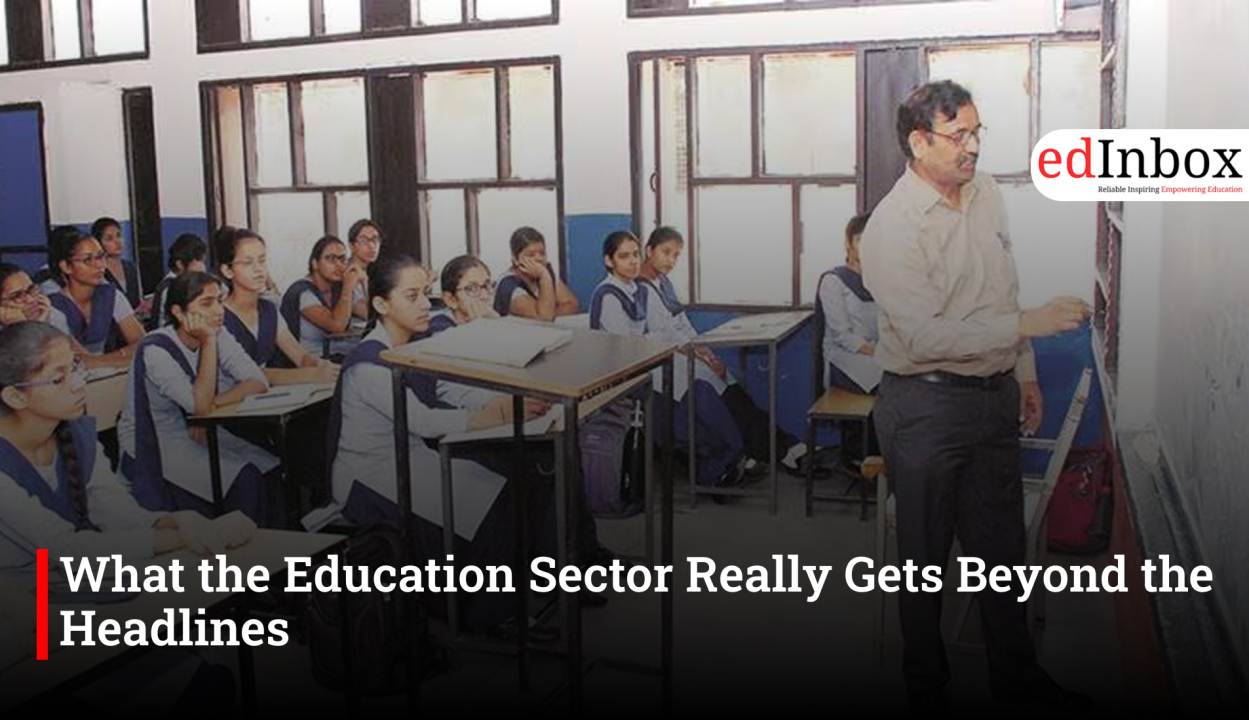
What the Education Sector Really Gets Beyond the Headlines
Typography
- Smaller Small Medium Big Bigger
- Default Helvetica Segoe Georgia Times
- Reading Mode