A recent broadcast by Iranian state television accused the Netherlands-based online university Iran Academia of engaging in what authorities described as “soft subversion”. The report, citing the intelligence arm of the Islamic Revolutionary Guard Corps (IRGC), claimed that authorities had identified “400 core members” connected to the institution and alleged that the platform functions as a training network for activists, separatist groups and gender-rights advocates.
Iran Academia rejected the allegations the same day, describing the broadcast as an attempt to intimidate students and scholars. The institution emphasised that it operates transparently as an independent academic initiative and maintains no offices or organisational members inside Iran.
To understand the broader implications of the controversy, we spoke with Roohola Ramezani, who holds a PhD in philosophy from Shahid Beheshti University in Tehran and previously served as a research fellow at the IFK International Research Center for Cultural Studies in Vienna.
Q: Iranian state television recently accused Iran Academia of “soft subversion”. What exactly were the allegations?
Roohola Ramezani:
The broadcast claimed that Iran Academia operates as a network supporting activists and political groups. It cited the intelligence branch of the Islamic Revolutionary Guard Corps and stated that around 400 “core members” were connected to the institution.However, according to Iran Academia’s response, that number simply refers to public scholar profiles listed on its website—people who voluntarily contribute lectures or publish work through its open-access platforms. These contributors are not members of a political organisation.
The institution rejected the accusations and described the broadcast as a political attempt to intimidate scholars and learners.
Q: For readers unfamiliar with it, what exactly is Iran Academia?
Ramezani:
Iran Academia is an online educational initiative founded in 2012 by scholars based in Europe and North America. Its aim is to provide university-level education in the humanities and social sciences in the Persian language.The platform offers certificate programmes, graduate-level courses, public lectures and an academic publishing platform. Many instructors are established researchers in fields such as sociology, political science, anthropology, philosophy and history.
A distinctive feature is that most instruction takes place in Persian, which is relatively rare for international online universities offering humanities courses.
Q: Why was such an initiative considered necessary?
Ramezani:
The founders saw it as a response to structural limitations within Iran’s higher education system. In many cases, certain academic materials or research topics—especially in the humanities—face restrictions related to censorship, curriculum design or admissions policies.Iran Academia describes its approach as a “democratised model of education.” Its courses and materials are open access, there is no ideological vetting of participants, and core resources are available without tuition fees.
Importantly, the platform operates through volunteer academics and public donations, and contributors are not financially compensated.
Q: How does this controversy connect to the broader academic environment in Iran?
Ramezani:
To understand the reaction, you have to consider the history of higher education in Iran. Since the early 1980s—particularly after the 1980–1983 Cultural Revolution—universities have operated under varying degrees of ideological supervision.Faculty appointments, curricula and research topics have often been monitored. Humanities and social sciences have been especially sensitive areas because they deal with political theory, social change and cultural analysis.
In recent years, especially after the 2022–2023 protests following the death of Mahsa Amini, pressures on universities intensified. There were more disciplinary cases involving students and scholars, and several academics faced suspension or legal action.
Q: Iranian authorities argued that some Iran Academia courses—especially those on political thought or gender studies—pose a threat. Why?
Ramezani:
In Iran’s political context, subjects such as civil liberties, social movements, gender equality or minority rights are often treated as politically charged.When an independent educational platform presents these topics through global academic literature—without state-imposed limits—it can be interpreted by authorities as bypassing domestic oversight.
The digital structure of the platform also complicates regulation. Governments can control physical universities through faculty appointments or campus supervision, but online institutions operating abroad are much harder to restrict.
Q: How do digital platforms change the relationship between states and higher education?
Ramezani:
This is a global transformation. Digital education has created transnational knowledge networks that extend beyond national borders.In the Persian-speaking world, there are now many forms of online academic activity—diaspora lecture series, Persian-language MOOCs and independent research collaborations.
States can filter websites or attempt to control internet access, but educational material often circulates through mirror sites, messaging apps or user-generated uploads.
This means that knowledge production is becoming harder to monopolise.
Q: Does this case have implications for students and scholars?
Ramezani:
Yes, particularly in terms of perception and risk. When a state frames an academic institution within a national-security narrative, it can discourage students from engaging with educational resources—even if those resources are legal and openly available.We have seen cases where participation in workshops, lectures or international conferences has been interpreted as political activity.
That creates uncertainty for students who rely on online platforms for professional development.
Q: What does this dispute reveal about the future of academic freedom?
Ramezani:
It illustrates a fundamental tension.As higher education becomes more global and digital, traditional tools of control—such as curriculum approval, faculty vetting or campus monitoring—become less effective.
Some governments respond by reframing academic activity itself as a security issue.
But at the same time, digital education expands opportunities for students who face restrictions at home.
The case of Iran Academia shows how new educational channels are emerging outside state oversight, while also generating new political friction.
Q: What do you think will happen next?
Ramezani:
Iran Academia has stated that it will continue operating normally and maintain its commitment to academic independence and open access.More broadly, we are likely to see more conflicts of this kind. As digital education grows, states with restrictive academic systems will face increasing challenges in regulating knowledge flows.
For students, scholars and international institutions, the key issue will be how to protect open educational spaces while ensuring that learners are not placed at risk.
Conclusion
The dispute surrounding Iran Academia reflects a broader shift in global higher education. As learning increasingly moves online and across borders, universities are no longer confined to national systems of control.
For many learners, especially in restrictive academic environments, digital platforms provide new opportunities for intellectual engagement. At the same time, these platforms challenge established political boundaries around knowledge.
The conversation, as Roohola Ramezani suggests, is not only about one institution. It is about the future relationship between education, technology and state authority in a rapidly globalising academic world.
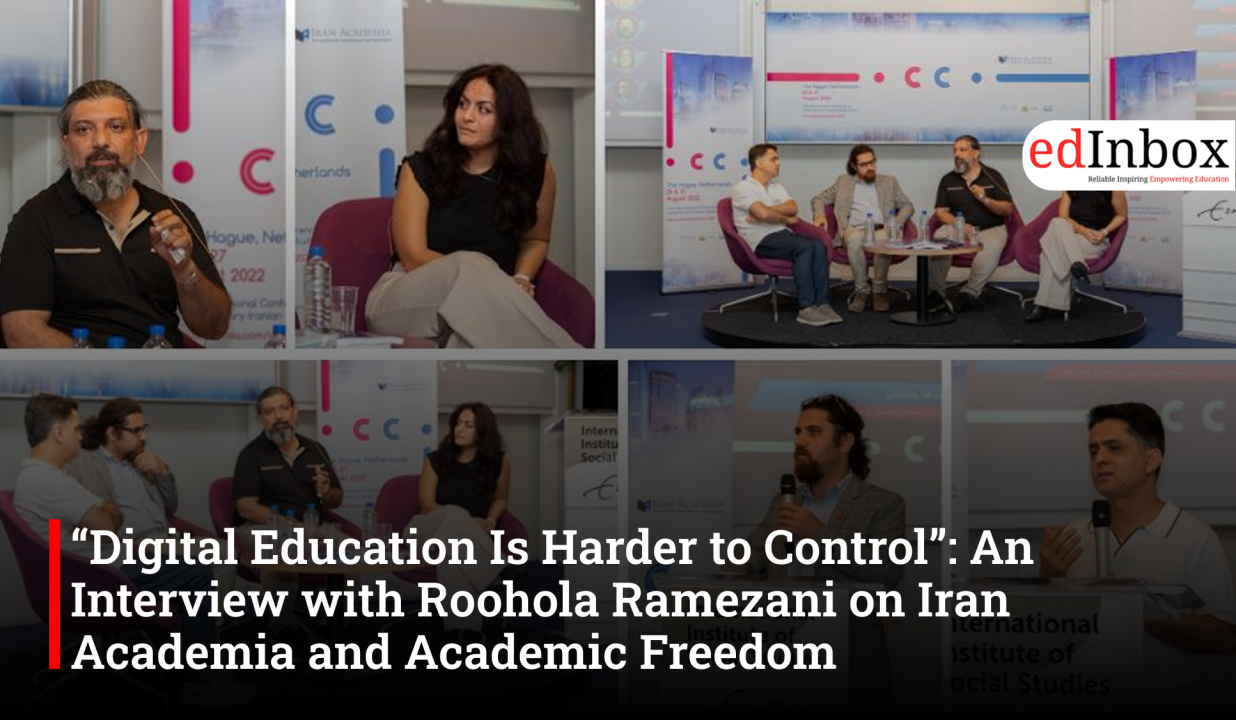
“Digital Education Is Harder to Control”: An Interview with Roohola Ramezani on Iran Academia and Academic Freedom
Typography
- Smaller Small Medium Big Bigger
- Default Helvetica Segoe Georgia Times
- Reading Mode