
As artificial intelligence is revolutionizing economies, educational institutions and governance models globally, it is the opinion of some experts that India, in the first place, must build its own techno backbone and not be fully reliant on global platforms. In this dialogue, V Kamakoti, Director of the Indian Institute of Technology Madras, shares his thoughts on a sovereign AI in India, the role of native models and the impact of AI on education.
Q: You have emphasised the need for sovereign AI. Why is this important for India?
Kamakoti: AI is not just a mere technology but a strategic power. If a nation solely relies on foreign AI systems, those systems might indirectly dictate the way decisions are made, the manner of knowledge creation and even the operations of national systems. Hence, India should create a sovereign AI that is in harmony with our societal value, languages, governance style and developmental goals.
Q: Does this mean India should reduce dependence on foreign AI models?
Kamakoti: Absolutely! To some degree, at least. International cooperation is vital but we should not let external models influence our thinking, learning or running of essential national processes. Creating local AI not only leads to technological self, reliance but also preserves integrity of our data and policy directives.
Q: You mentioned the role of Sarvam AI in this context. What makes it significant?
Kamakoti: Sarvam AI is an example of how Indian innovation can compete globally. The platform has developed strong capabilities in understanding Indic languages and has set benchmarks in large-scale language processing. This is crucial because India’s linguistic diversity cannot always be adequately handled by models trained primarily on Western datasets.
Artificial intelligence is also changing education. How should students approach AI tools?
Kamakoti: AI can become an excellent learning partner, but students should also find out if it really helps them understand the concepts better. Technology should be there to stimulate our critical thinking instead of doing the thinking for us. When used properly, AI can help speed up research, tailor learning and foster innovation.
What role can universities play in building India's AI future?
Kamakoti: Institutions like IITs should prioritise research, talent creation and partnership with industry. Universities can train the AI scientists and engineers of the future who will develop systems that are appropriate for India's requirements. We, however, have to make sure that the discussion about ethics and the consideration of the social consequences stay at the centre of AI development.
Experts believe that as artificial intelligence becomes part of everyday life from classrooms to governance, the capability of India to develop trusted, home grown AI systems may be what ultimately determines the extent to which the country is able to shape its digital future.
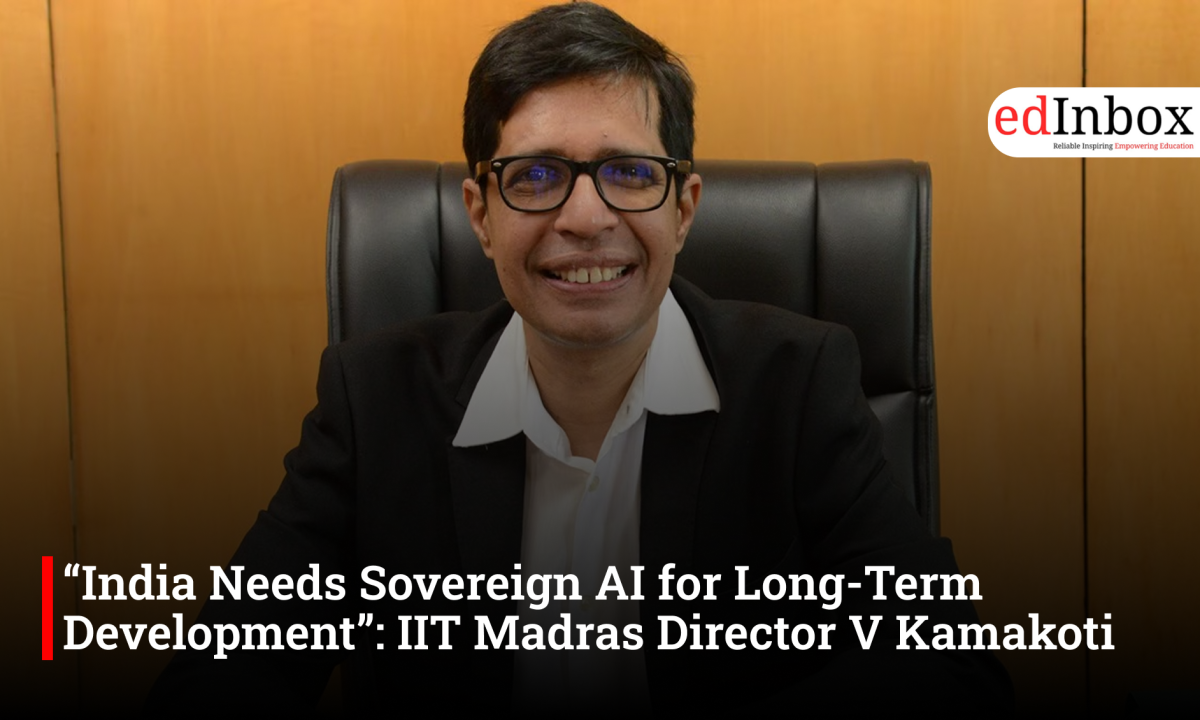
“India Needs Sovereign AI for Long-Term Development”: IIT Madras Director V Kamakoti
Typography
- Smaller Small Medium Big Bigger
- Default Helvetica Segoe Georgia Times
- Reading Mode