
India enjoys a tremendous demographic advantage by having one of the world's youngest populations.
The attention in India's education policy has further shifted towards not only enabling the students to grasp large, scale ideas in theory but also to implement those ideas as their actions.
Talking at the ThinkEdu Conclave 2026, former chairman of UGC, Mamidala Jagadesh Kumar, stated that changes in India's educational system are necessary to prepare the succeeding generation.
During a session on 'Dreamers and Doers: The Next Gen Student', where author Shankkar Aiyar was the moderator and former chief secretary of Tamil Nadu Girija Vaidyanathan was among the panelists, Prof Kumar talked about the future of education, interdisciplinary study, and the concept of being able to study from anywhere.
Q: India has the world's youngest population. How can the education system prepare students for the future?
Prof Mamidala Jagadesh Kumar:
The key to India's development is its young population, and we will be able to benefit from this demographic dividend only if our students are ready to convert their ambitions into real actions. Our education system must identify and nurture both dreamers and doers. We should set up scenes for our students to think out of the box, innovate and solve the world problems through applying their knowledge.
Q: You mentioned old educational models. Which lessons can India get from them at present?
Prof Mamidala Jagadesh Kumar:
As a matter of fact, the educational system during the Madras Presidency era almost 200 years ago, was very socially inclusive, accessible and there was a high demand for its quality. There were a lot of things in that model from which we can learn now as well. Our traditional knowledge systems also focused on comprehensive learning. Works such as Thirukkural talk about the knowledge which changes the character and gives rise to good deeds.
In the present day context, we should not simply adhere to the inflexible Western paradigms. Rather, India should bring back and modify its own educational methods, especially those involving cross, disciplinary learning.
Q: How does current education policy support this shift?
Prof Mamidala Jagadesh Kumar: National Education Policy 2020 advocates a lot for multidisciplinary education. It is one of its features that it offers students the freedom to learn not only one subject area but a few different ones also.
Such an approach will have a step wise effect i.e. students develop broader thinking and diverse skill development along with acquiring knowledge while eventually becoming a team of thinkers and problem solvers.
Q: What advice would you give to the next generation of students?
Prof Mamidala Jagadesh Kumar:
Students must not hesitate to dream, but they should also be prepared to work towards turning those dreams into reality. Education should not only deliver degrees—it must empower students to innovate, build, and contribute meaningfully to society.
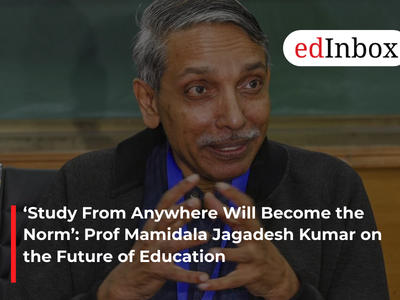
‘Study From Anywhere Will Become the Norm’: Prof Mamidala Jagadesh Kumar on the Future of Education
Typography
- Smaller Small Medium Big Bigger
- Default Helvetica Segoe Georgia Times
- Reading Mode