
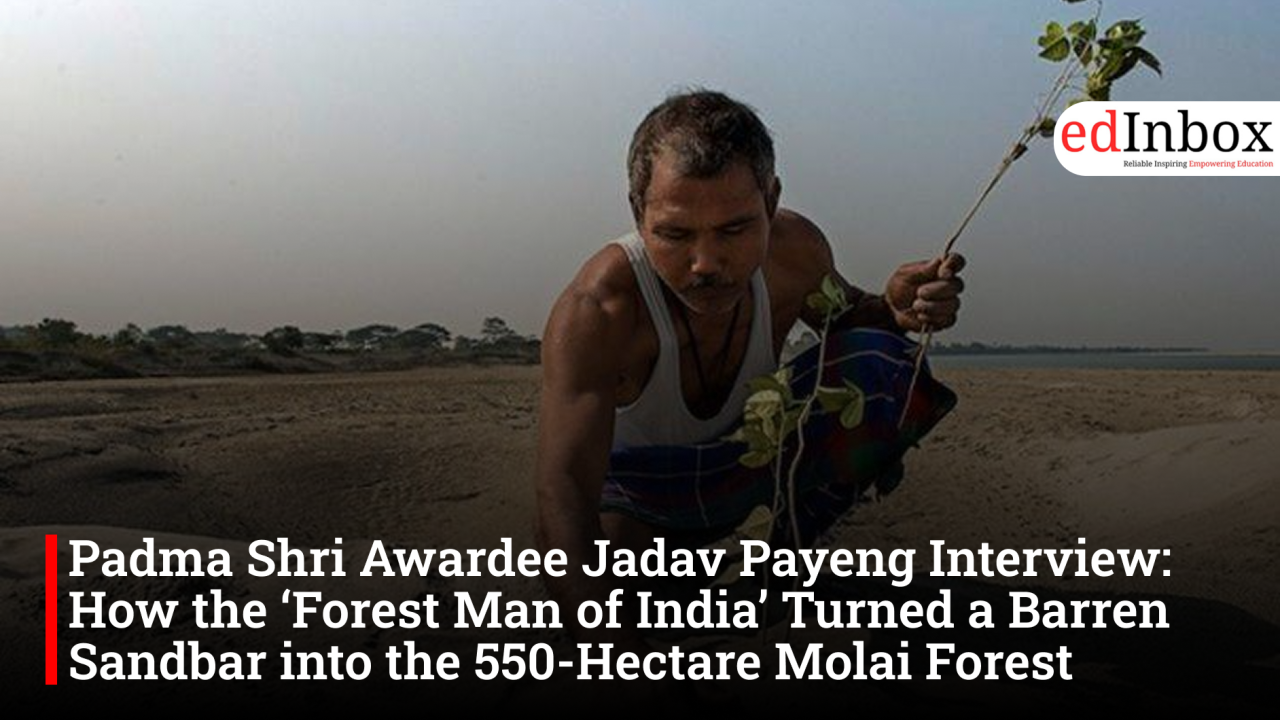
For more than three decades, environmentalist Jadav Payeng has been quietly transforming a barren sandbar along the Brahmaputra River in Assam into a thriving ecosystem. Today, the once lifeless land has grown into the sprawling Molai Forest, a 550-hectare forest rich in biodiversity. In this interview, the Padma Shri awardee speaks about his journey, the inspiration behind planting thousands of trees, and why environmental conservation must begin with young people.
Q: Your friends moved to cities, but you chose to stay back on a river island. Why?
Jadav Payeng: I grew up close to nature in the Mising tribal community, where forests and rivers are part of everyday life. While many of my friends moved to cities for careers, I felt a deeper connection with the land. Planting trees gave me purpose. Over time, the forest became my home and my life’s work.
Q: What inspired you to start planting trees on the sandbar?
Payeng: In 1979, after a severe flood along the Brahmaputra, I saw hundreds of snakes lying dead on a treeless sandbar. They died because there was no shade to protect them from the heat. That sight disturbed me deeply. I decided to plant bamboo saplings so that animals and birds could survive in the future.
Q: How did the forest gradually grow over the years?
Payeng: I initially worked in a social forestry project in Aruna Chapori near Kokilamukh. When the project ended after five years, others left, but I stayed behind and continued planting trees alone. Slowly, bamboo, arjuna, silk cotton and other native species began to grow, and the barren land gradually turned into a dense forest.
Q: How large is the forest today and what wildlife does it support?
Payeng: The forest, now known as Molai Forest, spreads across nearly 550 hectares. It is home to deer, rabbits, monkeys, birds and vultures. Even elephants and rhinos visit the forest. Every year, herds of elephants come and sometimes stay for months.
Q: What is Molai Forest 2.0 and how is your family involved?
Payeng: My daughter Munmuni is now leading the next phase of the project. Through Molai Forest 2.0, we are restoring eroded river islands along the Brahmaputra. So far, more than a million saplings have been planted to protect the fragile river ecosystem.
Q: You received the Padma Shri in 2015. What does the recognition mean to you?
Payeng: Awards are encouraging, but they are not my real motivation. The greatest reward is seeing trees grow and wildlife return to the land. That gives me happiness.
Q: What message would you like to share with young people?
Payeng: If every child plants and nurtures just two trees, the planet can become greener. Environmental protection begins with small actions.
Padma Shri Awardee Jadav Payeng Interview: How the ‘Forest Man of India’ Turned a Barren Sandbar into the 550-Hectare Molai Forest
Typography
- Smaller Small Medium Big Bigger
- Default Helvetica Segoe Georgia Times
- Reading Mode