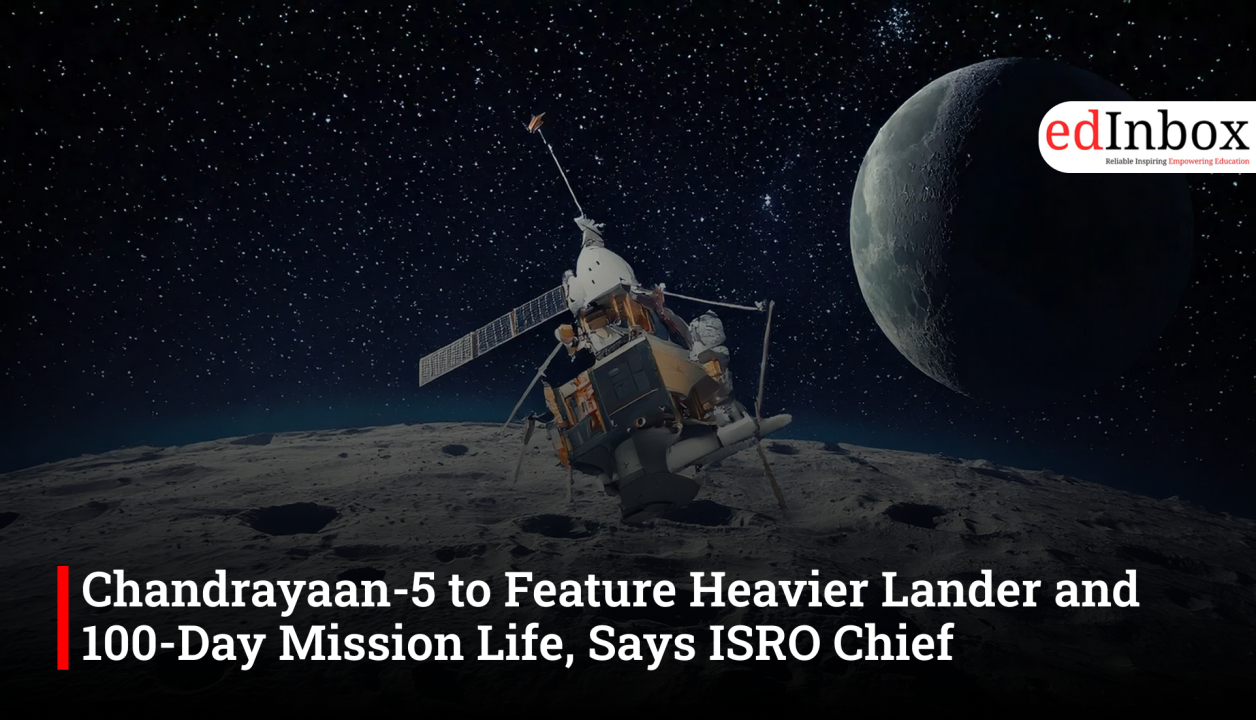
India's lunar exploration programme is gearing up for a new level with some major changes planned in the next missions. On Wednesday, the Chairperson of Indian Space Research Organisation (ISRO), V. Narayanan, revealed that the planned Chandrayaan, 5 mission would have a heavier lander and rover which could work on the Moon for a much longer time.
While talking at the launch of the fourth edition of the Space Science and Technology Awareness Training programme (START 2026), Narayanan mentioned that the forthcoming mission aims at significantly increasing the duration and capability of India's lunar experiments.
"The Chandrayaan, 3 landers mission life was approximately for 14 days. We are aiming for a lifespan of about 100 days for the next mission, " he added.
Sample Return is Planned in Chandrayaan 4
India is ready for Chandrayaan, 4 which in fact, is before Chandrayaan, 5, and the purpose of this mission is to retrieve samples from the Moon and bring them to the Earth, which is a big technological leap in the exploration of planets.
Narayanan said that the rover which is being made for the coming missions will be a lot bigger too. For example, while Chandrayaan, 3 had a 25 kg rover only, the one which is of the next generation and is being developed to a large extent is supposed to be around 350 kg in weight, which will facilitate conducting the most advanced scientific lunar surface experiments.
Expanding Planetary Missions
The ISRO chief also outlined several upcoming interplanetary missions, including the proposed Venus Orbiter Mission and a future Mars landing mission, building upon the success of India’s earlier Mars Orbiter Mission.
“These projects are under discussion for government approval, and there is significant interest in expanding India’s scientific exploration in space,” Narayanan said.
Space Vision 2047
Quoting India's Space Vision 2047, the Prime Minister elaborated on the long, term blueprint of India's space programme announced by the government. Along with the human spaceflight programme Gaganyaan, India is also planning for other space missions that will be game changers.
ISRO is planning to send Indian astronauts into space in the next two years, have an Indian space station by 2035, and the first manned lunar landing by Indians will be in 2040.
Can India Reach the Moon Again? Major Question Arises After Chandrayaan 3
Narayanan recognized the great work of Chandrayaan 3 and pointed out that the mission allowed India to do a great feat at the Moon's south pole by being the first country to make a soft landing there successfully in 2023. The lunar surface investigation led to discovery of new minerals, analysis of moonquakes and lunar thermal profiling as well.
Besides this, he mentioned other scientific exploits like the solar probe Aditya, L1 and space telescope AstroSat which has been recently completing 10 years of successful operation in orbit.
"Starting from very basic levels, India has now got the technical competence to design launch vehicles, manufacture satellites, develop state- of- the- art optical instruments for space observations, " Narayanan remarked, highlighting the increasing importance of science & technology in India's space aspirations.
Chandrayaan-5 to Feature Heavier Lander and 100-Day Mission Life, Says ISRO Chief
Typography
- Smaller Small Medium Big Bigger
- Default Helvetica Segoe Georgia Times
- Reading Mode