
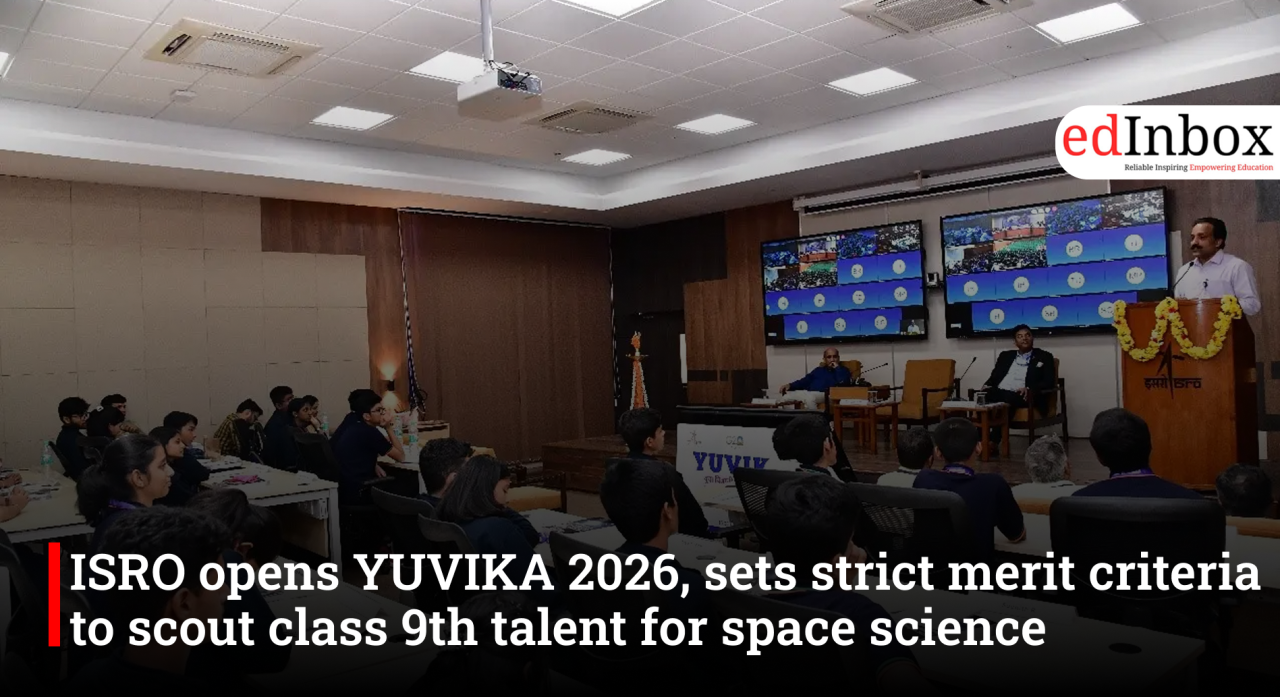
The Indian Space Research Organisation (ISRO) has released the 2026 edition of the Young Scientist Programme, a.k.a. YUVIKA (Young Scientist Programme). This program is targeted towards school students with an aim to introduce them to the basics of space technology, space science, and space applications.
ISRO has actually launched this program with one major clear objective: to find young talented individuals and then guide them towards Science, Technology, Engineering and Mathematics (STEM). Officials have disclosed that the initiative is just one part of a longer plan to build up the scientific workforce of India in the future.
ISRO YUVIKA 2026: Candidate eligibility
Students who will be in Class 9 on 1st January 2026 and are studying in schools situated in India are eligible to apply. Besides, ISRO has also announced that there will be representation from each State and Union Territory, hence students from the entire country will have an equal opportunity.
ISRO YUVIKA 2026: How the applicants will be shortlisted
Just as it has been with previous editions, the selection process for YUVIKA, 2026 would be merit- based and multi-tiered. Half the total points or 50 percent will be awarded to the marks obtained in Class 8 or the latest examination.
Other parameters include:
Online quiz performance: 10%
Participation in science fairs and co-curricular activities: 2–10% depending on level
Olympiad or equivalent achievements: 2–5%
Sports competition achievements: 2–5%
Scout and Guides / NCC / NSS membership (last 3 years): 5%
Students from rural schools located in Panchayat areas: 15%
The inclusion of rural school weightage signals ISRO’s attempt to widen access and identify talent beyond urban centres.
ISRO YUVIKA 2026: Programme centres across India
YUVIKA-2026 will be hosted at nine major ISRO centres:
Indian Institute of Remote Sensing, Dehradun
Vikram Sarabhai Space Centre, Thiruvananthapuram
Satish Dhawan Space Centre, Sriharikota
- R. Rao Satellite Centre, Bengaluru
Space Applications Centre, Ahmedabad
National Remote Sensing Centre, Hyderabad
North-Eastern Space Applications Centre, Shillong
ISRO Propulsion Complex, Mahendragiri
Regional Remote Sensing Centre, Jodhpur
Students will receive direct exposure to space laboratories, satellite technology, remote sensing applications and propulsion systems.
Travel and stay covered
ISRO will reimburse travel expenses for selected students. The reimbursement will be limited to II AC train fare or equivalent authorised AC bus fare from the nearest railway station or bus terminal to the reporting centre and back. Students must submit original travel tickets for reimbursement. If travel is undertaken in a higher class, reimbursement will be capped at the II AC fare. The agency will bear all costs related to course material, accommodation and boarding during the programme.
Building the next generation of scientists
YUVIKA is not merely an orientation programme. It is a strategic move to cultivate a child's scientific curiosity during the early stages of development. Along with academic excellence, co curricular accomplishments and rural representation are also considered by ISRO, thus, broadening the talent pool.
India, being one of the countries that is racing to space in the international competition, the country's space agency is focusing on its youngest minds even before they enter engineering colleges or research laboratories.
The application submission window starts on February 27. For several students of Class 9, it might be their initial step towards learning about rockets, satellites, and space missions.
ISRO opens YUVIKA 2026, sets strict merit criteria to scout class 9th talent for space science
Typography
- Smaller Small Medium Big Bigger
- Default Helvetica Segoe Georgia Times
- Reading Mode