A War That Was Waiting to Happen
Wars often look sudden only on television. In reality, the most consequential ones are usually years in the making, ripening beneath diplomacy, public posturing, covert operations, and mutual fear. The present Iran-Israel-U.S. war belongs to that category. It did not begin
simply because one side woke up on February 28, 2026 and chose violence over peace. It began because the ground had been prepared for confrontation for years, while diplomacy, though active, never became strong enough to overpower the logic of force. That is why the official explanation for the attack tells only part of the story. Publicly, Israel and the United States framed their action as a necessary response to an intolerable threat. The declared objective was straightforward: prevent Iran from crossing the nuclear threshold,
weaken its missile programme, and destroy the military capabilities that made Tehran dangerous to Israel and destabilising to the region. In that version, the war was an act of pre-emption.
But history is usually more layered than official statements. A nuclear agreement with Iran was not actually sealed when the attack came. Talks were reportedly advancing, and there were signs that the contours of a breakthroughs were being explored. Yet the most difficult issues were still unresolved. Iran wanted recognition of its right to enrich uranium. The West wanted deep restrictions and intrusive verification. Israel wanted far more than a slowing down of Iran’s capabilities; it wanted strategic rollback. What was on the table may have reduced the threat. It would not have erased it.
That difference matters. Because if negotiations were moving but not producing the kind of final outcome Israel wanted, then the strike begins to look less like a reaction and more like a decision: a decision to act before diplomacy hardened into an arrangement that would be politically difficult to undo. In that reading, the attack was not a breakdown of peace. It was the rejection of an incomplete peace.
The Shadow War Finally Stepped Into the Sun
To understand why the region reached this point, one has to go back beyond the immediate crisis. Iran and Israel had been fighting a shadow war for years. There were assassinations, sabotage operations, cyberattacks, strikes on proxy networks, and a long campaign of pressure
designed to weaken Tehran without triggering a full regional explosion. The killing of Qasem Soleimani years earlier had already marked the passage into a more open and dangerous phase. The collapse of earlier nuclear diplomacy deepened mistrust. Every failed round of negotiation made the next confrontation easier to imagine.
Then came the weakening of Iran’s outer ring of deterrence. The wars and proxy battles of the past few years, especially after October 7 and the chain of military responses that followed, damaged parts of the network on which Tehran had long relied. Hezbollah came under heavier strain. Syria became a less reliable corridor. Militant partners who once formed a wide buffer around Iran no longer offered the same strategic insulation. At the same time, old taboos fell. Iran and Israel had already exchanged more direct blows than before. What had long been indirect became increasingly direct, and what had once seemed unthinkable began to feel almost inevitable.
By early 2026, the region was no longer asking whether the shadow war could become a real war. It was asking when.
The Gulf’s Uneasy Awakening
At first, the Gulf states tried to keep this war at arm’s length. Their instinct was not ideological. It was practical. Saudi Arabia, the United Arab Emirates, Qatar, Kuwait, Bahrain, and Oman all understood that a major Iran war would threaten the very things they had spent years building: investor confidence, trade flows, energy security, transport reliability, tourism, and the image of the Gulf as a stable economic crossroads. They did not want to become battle space. They wanted the fire contained.
That early posture was visible in the cautious language of restraint, de- escalation, and diplomatic engagement. Oman, true to its long habit, leaned hardest into mediation. Qatar remained invested in dialogue. Saudi Arabia and the UAE were wary of Iran but not eager for regional collapse. The Gulf mood, in other words, was not one of enthusiasm for the U.S.-Israeli offensive. It was one of strategic discomfort.
But wars have a way of pulling in those who most want to avoid them. Once Iranian retaliation began touching Gulf assets, airspace, energy infrastructure, and the broader security environment, the tone shifted. The region did not become uniformly pro-war. But it did become more defensive, more alarmed, and less trusting of Tehran’s claims that its fight was only with Israel and America. Saudi Arabia moved from cautious neutrality toward deterrent caution. The UAE became sharper in blaming destabilising attacks. Qatar, too, had to balance mediation with self-protection. Bahrain and Kuwait, because of their exposure and security ties, were drawn more tightly into crisis management. So the Gulf’s evolution over the first two weeks tells a revealing story. These states still wanted the war to stop. They still feared a region-wide breakdown more than they desired anyone’s total victory. But their neutrality became more brittle as the war moved closer to their own economic and security nerves.
India and Europe: Balancing Without Controlling
Outside the immediate battlefield, India and the European Union
represent two different styles of strategic balancing. India’s position has been shaped by exposure and restraint. It has too much at stake in West Asia to indulge in moral absolutism. Energy dependence, shipping routes, trade, diaspora welfare, and broader geopolitical ties all compel New Delhi to speak carefully. India’s instinct in such crises is rarely theatrical. It is operational. Protect citizens, preserve access, keep relations alive across rival camps, and avoid being trapped in someone else’s war narrative. Over the past two weeks, India’s stance appears to have shifted not in principle but in emphasis: from cautious observation to more visible concern as the economic and regional stakes deepened.
Europe has looked more torn. The European instinct is to speak the language of law, civilian protection, and restraint. But Europe also fears energy disruption, maritime insecurity, refugee pressures, and the collapse of any diplomatic framework that could still matter. That makes
its position is less unified than it sounds in official statements. Some European actors are deeply uncomfortable with the original assault. Others are more focused on containing Iran’s response. What binds They are not strategic confidence, but anxiety. Europe wants de- escalation, but it lacks the decisive leverage to impose it. In a sense, both India and Europe are trying to navigate the same reality from different angles: the war is too big to ignore, too dangerous to join, and too consequential to leave entirely to Washington, Jerusalem, and Tehran.
Russia and China: Opposition Without Rescue
Russia and China have both opposed the U.S.-Israeli campaign, but their opposition is not identical in motive or method. For Russia, Iran is part of a larger geopolitical picture. A crushing defeat for Tehran would not just reorder the Middle East; it would also strengthen Western power at a time when Moscow wants exactly the opposite. Russia therefore sees the war through a multipolar lens.
Supporting Iran diplomatically, politically, and perhaps technologically helps deny the United States and Israel a clean strategic triumph. Moscow’s interest is not necessarily to make Iran victorious in some grand romantic sense. It is to prevent the emergence of an order shaped entirely by Western military success.
China’s approach is more cautious and more commercially grounded. Beijing strongly objects to the violation of sovereignty and the derailment of diplomacy, but its greatest concern lies in stability. China depends heavily on the broader region for energy and trade. It has no interest in a long war that disrupts shipping, shakes commodity markets, and destabilises one of the most important commercial theatres in the world. Beijing’s posture, therefore, is less ideological than functional: stop escalation, preserve flow, avoid strategic chaos.
Together, Russia and China form a protective rear environment for Iran, but not an interventionist alliance. They are not riding in as saviours. They are helping ensure that Iran is not isolated beyond recovery. Iran’s Countermove: From Target to Strategic Disruptor The opening assault on Iran appears to have been designed around a familiar theory of modern war: hit fast, blind the command structure, kill senior figures, break the rhythm of response, and create such disorientation that the state stumbles before it can reorganise. For a moment, that seemed plausible. The scale of the initial damage was serious. Leadership nodes were struck.
High-level personnel were lost. The message was one of dominance. Yet Iran did not behave like a broken state. It behaved like a state that had long prepared for the first blow. That may be the most important military lesson of this war so far. Tehran’s strategic doctrine seems to have assumed from the beginning that any major conflict would open with attempts at decapitation. So instead of depending on a neat pyramid of command, it invested in dispersal, redundancy, hardened systems, decentralised launch capacity, and the ability to survive leadership loss. Its aim was not to prevent damage. Its aim was to remain dangerous after damage. This is where Iran’s image in the war began to change. At first it looked like the underdog absorbing a devastating strike. Then it began to reveal its real method: not contesting air supremacy directly, but widening the geography of cost. Missile and drone attacks stretched the battlespace.
Gulf infrastructure, military installations, shipping routes, radars, and economic nerves all became part of the strategic theatre. Iran was not trying to defeat America and Israel in a conventional sense. It was trying to make their military superiority strategically expensive, politically uncomfortable, and economically corrosive.
That is how an underdog starts looking dominant without ever becoming conventionally stronger. It changes the terms of pressure. It forces richer, more advanced opponents to defend far more space, spend far more money, and absorb far more uncertainty than they expected.
Hormuz: The Narrow Sea With Global Consequences
No part of the conflict captures Iran’s strategic imagination more clearly than the Strait of Hormuz. This narrow waterway is not just a shipping route. It is a pressure point in the global economy. Tehran understands that any threat there resonates far beyond the Gulf. It reaches oil markets, shipping insurers, Asian importers, European anxieties, and the political calculations of distant capitals.
Iran’s handling of Hormuz has become increasingly sophisticated. Rather than a simplistic and total closure, the more effective method is calibrated disruption. Slow movement. Raise fear. Increase insurance costs. Disrupt scheduling. Create the sense that the waterway remains open in theory but unstable in practice. This is coercion by uncertainty, and it works because markets react not only to closure but to credible risk. The brilliance of that strategy, from Iran’s perspective, lies in its economy. Tehran does not need to dominate the sea in a classical naval sense. It only needs to make passage sufficiently dangerous, or sufficiently expensive, that the strategic burden on its enemies multiplies. A fighter jet campaign can destroy installations. It cannot easily restore confidence.
America and Israel: United in War, Divided in Endgame
At the start, the United States and Israel appeared to be moving in lockstep. Both spoke of neutralising Iran’s capabilities. Both framed the war as necessary. Both projected resolve. Yet as the conflict deepened, the difference between initial goals and sustainable goals became harder
to hide.
Israel’s preferred outcome still appears maximalist. It wants not merely a delay in Iran’s nuclear progress, nor merely a degraded missile programme, but a fundamental strategic transformation of Iran. In its hardest form, that means regime destabilisation or regime change. For Prime Minister Netanyahu, anything less may look like a half-finished War.
American calculus is more fluid. Washington may have entered the campaign prepared to speak in sweeping terms, but the realities of war tend to discipline ambition. As the conflict spreads, markets react, allies grow nervous, and the risk of a wider regional fire rises, the United States have reasons to seek a more controllable conclusion. That means defining victory in narrower terms: heavy damage inflicted, deterrence reasserted, major threats delayed, and then an exit. This creates a familiar but dangerous alliance tension. Israel may want the campaign extended until a transformational result becomes possible. The United States may increasingly want a stopping point it can sell as success. They remain aligned in warfighting, but not necessarily in the shape of peace.
Ceasefire on Whose Terms?
Iran’s ceasefire conditions make clear that Tehran does not see itself as a defeated supplicant. Its demands reportedly include recognition of its nuclear rights, reparations for damage, and guarantees against renewed attack. Those are not technical details. They go to the political heart of the war. Iran wants more than a pause. It wants security and recognition. For Washington and Jerusalem, those demands are deeply problematic. A formal guarantee not to attack Iran again would be seen as handing Tehran strategic protection it has fought years to avoid granting.
Recognition of an unrestricted nuclear fuel cycle would, from their perspective, validate the very thing they claim to be preventing. So the deadlock is severe. Iran wants the war to end in a way that confirms its resilience. Its adversaries want the war to end without rewarding that resilience.
That is why ceasefire talk remains difficult. Everyone says they want an off-ramp. But every proposed off-ramp leads directly into someone else’s strategic defeat.
The Economic War Beneath the Military One
Even when bombs fall on specific targets, wars like this are never only military. They are economic contests as well, and sometimes the economic theatre determines the political outcome. The immediate fallout is already visible: oil price shocks, higher insurance costs, disrupted shipping schedules, nervous capital, strained supply chains, and the renewed recognition that one regional conflict can unsettle the entire global system.
For the Gulf, this is not just about energy exports. It is about the credibility of a regional model built on reliability. For India, Europe, and major Asian economies, it is about import costs and strategic vulnerability. For the wider world, it is about the fragility of a supposedly interconnected global economy that still depends on narrow chokepoints and politically unstable corridors.
If the war lasts, its long-term effect may not simply be inflation or slower growth. It may accelerate a restructuring of how states think about energy security, maritime strategy, logistics, and political alignment. Wars do not only destroy. They also reorder priorities.
What Endings Are Still Possible?
The hardest truth about this conflict is that no actor has yet found a fully satisfactory way out.
A negotiated ceasefire is possible, but only if all sides lower their demands enough to live with ambiguity. A prolonged war of attrition is also possible, especially if military superiority continues to produce tactical wins without political closure. An imposed pause driven by global economic panic could emerge if Hormuz disruption becomes unbearable. The most dangerous path would be a bid for regime collapse without a viable plan for what follows, because that could convert a
strategic adversary into a vast regional vacuum.
Perhaps that is the deepest lesson of the crisis. Modern war often begins with clarity and drifts into contradiction. The opening days are full of declared aims. The later days are full of incompatible exits.
The Road to 2030
By the time this war ends, the Middle East may not belong to the same strategic era in which it began. The region is likely to become more heavily militarised, more suspicious, and more openly divided between competing security architectures. The Gulf states will hedge harder.
Israel may remain militarily formidable but politically more contested. Iran, even if damaged, may emerge with a stronger belief in asymmetric leverage and deeper dependence on Russia and China. India will continue trying to preserve room on all sides. Europe will be forced to decide whether it wants relevance or only commentary.
The world approaching 2030, then, may be shaped less by who won this war outright and more by what the war proved. It has proved that overwhelming firepower does not automatically produce strategic control. It has proved that under pressure, regional powers can weaponise geography, markets, and uncertainty as effectively as missiles. And it has proved that in a deeply connected world, a conflict that begins with one nuclear question can rapidly become a global question of trade, energy, law, alliances, and order itself.
This war was launched in the name of preventing danger. It may yet be remembered as the event that revealed how large, how layered, and how unfinished the new dangers of the age really are.
Prof Ujjwal K Chowdhury is the Pro Vice Chancellor of Techno India University, and a regular writer on education,media and world affairs.
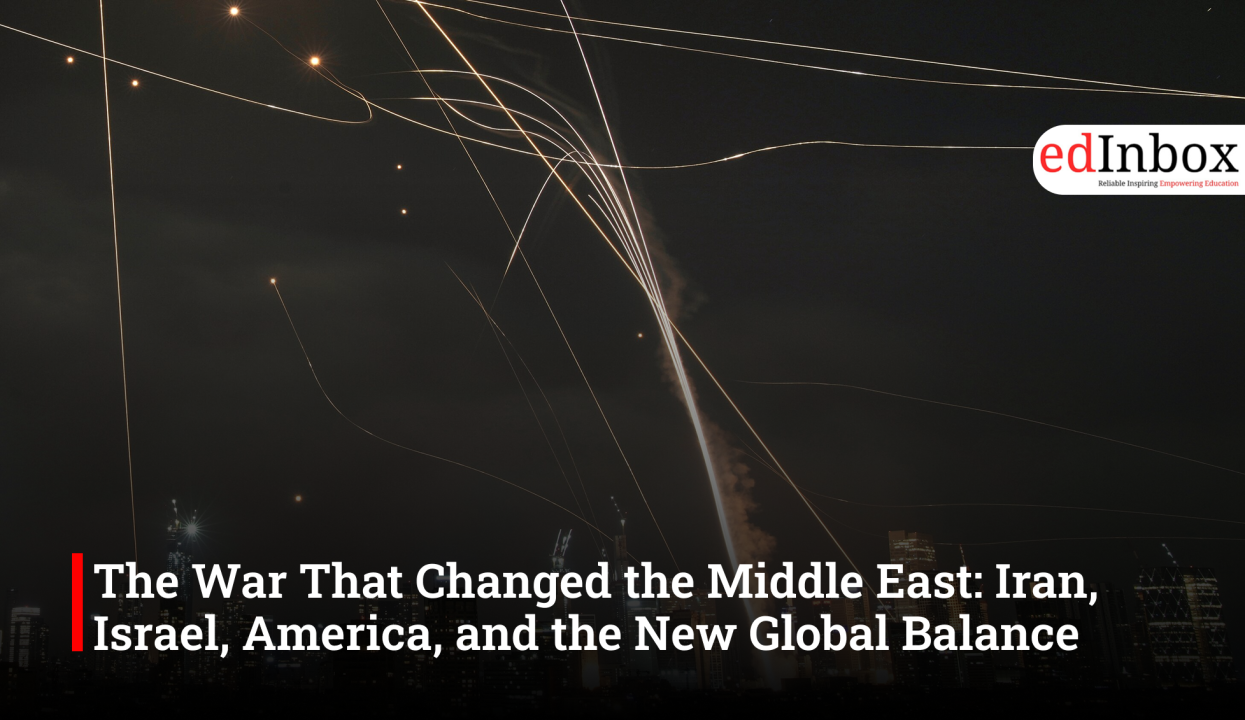
The War That Changed the Middle East: Iran, Israel, America, and the New Global Balance
Typography
- Smaller Small Medium Big Bigger
- Default Helvetica Segoe Georgia Times
- Reading Mode