
How Higher Education is being reshaped by war, heat, money stress, migration shocks, mental strain and AI
There was a time when people liked to imagine that universities stood slightly above history. Outside the campus gates there might be recession, political upheaval, or social unrest. Yet within the university, life seemed to move in a calmer rhythm. Students walked to class carrying backpacks and unfinished dreams. Professors debated ideas rather than airspace closures. Libraries stayed open. Laboratories hummed with quiet activity. Hostels remained alive with late-night discussions about careers, cinema, politics and love.
That picture still appears in university brochures. In reality, it has faded.
Higher education today is experiencing what scholars increasingly describe as a polycrisis,not one single disruption but several crises unfolding simultaneously, overlapping, feeding one another and turning universities into shock absorbers for problems they did not create. Wars interrupt student mobility. Visa restrictions strain university finances. Climate events force campuses to close or alter schedules. Housing shortages reshape international education policy. Artificial intelligence unsettles traditional teaching and assessment. Mental health challenges quietly weaken learning capacity.
None of these pressures now exists in isolation. They collide and compound, producing cascading effects.
This is why the current moment feels fundamentally different from the earlier crises universities were used to managing. It is no longer primarily about curriculum reform, accreditation standards, teaching methods or faculty shortages—though those issues remain important. Today, the biggest shocks to higher education often come from far outside the classroom. They are geopolitical, climatic, technological, economic and psychological.
A war in Europe can disrupt the future of a medical student in Kolkata. Instability in West Asia can suddenly raise flight costs for a student studying in London who wants to return home to Hyderabad. A housing shortage in Canada can narrow the aspirations of thousands of Indian families. A severe heatwave in Odisha can shift classes from afternoon hours to early mornings.
For India, these are not distant developments. They are deeply intertwined with the country’s educational story.
India hosts one of the largest higher education systems in the world. It has a massive youth population, a long cultural belief that education offers dignity and social mobility, and a growing community of students seeking opportunities abroad. At the same time, India is deeply connected to global migration, Gulf remittances, Western education markets, climate stress and digital transformation.
When the world becomes unstable, Indian higher education does not observe from a safe distance. It feels the tremor immediately.
The classroom, in other words, is no longer a shelter from global turmoil. It has become one of the places where the fractures of the world appear most clearly.
The Day the Ivory Tower Stopped Being Ivory
The phrase “ivory tower” has always carried a hint of arrogance. It implied distance from ordinary life—from urgency, noise and material struggle. Yet during much of the twentieth century universities did enjoy a certain insulation. Governments changed, markets fluctuated, but universities were still imagined as long-duration institutions—slow, stable places where time moved differently.
That insulation has weakened dramatically.
The reason is not simply that higher education has become global. It is that it has become deeply entangled. Universities now depend on international students for revenue, on aviation networks for mobility, on digital platforms for continuity, on cross-border research collaborations for prestige, on immigration policies for access and on public trust for legitimacy.
A university today is not merely a campus. It is a node in a vast and fragile network. When that network shakes, every node shakes as well.
This is precisely what the idea of polycrisis captures. Crises no longer arrive one by one. They arrive together. War drives up prices. Rising prices increase student stress. Stress undermines learning. Visa restrictions reduce international admissions. Reduced admissions weaken finances. Financial pressure erodes student services. Climate shocks interrupt classes. Artificial intelligence confuses assessment systems.
The crisis is not a single blow. It is a sequence of blows.
Universities are therefore being asked to do something far more difficult than simply educating. They must remain functional while the ground beneath them keeps shifting.
When Missiles Fly, Students Run
Nothing exposes the vulnerability of higher education more starkly than war.
The Russia-Ukraine war provided a striking example. Before the invasion, Ukraine had become a popular destination for affordable higher education, particularly in medicine. For many Indian families who could not afford expensive private medical education at home, Ukraine offered a narrow but genuine path into the profession.
Tuition was manageable. Degrees were recognised. Aspirations had a route.
Then war began, and that route collapsed.
Lecture halls became shelters. Anatomy laboratories fell silent. Students who had travelled abroad to become doctors suddenly found themselves counting border crossings, rationing food, charging phones in basements and searching for safe corridors out of a war zone.
India’s Operation Ganga evacuated more than 22,000 Indian nationals from the conflict area. But evacuation was only the beginning. The deeper question remained: what happens to a student’s future when the country hosting their education is suddenly at war?
In India the impact was deeply personal. In West Bengal alone, hundreds of returning students and workers arrived home from the conflict zone. Families who once proudly spoke about a child “studying MBBS in Ukraine” now found themselves speaking about transfer rules, recognition problems, internship placements and regulatory limitations.
The state attempted creative responses. First-year medical students were placed in state medical colleges. Advanced medical and dental students were allowed to continue practical work and internships in government hospitals. Engineering students were accommodated in private institutions. Veterinary students were adjusted elsewhere.
The response was compassionate and serious. Yet it also revealed the rigidity of regulatory structures. Medical education cannot absorb large numbers overnight. Faculty ratios, clinical training requirements and seat limits impose hard constraints.
The episode revealed a painful truth many Indian families already sensed: education may be a dream, but it is also a fragile logistical chain. A single geopolitical rupture can break it.
Inside Ukraine, the damage was even deeper. Universities were damaged or destroyed. Laboratories built over decades vanished. Scholars were displaced. Teaching often continued only through emergency online systems, where education became less an academic routine and more a tool of psychological survival.
Even countries far from the battlefield felt indirect effects. The war disrupted global food supply chains, raising prices worldwide. That meant higher catering costs and living expenses for students in universities thousands of kilometres away.
In today’s higher education ecosystem, even the canteen bill can carry the shadow of a distant war.
When the Sky Closes
If the Ukraine conflict showed how war can collapse educational pathways, instability in the Middle East reveals how quickly the machinery of global education can stall.
The region matters for two crucial reasons. It is a major aviation corridor and a central hub of labour migration and remittance flows for South Asia.
When instability rises in the Middle East, the consequences are both logistical and financial.
Many Indian students travelling to Europe or North America rely on flight routes through Gulf hubs. Under normal conditions these journeys are manageable. But during military escalation, airlines are forced into long detours. Ticket prices that once hovered around ₹45,000 can suddenly exceed ₹2 lakh.
This is not a minor inconvenience. It transforms mobility into privilege.
The Gulf also hosts major education hubs. Dubai contains several branch campuses of global universities. Qatar’s Education City has become internationally recognised. Students were attracted by their global branding, infrastructure and geographical proximity to South Asia.
Yet the promise of stability is fragile. The moment families begin to worry about safety, student flows change quickly. Universities can shift lectures online, but they cannot easily restore peace of mind.
Then there is the remittance dimension. India receives roughly $130–140 billion annually in remittances, the largest amount in the world, with a substantial portion coming from Gulf economies.
For many households, that money pays for far more than daily living expenses. It funds school fees, coaching centres, hostels and postgraduate education.
When Gulf economies face instability, the consequences ripple outward. A job crisis in Dubai can become a dropout risk in Kolkata. A slowdown in Saudi Arabia can postpone a master’s degree in Kerala.
This is globalisation from below: a child’s education resting on the economic stability of a distant labour market.
The West Is No Longer Permanently Stable
For decades, Indian middle-class aspiration followed a familiar map. The most ambitious students aimed for universities in the United States, the United Kingdom, Canada or Australia—countries viewed as stable, prestigious and institutionally dependable.
That map is now shifting.
Western universities are facing their own crises. Many institutions built financial models heavily dependent on international students paying high fees.
As long as global mobility kept rising, the model worked. But politics, demography and cost-of-living pressures have begun to challenge it.
Brexit disrupted the United Kingdom’s higher education sector by altering fee structures and visa rules for European students. Enrolments declined, revealing the system’s financial vulnerabilities.
Canada offered an even clearer example. It had become one of the most popular destinations for Indian students. But housing shortages and infrastructure stress pushed the government to impose caps on international student permits.
Suddenly, colleges that had built recruitment pipelines in India faced sharp declines in admissions.
For Indian families, the message was sobering. A study-abroad dream can now be derailed not by academic performance but by foreign housing politics.
The United States faces a different challenge: the demographic cliff. Declining birth rates after the 2008 financial crisis mean fewer domestic students reaching college age. Smaller institutions now face fierce competition, mergers and closures.
Higher education in parts of the West is not expanding. It is contracting.
For India, this change brings both uncertainty and opportunity.
When Heat Enters the Timetable
Climate change was once a subject studied in classrooms. Today it shapes how classrooms function.
UNICEF estimates that over 240 million students worldwide experienced educational disruption due to climate-related events in 2024 alone.
India offers clear examples. Severe heatwaves have forced states such as Odisha to shift classes and examinations to early morning hours.
What appears to be a simple administrative adjustment signals something much larger: the environment has begun structuring the academic day.
Floods, cyclones and rising temperatures affect campuses, hostels, transport systems and laboratories. Elite institutions may adapt with cooling systems, upgraded infrastructure and hybrid learning models. Smaller institutions struggle.
Climate resilience is rapidly becoming a new axis of educational inequality.
The Quietest Crisis
Some crises arrive with explosions and headlines. Others spread quietly.
Mental health belongs to the second category.
Across campuses, anxiety, depression and emotional exhaustion are increasingly visible. Students carry financial worries, social media pressures, climate anxiety and uncertainty about jobs.
Faculty members face their own pressures: administrative burdens, publication demands, digitisation expectations and rising student distress.
Universities may appear functional on paper while exhaustion quietly spreads within them.
Mental health is no longer separate from academic quality. It has become one of its hidden foundations.
The AI Storm in the Classroom
As universities struggled with geopolitical shocks and climate disruptions, another transformation arrived: generative AI.
The immediate fear was academic dishonesty. If a machine can produce essays, code and research summaries instantly, what happens to traditional assignments?
But the deeper question is philosophical: what exactly are universities assessing?
If AI can generate competent academic writing, does a written submission demonstrate knowledge, skill, prompting ability or simply access to technology?
For a country like India, where large classrooms already complicate assessment, this challenge is profound.
AI may also offer opportunities: tutoring support, translation assistance and personalised learning.
The challenge is redesigning pedagogy quickly enough to preserve genuine learning.
India’s Moment and Its Test
Amid global disruption, the hierarchy of higher education is shifting. Several Global South countries are expanding capacity, and India is part of that transformation.
The National Education Policy 2020 envisions a more international and interdisciplinary system. India aims to attract far more international students by 2030.
Demographically, India holds a major advantage: while many Western nations face shrinking youth populations, India still has a large and growing college-age cohort.
But scale alone is not enough.
Students now ask deeper questions:
Can an institution remain stable during crisis?
Does it support international students effectively?
Is the campus climate-resilient?
Are mental health services meaningful?
Is governance credible?These questions matter as much as rankings.
The University That Will Survive This Decade
The central lesson is clear: universities can no longer be designed only for normal times.
They must be built for interruption.
That means institutions capable of switching teaching modes quickly, maintaining communication across borders, supporting student welfare, ensuring climate resilience and adopting ethical AI policies.
Most importantly, they must treat trust as infrastructure.
Students and families increasingly judge universities not only by prestige but by how they behave under pressure.
A great university today is not simply one that excels during calm periods. It is one that continues to teach, research and support its community even when the world outside is unstable.
The Final Truth
The crisis in higher education is not a single story. It is many stories unfolding at once.
It is the story of Indian medical students in Ukraine discovering how quickly war can shatter a career path.
It is the story of families in Kerala or Kolkata worrying that Gulf instability could affect education funding.
It is the story of a Canadian housing shortage altering Indian study-abroad plans.
It is the story of an Odisha heatwave entering the timetable.
It is the story of a student silently struggling with anxiety.
It is the story of teachers trying to evaluate learning in an AI-saturated world.Universities are no longer sheltered islands. They are deeply exposed institutions woven into the global flows of migration, money, technology, climate and power.
Yet their importance has only grown.
When the world becomes unstable, universities do more than grant degrees. They preserve continuity. They sustain aspiration. They train the professionals and citizens who must make sense of disorder.
The campus is no longer outside history.
It is one of the places where history now arrives first.
And the real test for higher education—both in India and across the world—is no longer whether it can shine during peaceful times.
The real test is whether it can endure, adapt and continue educating when the age itself becomes turbulent.
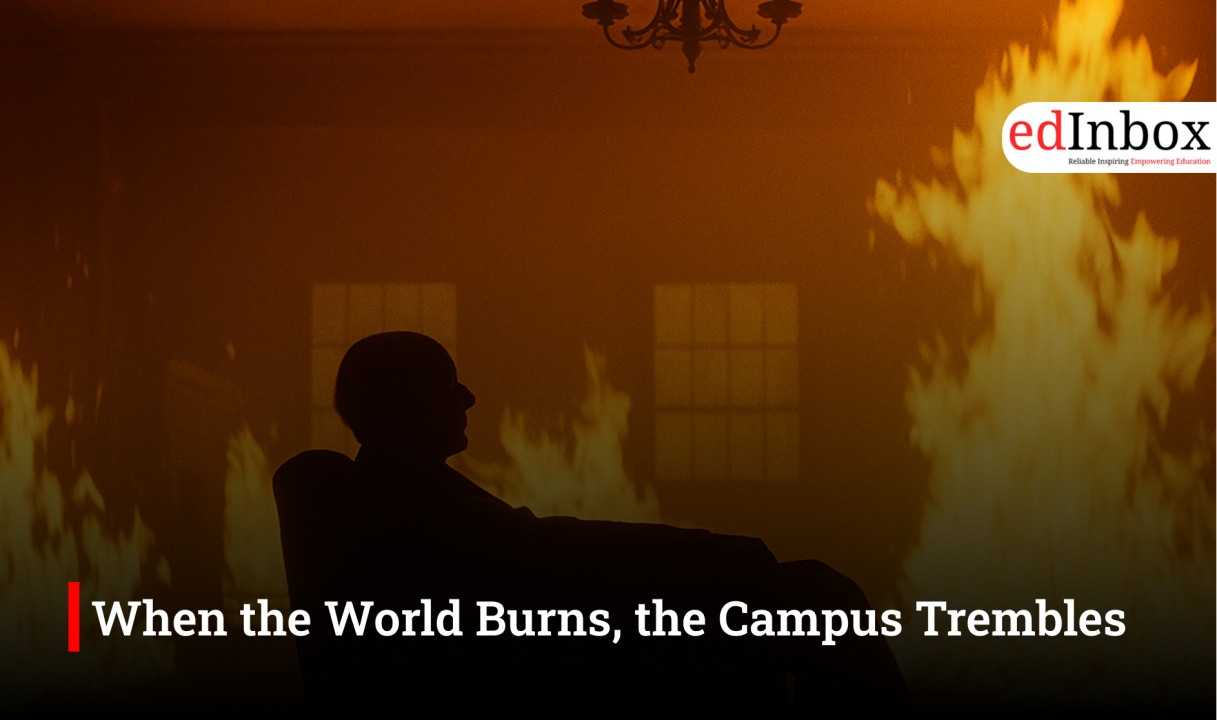
When the World Burns, the Campus Trembles
Typography
- Smaller Small Medium Big Bigger
- Default Helvetica Segoe Georgia Times
- Reading Mode