You googled "top journalism courses in India" for a reason. Either your boards just got over, you are switching careers, or someone told you journalism is dying and you want to prove them wrong, right? Are you considering a career in journalism in 2026? Well, before you choose a college or fill out an application, read this guide. It could save you three years of regret and lead you to the course that actually becomes Jesus in your life.
Is a Journalism Career Worth It in 2026?
The answer can be subjective. The media market in India is booming, with a 2026 forecast of reaching 30 billion dollars (proceeding at 13 percent per annum based on FICCI-EY report). There is an explosion of digital news, data journalism, and video content. Jobs in OTT platforms, YouTube news, and agri-reporting are new and are in high demand, whereas old print jobs are shrinking.
Journalism rewards curiosity, talking to people, and digital skills, not a person sitting on a chair drafting copies by stealing news from here and there. So, yes, it is worth it in 2026 if you are skilled, curious, chatty, and someone who earnestly wishes to fix the workings of the world.
Indian Journalism Courses and Types
In India, there are four levels of Journalism courses aspirants can pursue via journalism entrance exams 2026:
- Undergraduate Studies (Post Class 12): BA Journalism, BA Mass Communication, BJMC -three to four years. Good if you are taking it immediately after Class 12 and have a choice of full foundational degree. The mean annual fee is between 16,000-4 lakh based on the institute.
- Postgraduation courses (After Bachelors): MA journalism, MA Mass communication, MJMC, PG diploma- one to two year programme. Even the IIMC Delhi PG Diploma on its own is generally considered more career-valued than a full MA at most of the privates. This is the point at which the name of the institution plays the most significant part.
- Diploma Courses: Practical in nature, one-year focused programmes. Good alternative to the students who prefer other degrees but need media skills or working professionals who need to switch to journalism.
- Certificate Courses: short-term, skill-specific. Should not be utilized as a substitute to a degree.
Key Specialization Areas in Journalism
Journalism key specialization areas have traditionally been more about hunting, relieving and publishing but after 2020 everything has changed. The latest in-demand specializations that one can pursue via journalism entrance exams 2026, include:
- Digital Journalism: This is the fastest growing job role. All the media houses are recruiting digital-first journalists with knowledge of SEO, video storytelling and social media strategy.
- Broadcast Journalism: High prestige, competitive. The television is changing rapidly as YouTube news channels and OTT news platforms are replacing the traditional television.
- Investigative Journalism: Most esteemed, slowest to earn money at the beginning. Careers that are decades long.
- Public Relations and Corporate Communication: Highest salary increment during the initial years. A huge number of journalism graduates make a successful transition here.
- Data Journalism: Newest, most demanded and, at the moment, undersupplied in India. The good technical journalism skills and data analysis ensure that the graduates are nearly recruitable.
Who Should Pursue Journalism in 2026?
Pursue journalism if you read the news compulsively, feel physical irritation when a story is told badly, can talk to strangers easily, believe in the public's right to know, and are willing to build reputation before chasing salary.
Reconsider if you think journalism is glamorous, are choosing it because another option did not work out, or expect a fast-tracked high salary without several years of ground-level work first.
Journalism Salary in India 2026: Freshers to Top Roles
Getting into best journalism colleges in India 2026 shouldn’t be the only aim; building skills is MUST. In 2026, avg freshers get ₹4.2 LPA and more if they have the skills. Grows with skills.
Role
Salary (LPA)
Role
Salary (LPA)
Reporter
2–10
Anchor
10–50+
Digital Journalist
3–15
Editor
3–17
Senior
20–50
Hirers: The Hindu, Times Group, Dainik Bhaskar, Radio Mirchi and more.
How To Pursue Journalism?
Step 1: Eligibility (Any Stream Welcome)
- 50%+ in Class 12 (any stream: Arts/Science/Commerce).
- Age: 17+ for UG; graduation for PG.
- Tip: Develop basic skills- read The Hindu, write 500 word blogs.
Step 2: Select Course and College
- UG (BA/BJMC) post-12th, PG (MJMC/PG Diploma) post-grad.
- Target favourites: IIMC, Jamia, DU (see the complete list above).
Step 3: Prep Main Entrance Exams
- CUET UG/PG: May-June/March (NTA). Syllabus: GK, English, Reasoning.
- Jamia/ACJ/IPU: own tests - April-May.
- Daily hack: 1 hour current affairs and mock tests (free on NTA app).
Step 4: Registration and Appearing (Deadlines Alert)
- CUET: NTA site (Feb-Mar window).
- Fees: ₹1,000–₹2,000.
- Paperwork: 12 th marksheet, identification.
Step 5: Develop Portfolio
Have strong 3-5 news articles, videos or researched news. Intern locally for standing out in the interview (if the uni demands it).
Step 6: Have a Backup Plan
Missed CUET cutoff or find traditional exams too stressful? Like many Gen Z students realizing old-school tests are hectic, switch to GMCET (Global Media Common Entrance Test). It's your smart backup for journalism courses:
Why is GenZ choosing the GMCET Entrance Test?
- Several seats, one test: BA/MA Journalism, Digital Media is provided by partner universities such as Manipal Academy (MAHE), Amity, and affiliates of Symbiosis.
- The format is simple. MCQs online + ability test (not as hectic as the marathon in CUET).
- There are over 100 GMCET partner universities 2026 waiting for the right talent to find the right campus.
- Gen Z prefers it because it is Skill-based, not rote learning. Fees: ₹1,500. Placements through partners: 80% and above in media houses.
- GMCET is the reverse of the other doors, it opens when others are closed, it is ideal to enter in a hurry and lead your way to the top in the industry.
Step 7: Reserve Seat, Pay Fee and Start Well.
Enroll for counselling, pick the college, pay the provisional admission fee and start your journey to be a great journalist.
In India, there are more than 1,270 journalism programme colleges. The difference between the top ten and the rest is very vast in quality. The decision you make about college will help you establish your career more than just about any other choice you make during the year.
Don't forget these: Study hard for the CUET or GMCET entrance test. Before applying, research all the institutions. Make a writing or reporting sample prior to the interview. Read at least two newspapers every day.
The future of journalism in India is yet to be experienced. The stories that matter most have not been written yet; be the writer, be the exposer.
Note: visit gmcet.org for free career consultation and the right guidance you need to succeed.
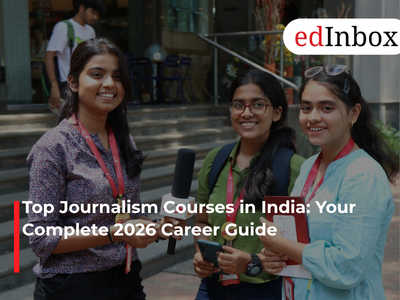
Top Journalism Courses in India: Your Complete 2026 Career Guide
Typography
- Smaller Small Medium Big Bigger
- Default Helvetica Segoe Georgia Times
- Reading Mode