
Are you someone confused between traditional media education and modern media education? In India media courses have evolved. Conventional courses were on print journalism and radio, whereas the current courses are on digital marketing, social media and AI content creation. The following guide clarifies the differences to the students of Bhubaneswar, Delhi, or any other location that may be seeking the differences in media education, the best mass communication course in 2026, or the reason to study contemporary media.
What is Traditional Media Education?
The education of traditional media revolves around the traditional mass communication mediums. Consider newspapers, television news, radio and film production of the 20th century.
Key Features:
- Curriculum: Print journalism, radio jockeying, television reporting, advertising fundamentals, public relations.
- Instructional Method: lectures, heavy theory, writing news stories or script assignments.
- Skills Learned: News writing, editing, broadcast anchoring, simple photography, ad copywriting.
- Equipment: Typewriters (previously), rudimentary cameras, editing programmes such as Final Cut Pro.
- Career Choices: newspaper reporter, radio announcer, television reporter, movie editor.
- Examples: BA Journalism (Delhi University), Diploma in Mass Communication (Indian Institute of Mass Communication).
What is Contemporary Media Education?
Modern media education encompasses the new media, which include digital media, social media, and interactive media. It equips students with the current online environment where Instagram reels and YouTube are moving the news at a faster pace than television.
Key Features:
- Curriculum: Digital marketing, social media management, content creation, SEO, data analytics, podcasting, influencer marketing, AR/VR storytelling.
- Pedagogical Method: Practical projects, live streaming practise, group campaigns, industry internships.
- Skills Learned: Video editing (Premiere Pro), graphic design (Canva), analytics (Google Analytics), live streaming, AI content tools.
- Tools: drones, social media dashboards, Smartphones, apps such as CapCut.
- Career Advice: Digital marketer, content creator, social media manager, YouTuber, OTT platform producer.
The reason why Traditional Media Education is still relevant.
Don’t count it out completely.
- It develops good basics- grammar, story telling ethics.
- There are employment in Tier-2 cities in local newspapers and radio.
- These skills are still required by the big media houses like Times of India and NDTV.
- Classes are less expensive and do not need much technology.
- This is the right route to take when one wants a stable job as a reporter in print or TV.
The Reason Students must seek Contemporary Media Education (2026).
By 2026, the market of digital media in India will be 500 crore. The following are the reasons why you should take modern courses:
- Huge employment pressure: more than half a million jobs in digital-marketing are vacant annually.
- Social-media managers can receive 5-15 lakhs at the entry level.
- The average content creators earn ₹8 lakh, and they have the freedom to work as freelancers.
Skills that will remain relevant in the future are necessary: each company must have an Instagram or Tik Tok strategy. Artificial intelligence such as ChatGPT can assist in the creation of captions, so you will not be replaced. Working remotely is an option- you can work anywhere in India on the U.S. clients.
Best Modern Media Studies in India.
- BA Digital Media -Symbiosis, Pune ( 4 lakhs)
- BVoc New Media- Makhanlal Chaturvedi University.
- MA Social Media Marketing- Lovely Professional University.
Certifications: Google Digital Garage (free), HubSpot Content Marketing. Entrance tests are IIMC Entrance, GMCET, XIC OET and SET.
Challenges to Consider
- Traditional: Reduced employment opportunities as newspapers are on the downward slope 10% per year.
- Modern: Trends evolve rapidly - Tik Tok was banned, new applications emerge, and therefore it is necessary to constantly upskill.
Which Should You Choose?
Pick Contemporary Media if:
- You are an Instagram or Tik Tok user.
- Desire freelance or telecommuting.
- Technologically minded and likes to edit videos.
- Aim for a ₹10‑lakhs+ salary early.
Stick with Traditional if:
- You are a newspaper or television lover.
- Prefer a stable 10‑to‑5 job.
- Live in a small town.
- Have a tight budget.
So,the winner of 2026 is contemporary media education. Digital employment increases by 25 percent per year and the traditional media decreases. In India, the number of internet users is 900 million, which means that content creators are in high demand. It starts with free courses on YouTube, learning how to use Instagram Reels, and then you can think about Symbiosis or LPU or some other top university that aligns with you. Connect with us at 08035018499 for free career consultation.
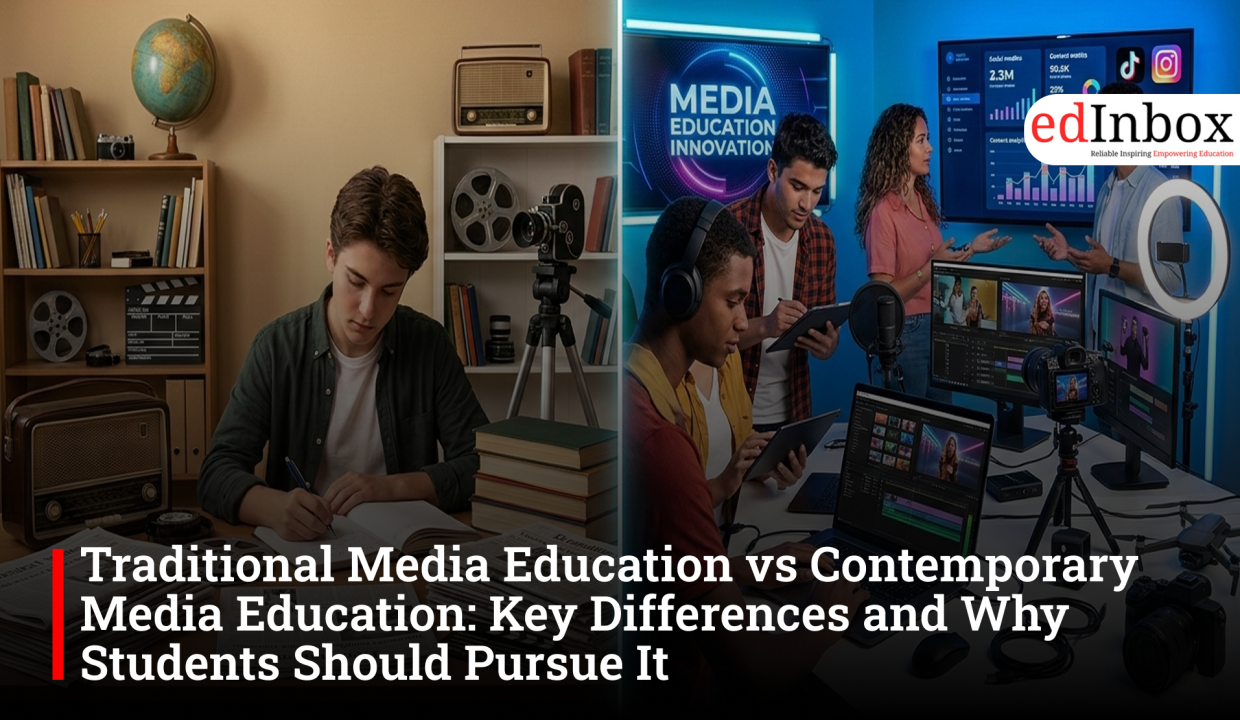
Traditional Media Education vs Contemporary Media Education: Key Differences and Why Students Should Pursue It
Typography
- Smaller Small Medium Big Bigger
- Default Helvetica Segoe Georgia Times
- Reading Mode