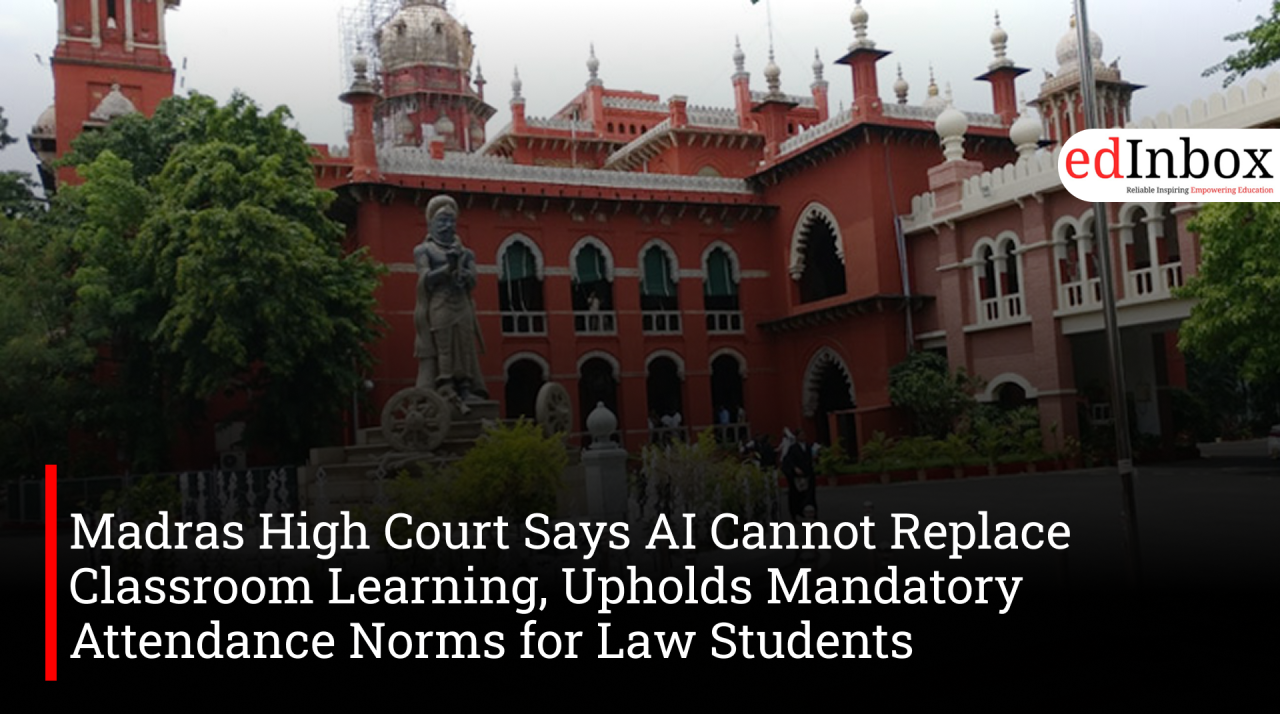
In a significant ruling that highlights the continuing importance of physical classrooms in higher education, the Madras High Court has held that artificial intelligence tools such as ChatGPT cannot substitute the role of qualified teachers in imparting knowledge, ethics and professional values to students.
The judgment came while the court was hearing a case related to attendance requirements for law students and has reignited the debate on the role of technology in education, particularly as institutions increasingly adopt digital learning platforms.
A division bench comprising Justices S.M. Subramaniam and N. Senthilkumar observed that while technological advancements and online learning resources can support education, they cannot replace the dynamic and interactive environment of a classroom. The judges stressed that professional education, especially legal studies, involves much more than the transfer of academic information.
According to the court, qualified lecturers play a crucial role in shaping students' character, integrity, morality and professional ethics—qualities that cannot be effectively taught through artificial intelligence systems or virtual platforms alone. The bench noted that classroom discussions, debates and exchanges of diverse viewpoints help students develop critical thinking skills and a deeper understanding of constitutional values and social responsibilities.
"Artificial intelligence tools may assist learning, but they cannot replicate the human interaction and mentorship essential to legal education," the court observed while underscoring the importance of regular classroom engagement.
The ruling came in the context of a dispute over attendance requirements prescribed by the Bar Council of India (BCI). The court upheld Rule 12 of the BCI Legal Education Rules, which mandates a minimum attendance of 70 per cent for law students. The rules permit relaxation up to 65 per cent only under exceptional circumstances.
The division bench set aside an earlier order of a single judge that had allowed students with significantly lower attendance to appear for examinations. The court maintained that existing regulations must be strictly followed unless they are formally amended by the competent authority.
The case involved three students of Tamil Nadu Dr Ambedkar Law University whose attendance records ranged between 37 per cent and 46 per cent. Due to inadequate attendance, the university had barred them from appearing in semester examinations and directed them to repeat the academic year.
Earlier, a single judge had granted relief to the students and recommended that the Bar Council reconsider its attendance norms in light of changing educational practices. However, the university challenged the order before the division bench, arguing that attendance regulations are essential to maintaining academic standards and professional discipline.
Allowing the university's appeal, the High Court reinstated the original attendance requirements and emphasised that students who regularly attend classes should not be placed at a disadvantage compared to those who fail to meet prescribed academic obligations.
The judgment arrives at a time when the issue of mandatory attendance is under national scrutiny. The Supreme Court is currently examining the broader question of attendance requirements in higher education after staying a Delhi High Court order that had restrained institutions from debarring students from examinations on the basis of low attendance.
Legal experts believe the Madras High Court's decision could influence the ongoing national debate by reinforcing the view that attendance remains a critical component of professional education. The ruling underscores the judiciary's recognition that while technology can enhance learning, the classroom continues to be central to developing competent, ethical and socially responsible professionals.
As educational institutions increasingly integrate artificial intelligence into teaching and learning processes, the judgment serves as a reminder that technology is best viewed as a supplement rather than a replacement for human educators and face-to-face academic engagement.
Madras High Court Says AI Cannot Replace Classroom Learning, Upholds Mandatory Attendance Norms for Law Students
Typography
- Smaller Small Medium Big Bigger
- Default Helvetica Segoe Georgia Times
- Reading Mode