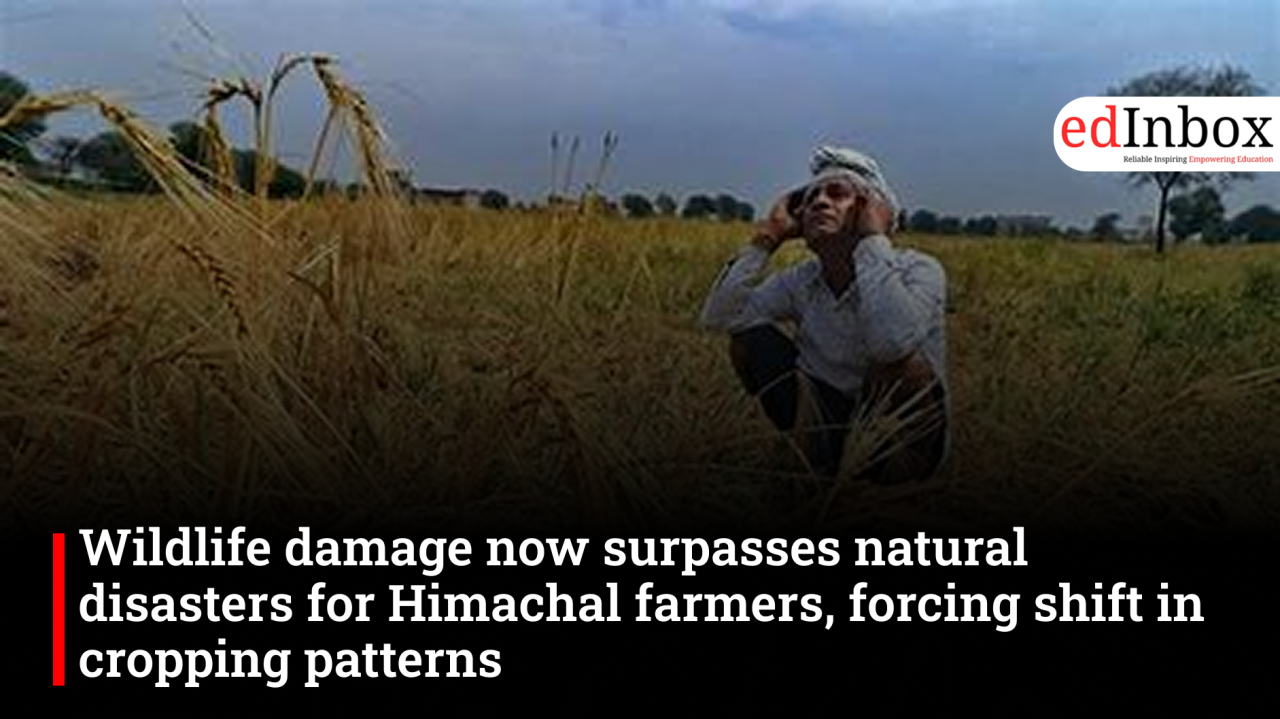
Crop losses caused by wild animals are emerging as a bigger threat than natural disasters for farmers in Himachal Pradesh, with growing attacks from monkeys, wild boars, nilgai, bears, parrots and peacocks forcing cultivators to abandon traditional crops and leave agricultural land fallow. Farmer organisations are now demanding scientific wildlife management, better compensation and stronger government support to prevent a deepening rural crisis.
While erratic weather and climate change continue to affect agriculture, farmers say wildlife-related losses have become the more immediate challenge. During the 2025 monsoon season, natural disasters caused an estimated ₹79 crore in losses to the state's agriculture and horticulture sectors. In contrast, a Gyan Vigyan Samiti impact assessment estimated annual losses from wild animals and birds at nearly ₹2,300 crore, highlighting the scale of the problem.
According to the study, over 70 per cent of gram panchayats in Himachal Pradesh have been affected by wildlife attacks. The report estimated losses of around ₹200 crore in agricultural crops, ₹100 crore in horticulture, and ₹500 crore due to farmland being left uncultivated, in addition to substantial productivity losses from farmers spending time guarding fields instead of engaging in income-generating activities.
The crisis is also reshaping farming practices. Research by scientists from Chaudhary Sarwan Kumar Himachal Pradesh Agricultural University, Palampur, found a 17.35 per cent decline in gross cropped area and a 12.66 per cent reduction in net sown area in the mid-hill region, with many farmers shifting from maize, pulses and vegetables to relatively safer crops such as turmeric, ginger, colocasia and okra.
Horticulture, one of Himachal Pradesh's economic pillars, is also under increasing pressure. The state's horticulture area has expanded from 116,338 hectares in 1991-92 to over 237,000 hectares in 2024-25, with the annual apple economy valued at nearly ₹5,000 crore. Orchardists report that monkeys, bears, bats and parrots are causing significant fruit losses, increasing labour costs and reducing profitability.
Farmer groups, including the Himachal Kisan Sabha, have urged the government to adopt scientific wildlife population management, strengthen compensation mechanisms and include crop protection measures such as fencing under MGNREGA. They warn that without coordinated policy interventions balancing conservation with farmers' livelihoods, Himachal Pradesh's agriculture, food security and rural economy could face an increasingly severe crisis.
Wildlife damage now surpasses natural disasters for Himachal farmers, forcing a shift in cropping patterns
Typography
- Smaller Small Medium Big Bigger
- Default Helvetica Segoe Georgia Times
- Reading Mode