
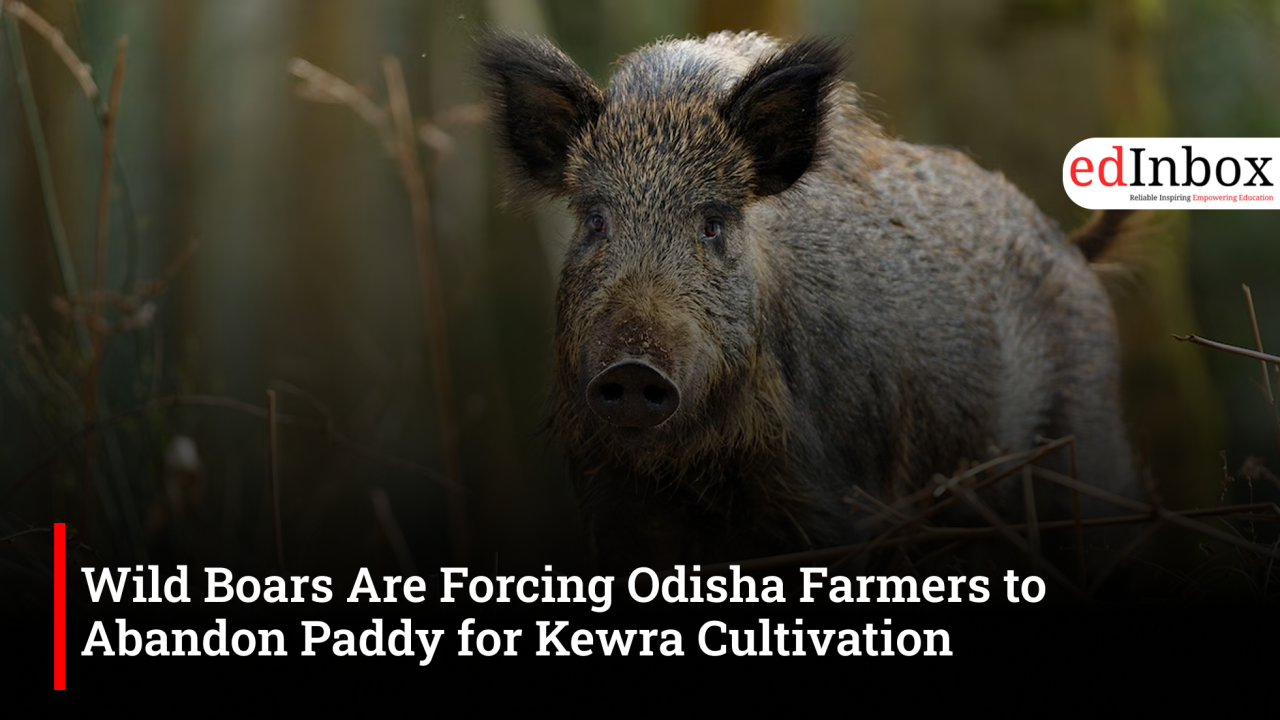
For generations, paddy farming has been the backbone of rural life in Odisha's Ganjam district. Today, however, many farmers are abandoning the crop as repeated raids by wild boars make cultivation increasingly unviable.
In villages across Rangeilunda block, fertile and water-rich agricultural land near the Bay of Bengal is gradually being converted to kewra (screw pine) plantations, as farmers struggle to cope with mounting crop losses caused by wildlife.
Among them is farmer K Bhimaya Reddy of Nakaram village, who stopped cultivating paddy on his 2.02 hectares of land five years ago after repeated destruction by wild boars.
"Every time the crop begins to grow, herds of wild boars enter the fields and destroy it. In many cases, farmers cannot even recover their cultivation costs," said Ch Sudhkar Reddy, a farmer from Dankalpadu village.
The problem has become so severe that farmers in several villages have declared a "crop holiday" in protest. Social activist N Dambaru Reddy said repeated crop losses and the lack of effective preventive measures have left many cultivators with little choice but to either migrate for work or switch to alternative crops such as kewra, which takes five to seven years to flower but is less vulnerable to wildlife attacks.
According to local residents, the growing wild boar population has transformed farming into a high-risk activity. Many farmers now spend sleepless nights guarding their fields from animal raids. In parts of Ganjam, including Bhanjanagar, Polasara and Khallikote, temporary shelters have become common in farmlands as cultivators keep watch through the night.
"Our nights are spent chasing away stray animals," said farmer Trinath Pradhan from Gunduribadi village.
The wildlife challenge extends beyond wild boars. Blackbuck, monkeys and langurs also damage crops across the district. Yet despite suffering losses, many farmers continue to protect blackbuck populations because of long-standing local beliefs that consider the animal a symbol of prosperity.
In Bhetanai village near Aska, residents have voluntarily set aside more than 30 hectares of land as grazing grounds for blackbuck. Local conservationists say farmers rarely seek compensation for damage caused by the endangered species.
State government data shows compensation is being paid for wildlife-related crop losses. According to the Wildlife Odisha 2025 report, more than Rs 250 crore was distributed between 2015-16 and 2024-25 for crop damage caused by wild animals. During the same period, over 4.7 lakh farmers reported losses affecting more than 63,000 hectares of farmland.
However, farmers argue that compensation alone is not enough and that preventive measures remain inadequate.
In response, some cultivators have turned to technology. Solar-powered animal repellent systems and solar fencing are increasingly being used to protect crops from wild boars, monkeys and stray cattle.
Farmer Subash Pradhan from Nandik village said damage to his vegetable crops declined significantly after installing a solar-powered repellent device.
Agricultural scientists and government agencies are also promoting climate-resilient and wildlife-resistant farming practices under various rural development programmes. In Kandhamal district, authorities have installed solar fencing across multiple villages to reduce crop losses caused by animals.
Despite these efforts, many farmers believe stronger intervention is needed. For them, the conflict is no longer just about wildlife conservation—it is about protecting livelihoods, ensuring food security and preserving the future of farming in rural Odisha.
As wild animal populations continue to expand and farmland remains vulnerable, the battle between cultivation and conservation is becoming an increasingly difficult challenge for thousands of farming families across the state
Wild Boars are forcing Odisha farmers to abandon paddy for kewra cultivation
Typography
- Smaller Small Medium Big Bigger
- Default Helvetica Segoe Georgia Times
- Reading Mode