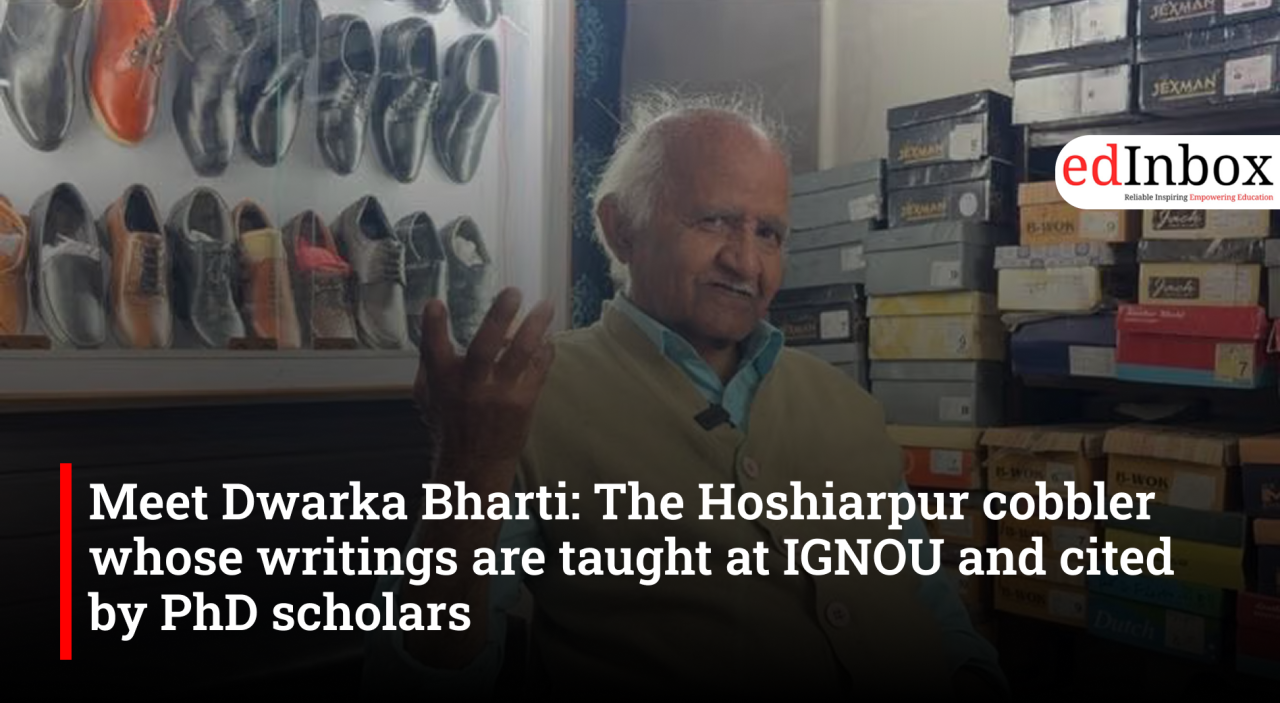
Every morning, 77-year-old Dwarka Bharti opens his modest shoe shop in Punjab's Hoshiarpur. Customers come seeking handcrafted footwear, but many leave surprised to discover shelves lined with Dalit literature, Buddhist philosophy, books by Dr B.R. Ambedkar, and several titles authored by the cobbler himself.
For Bharti, shoemaking and writing are not separate pursuits—they are both acts of resistance.
His poetry is part of the IGNOU MA Hindi Dalit Literature syllabus, while his writings are regularly cited by PhD researchers at Punjab University studying Dalit literature. Yet outside academic circles, he remains best known as the neighbourhood cobbler who quietly repairs and crafts shoes by hand.
From cobbler's bench to university classrooms
Bharti's poem "Aaj Ka Eklavya" has earned a place in the Indira Gandhi National Open University's postgraduate curriculum, introducing thousands of students to his work every year.
His writings have also become important reference material for scholars researching Dalit literature, placing him alongside prominent Punjabi Dalit writers such as Prem Gorkhi, Lal Singh Dil, L.R. Bali and Balveer Madhopuri.
Despite this recognition, Bharti avoids publicity.
"When customers see the books, they ask whether I read them," he says with a smile. "I rarely tell them that I wrote many of them."
'I'm an artisan, not just a cobbler'
Bharti rejects the idea that his profession should define his social identity.
"In this country, people see my work through the lens of caste," he says. "Elsewhere, I would simply be recognised as an artisan."
Rather than abandoning his ancestral occupation, he chose to redefine it. For him, making shoes is a skilled craft deserving dignity and respect, not a marker of caste hierarchy.
His commitment to equality even extends to his name. He dropped his caste surname years ago and adopted "Bharti", meaning a citizen of India.
"The surname creates ambiguity," he explains. "People cannot immediately identify my caste. I am simply an Indian."
Writing as a form of social resistance
Bharti began writing during the 1980s after witnessing caste discrimination while working on the Beas-Satluj Link Project in Himachal Pradesh.
The experience deeply influenced his worldview and inspired his first published poem, "Hum Abhi Thake Nahi" (We Are Not Tired Yet), which portrayed the struggles of migrant labourers living uncertain lives around railway stations.
Influenced by the social justice movement led by Kanshi Ram and the writings of Dr B.R. Ambedkar, Bharti gradually built a literary career centred on caste discrimination, social equality and dignity of labour.
For him, literature is not a commercial pursuit.
"I never wrote for money," he says. "Writing is where ideas can live freely."
A lifelong reader inspired by Premchand and Manto
Bharti's passion for literature began early.
He recalls reading everything he could find while studying in Class 7—from novels by Premchand, Krishan Chander and Saadat Hasan Manto to old newspapers and discarded books.
That habit never left him.
Even while working abroad as an electrician in Iraq during the Iran-Iraq War in 1980, he continued reading whenever possible and spent his free time discussing literature and politics with workers from Pakistan and Bangladesh.
He even remembers catching a glimpse of Iraqi President Saddam Hussein during official inspections in Baghdad.
Preserving Punjabi Dalit literature
Over the past four decades, Bharti has contributed significantly to documenting Dalit literary history.
He played a key role in compiling "Yuddharat Aam Aadmi: Punjabi Sahitya Mein Dalit-Kalam", an important collection highlighting Punjabi Dalit writers and their contributions.
In 1984, he co-founded the Dr Ambedkar Memorial Library in Hoshiarpur with a group of friends. Today, the library houses more than 600 books in Punjabi, Hindi and English, with a dedicated section on Dalit literature.
According to library caretaker Preetam Ram Gomar, around 18 to 20 students visit the library daily for tuition, while weekend computer classes have made it an important educational space for local children.
Nearly four decades of uninterrupted publishing
Bharti's commitment to literature extends beyond books.
In 1987, he helped launch the monthly magazine Bodh Dharm Parcharak along with friends Ramesh Sidhu and Krishan Kumar Bodhi.
Nearly four decades later, the publication continues without interruption.
Every edition carries at least two articles and an editorial written by Bharti, while contributors from across India regularly send essays for publication.
A quiet legacy
Even after earning academic recognition, Bharti continues measuring customers' feet, stitching leather by hand and serving generations of families from the same shop inherited from his father, who learnt shoemaking in Lahore before Partition.
His shelves hold books that many visitors mistake for scrap paper.
Laughing, he says he has even told his family to burn them after his death because "there may be no one left to read them."
Yet his work already lives on—in university classrooms, research papers, libraries and the lives of students who continue to discover the words of a cobbler who refused to let caste define either his profession or his voice.
Meet Dwarka Bharti: The Hoshiarpur cobbler whose writings are taught at IGNOU and cited by PhD scholars
Typography
- Smaller Small Medium Big Bigger
- Default Helvetica Segoe Georgia Times
- Reading Mode