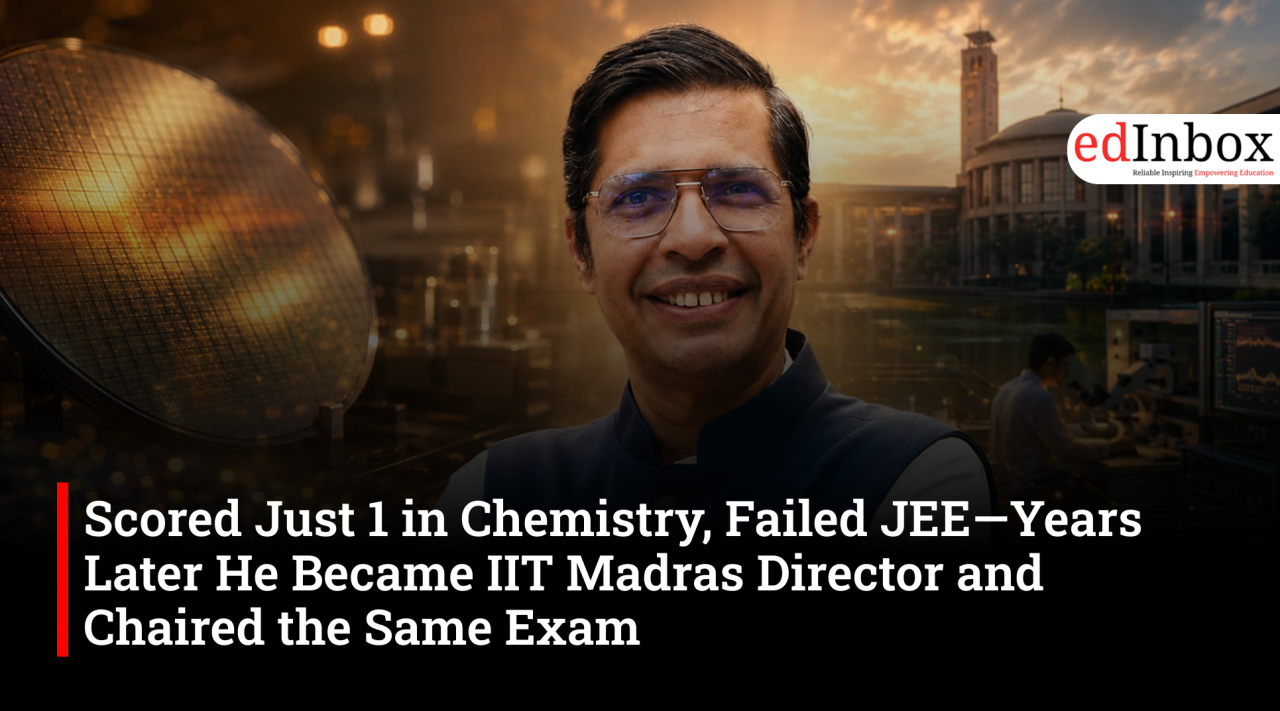
Every year, lakhs of students appear for the Joint Entrance Examination (JEE), hoping to secure admission to India's premier engineering institutes. For many, an unsuccessful result can feel like the end of a dream. But the journey of V. Kamakoti, the current Director of Indian Institute of Technology Madras, offers a powerful reminder that a single examination does not define a person's future.
Long before he became one of India's leading computer scientists, chaired the JEE, and received the Padma Shri, Kamakoti faced a setback familiar to many students—he failed to clear the JEE after scoring just one mark in Chemistry.
A Disappointing JEE Result Didn't End His Dream
Speaking about his early academic journey on several occasions, Kamakoti has shared that he was unable to qualify for the JEE because of his poor performance in Chemistry.
Rather than allowing one examination to determine his future, he continued his engineering education through other opportunities and remained committed to learning.
His perseverance eventually brought him to IIT Madras, where he completed both his Master's and PhD in Computer Science and Engineering, laying the foundation for an illustrious academic career.
From Student to Professor at IIT Madras
In 2001, Kamakoti joined IIT Madras as a faculty member in the Department of Computer Science and Engineering.
Over the next two decades, he built an impressive research portfolio in areas including:
Computer architecture
VLSI design
Embedded systems
Information security
Artificial Intelligence
Cybersecurity
He also led several nationally significant technology projects supported by the Ministry of Electronics and Information Technology (MeitY), contributing to India's growing digital and semiconductor ecosystem.
In a remarkable twist of fate, the student who once failed to clear JEE later went on to chair the very examination that had once rejected him.
Leading IIT Madras
In January 2022, Kamakoti assumed office as the Director of IIT Madras, one of India's highest-ranked engineering institutions.
Before taking over the institute, he had already served in several important national roles, including:
Head of IIT Madras' Microprocessor Development Programme
Leader of national information security initiatives
Member of the National Security Advisory Board
Chair of the Artificial Intelligence Task Force constituted by the Ministry of Commerce and Industry
His leadership has focused on strengthening research, fostering innovation and expanding collaborations between academia and industry.
Championing Responsible AI and Industry-Oriented Education
As Director, Kamakoti has consistently argued that engineering education must evolve alongside emerging technologies.
He has advocated for Responsible Artificial Intelligence, emphasising that ethics, transparency and accountability should guide AI development.
Another initiative promoted under his leadership is the Faculty of Practice model, which brings experienced industry professionals into classrooms to bridge the gap between academic learning and real-world engineering.
IIT Madras has also expanded interdisciplinary research, deep-tech innovation and startup incubation during his tenure, further strengthening its position as one of India's leading centres for technology and entrepreneurship.
National Recognition
Kamakoti's contributions to engineering research and technology have earned him several prestigious honours, including:
DRDO Academic Excellence Award
IBM Faculty Award
VASVIK Industrial Research Award
Abdul Kalam Technology Innovation National Fellowship
Padma Shri, India's fourth-highest civilian honour, conferred in 2026
These recognitions reflect decades of contributions to research, education and national technology development.
A Lesson Beyond Entrance Exams
While JEE toppers and rank holders rightfully receive widespread recognition every year, Kamakoti's story highlights another important truth: academic success is not always linear.
A disappointing entrance examination result may close one path, but it does not eliminate future opportunities. Persistence, continuous learning and resilience can lead to achievements that far exceed early expectations.
From scoring just one mark in Chemistry and failing the JEE to becoming the Director of IIT Madras, chairing India's most competitive engineering entrance examination and earning one of the nation's highest civilian honours, V. Kamakoti's journey stands as a reminder that one examination can influence a career, but it does not determine an entire life.