
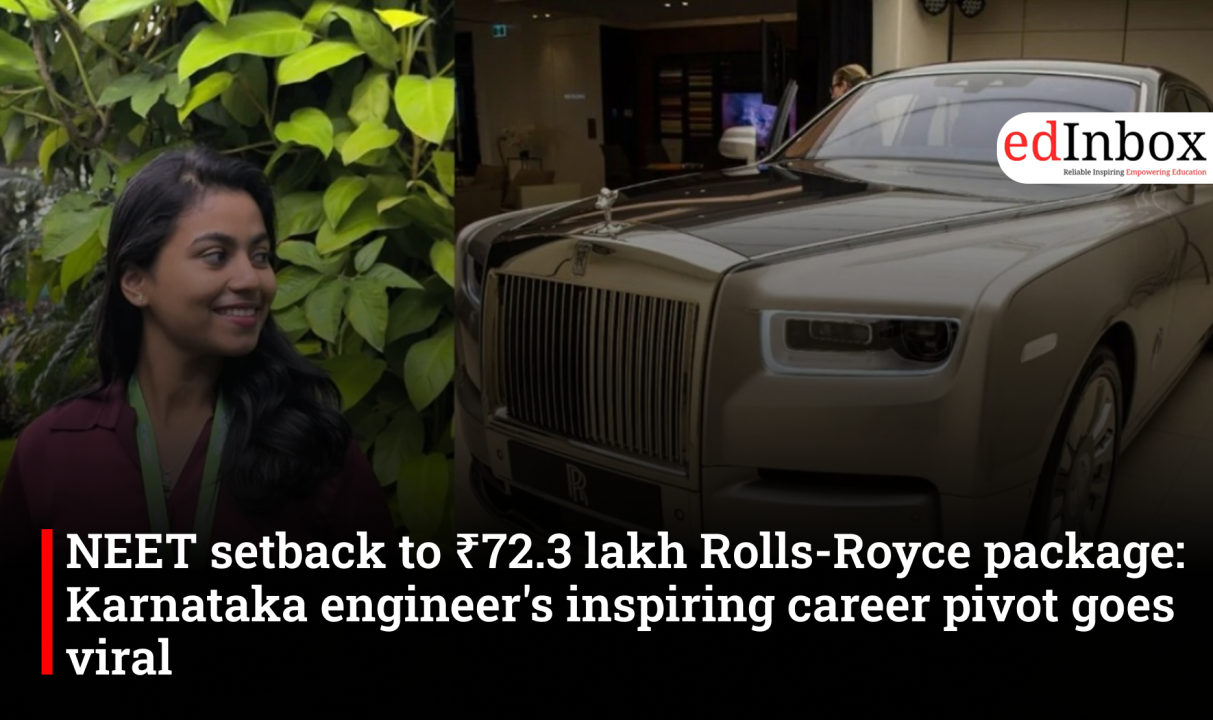
A failed attempt to secure an MBBS seat through NEET did not stop Rithuparna KS from building an exceptional career. Instead, the Karnataka student redirected her ambitions towards robotics and automation engineering, eventually landing a ₹72.3 lakh annual package at global engineering giant Rolls-Royce—a journey that is inspiring students to look beyond conventional career paths.
According to India Employment News, Rithuparna enrolled in Robotics and Automation Engineering at Sahyadri College of Engineering and Management, Mangaluru, after missing out on medical admission. Rather than viewing the setback as the end of her aspirations, she focused on developing practical engineering solutions and building a strong technical portfolio.
During her undergraduate studies, she designed a robot to assist areca nut farmers, participated in research projects, collaborated with researchers at NITK Surathkal, and earned recognition in international engineering competitions. Her work reflected a commitment to applying technology to solve real-world challenges, particularly in agriculture and automation.
The turning point came when Rithuparna secured an eight-month internship at Rolls-Royce's jet engine division. Balancing academics with demanding industry assignments, she successfully completed project milestones ahead of schedule, demonstrating strong technical capabilities and problem-solving skills.
Impressed by her performance, the company initially offered her a pre-placement package of ₹39.6 lakh per annum. Following her outstanding contributions during the internship, the offer was later revised to ₹72.3 lakh per annum, making it one of the highest campus placements from her institution.
Since December 2024, Rithuparna has been working on advanced robotics software development, contributing to projects involving Robot Operating System (ROS), Gazebo simulation, Python, C++, control algorithms, sensor integration, and autonomous robotic systems.
Her success story highlights the growing opportunities in emerging technology domains such as robotics, artificial intelligence, automation, and autonomous systems, where industry demand continues to rise globally.
For students disappointed by competitive entrance examinations like NEET, Rithuparna's journey offers an important lesson: a single examination does not determine long-term success. With adaptability, continuous skill development, industry exposure, and a willingness to explore new disciplines, alternative career paths can lead to equally rewarding professional opportunities and global careers
NEET setback to ₹72.3 lakh Rolls-Royce package: Karnataka engineer's inspiring career pivot goes viral
Typography
- Smaller Small Medium Big Bigger
- Default Helvetica Segoe Georgia Times
- Reading Mode