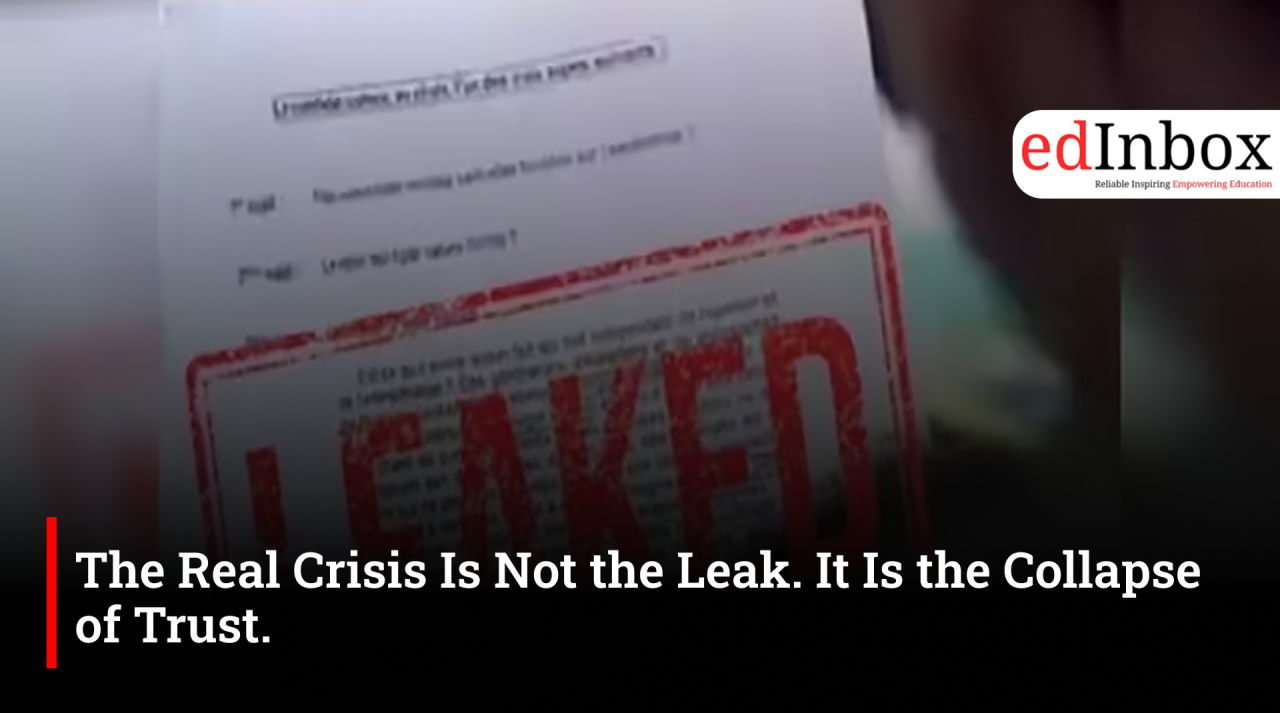
Every examination paper that leaks steals more than a question booklet. It steals years of hard work, family sacrifices, and the belief that merit still matters.
India's latest examination controversy has once again exposed a deeper institutional crisis. The debate is no longer confined to a single paper leak or the resignation of an Education Minister. It has evolved into a larger question: Can young Indians still trust the system that promises opportunity through merit?
The July 20 march to Parliament was born from this question. Tens of thousands of students travelled to Delhi not merely to protest an examination, but to demand accountability from institutions that determine their futures. Their message was simple: when an examination fails, it is not only a test that collapses—it is public faith in governance itself.
A GENERATION THAT DID EVERYTHING RIGHT - AND WAS STILL CHEATED
A generation that was told to study harder has discovered that hard work is no protection against a stolen question paper. It was told to trust merit, only to watch merit become negotiable. It was told that competitive examinations were the republic's great equaliser, only to learn that a leak can turn years of preparation, family debt and private sacrifice into waste overnight.
That is the moral centre of the students' movement now spreading across India. It is not a mystery manufactured in Beijing, Washington or a clandestine ideological cell. It is a public response to a documented institutional crisis. The immediate trigger was the cancellation and re-examination of NEET-UG 2026 after the paper-leak scandal. The National Testing Agency itself recorded 22.79 lakh candidates for the original examination and later notified a nationwide re-test on June 21.[1][2] The wider backdrop is even more damning: repeated leaks in recruitment, entrance and board examinations across states governed by different parties, enormous delays, weak prosecutions and vanishing accountability.
Yet, instead of beginning with the evidence, an influential section of partisan media and social-media propaganda has tried to change the question. Who leaked the paper? becomes Who funds the protesters? Why were safeguards breached? becomes Why was a Faiz song sung? Why are convictions so rare? becomes Which embassy issued a travel alert? The scandal is moved from the examination room to the protest site. Students become suspects; institutions escape the dock.
THE NUMBERS THAT PROPAGANDA CANNOT EXPLAIN AWAY
Before evaluating rumours about the movement, consider the proven scale of the problem. An Indian Express investigation in 2024 documented 41 recruitment-examination leaks in 15 states over five years. Those disruptions affected 1.4 crore applicants competing for just over 1.04 lakh posts.[3] That is not a campus quarrel. It is a mass injury to economic mobility.
A larger 2026 investigation examined 45 major paper-leak cases from 2002 to 2025, each involving at least one lakh applicants. It found that 3.86 crore aspirants had enrolled for the affected examinations. Re-tests were scheduled after an average delay of 183 days; in some cases the disruption stretched to four years. Among 1,658 people arrested, 925 were charge-sheeted, but only 18 were convicted - in merely two cases. Thirty-two were acquitted in two cases and 43 remained in judicial custody when the investigation was published.[4]
The evidence also defeats partisan simplification. Of the 45 major leaks studied by The Indian Express, 23 involved examinations under BJP-ruled governments at the Centre or in states, 14 under Congress-ruled bodies, and the remainder under other parties.[4] Uttar Pradesh topped the list, followed by Rajasthan and Gujarat. The honest conclusion is not that one party invented paper leaks. It is that a nationwide governance failure has persisted across political regimes - and that the Union government carries special responsibility when a national examination administered through a central agency collapses.
NEET-UG magnifies every weakness because the stakes are brutal. More than 2.27 million candidates appeared across 551 cities before the 2026 examination was scrapped, according to a later account compiling official and police information.[6] The NTA had publicly advertised a vast security architecture: over two lakh personnel, more than 6,000 observers, GPS-tracked transport, CCTV feeds, biometric authentication and central monitoring. It also said more than 65 Telegram channels had been blocked for circulating fake papers or fraudulent claims.[7] Yet the exam still had to be cancelled and held again. The gap between promised security and actual failure is exactly why public anger is rational.
This is the factual foundation of the movement. Any theory that claims the agitation is fundamentally foreign-made must explain why millions of affected Indian candidates, repeated cancellations, years of delay and microscopic conviction rates are somehow irrelevant. It cannot.
THE ACCOUNTABILITY DEFICIT UNDER BJP GOVERNMENT
45 major leak cases • 3.86 crore aspirants • 1,658 arrests • 925 charge-sheets • 18 convictions in only two cases • average re-test wait: 183 days.
WHEN AN EXAM FAILURE BECOMES A HUMAN EMERGENCY
The most painful dimension cannot be reduced to statistics. Hindustan Times reported that at least 11 NEET aspirants died by suicide in the 46 days between cancellation and the scheduled re-test, based on police records, family accounts and media reports.[6] The report was careful: in several cases, a direct causal link had not been officially established. That caution must be preserved. Suicide is complex; no responsible account should convert every death into a single-cause political slogan.
But caution is not an excuse for indifference. Families and police accounts repeatedly pointed to examination pressure, uncertainty and the collapse of carefully constructed plans. In one family account reported by Al Jazeera, years of coaching, land sales and household expenditure had been invested in a child's medical ambition. The father's anguished question captured the national grievance: “Can't they protect one paper that decides the future of millions?”[8]
The question is not whether a paper leak mechanically causes every tragedy. The question is whether an already punishing examination culture becomes intolerable when the state itself destroys predictability. Students face a scarce-seat lottery, coaching pressure, family expectations, age limits, financial strain and social comparison. A cancellation forces them to repeat travel, accommodation, preparation and emotional labour. It may collide with other examinations and admissions. It tells an exhausted young person that even perfect compliance cannot guarantee a fair chance.
This is why compensation cannot be discussed only as reimbursement of an examination fee. A credible response must include travel and logistical costs for the re-test, counselling and mental-health support, a transparent grievance mechanism, protection against academic disadvantage, and compassionate assistance to bereaved families without turning grief into political theatre. It must also include media guidelines that avoid sensational details, romanticisation or intrusive coverage of families.
The movement's moral legitimacy grows from this lived reality. Students did not first assemble around a geopolitical doctrine. They assembled around a broken promise: that the same paper, the same rules and the same chance would apply to everyone.
THE COUNTER-NARRATIVE FACTORY: CHANGE THE SUBJECT, CRIMINALISE THE QUESTIONER
Modern propaganda rarely tries to prove that no leak occurred. That would collapse under official notices and the re-test itself. Its more effective strategy is diversion. It accepts the grievance only long enough to declare that the grievance has been “hijacked.” The vocabulary then escalates rapidly: foreign-funded, Deep State, Islamist, communist, urban Naxal, anti-national, opposition-sponsored.
This technique performs three political functions. First, it fractures solidarity by making Hindu participants fear Muslim participants, nationalists fear leftists, and non-party citizens fear opposition parties. Second, it changes the burden of proof. Instead of the examination authority explaining how the paper escaped, each student must prove that no distant activist, political worker or embassy employee has ever interacted with anyone in the crowd. Third, it prepares moral permission for coercion. Once a protest is described as a foreign operation, a baton appears defensive rather than punitive.
The correct evidentiary rule is simple: an allegation of foreign funding requires financial evidence - bank transfers, donor records, contracts, FCRA violations, traced logistics or an official investigation with disclosed findings. An allegation of conspiracy requires coordination evidence - instructions, command structures, communications, material support or operational planning. A photograph, ideological overlap, a song, a diplomatic safety alert or an opposition leader's visit is not a substitute.
The following claims fail that test.
RUMOUR ONE: ‘CHINA FUNDED THE MOVEMENT’
The China narrative has been built through insinuation: some activists associated with left student organisations reportedly attended or interacted with an event linked to the Chinese embassy; therefore the entire CJP mobilisation was controlled or financed by Beijing. A highly polemical Organiser article called the protest a “Red-infested anti-India operation” and asked who paid for tents, logistics and media work.[9]
But the article's own language reveals the absence of proof. It says an inquiry “would need to establish” whether an embassy interaction had any connection to the protest, and that conclusions about gifts or support would depend on an official investigation.[9] In other words, the central connection had not been established. The piece then leaps from unanswered questions to certainty: Beijing must be directing chaos. That is not investigation. It is a presumption wrapped around a hypothetical.
Three distinctions matter.
- Participation by SFI, AISF, AISA, AIDSO or any other lawful student organisation does not convert a broad protest into a foreign operation. Indian political movements often contain people from parties, unions, independent collectives and unaffiliated citizens. Their ideological identities may be debated; their presence does not prove external command.
- Attendance at an embassy event is not evidence of funding. Embassies routinely hold cultural, academic, political and outreach events. A financing allegation needs a money trail. No publicly verified bank record, grant document, reimbursement ledger, transfer instruction or official finding has been produced in the reports that pushed the allegation.
- The movement's expenses are not mysterious merely because they are visible. Public agitations are often sustained through small donations, volunteer kitchens, sympathetic associations, local transport pools, digital creators and in-kind support. Those arrangements should be transparently disclosed by organisers, especially at scale. Transparency is good democratic hygiene. But “we do not yet know every donor” does not logically become “China paid.”
The appropriate verdict is therefore: unsubstantiated. If a competent agency has evidence of unlawful foreign finance, it should publish legally admissible findings and prosecute the offence. Until then, naming China functions as a political fog machine designed to obscure Indian administrative failure.
RUMOUR TWO: ‘THE US DEEP STATE KNEW - SO IT MUST HAVE PLANNED IT’
The second narrative treats a US Embassy demonstration alert as proof of advance conspiracy. The embassy advised American citizens on July 17 to avoid expected crowds and disruptions around central Delhi on July 20 and 21. A television report framed this as suspicious “foreknowledge.”[10]
The chronology dismantles the mystery. The march was not secret. Sonam Wangchuk and CJP figures had publicly spoken about the July 20 Parliament march days earlier; Reuters reported the plan on July 14.[11] The Monsoon Session of Parliament was opening. Farmer organisations had separately announced a July 21 mobilisation. Police deployment, traffic restrictions and public calls were visible. An embassy that failed to warn its citizens about such announced events would be neglecting its routine consular function.
Even the report that raised the conspiracy question conceded that demonstration alerts are standard diplomatic practice and are commonly based on open-source intelligence, local news, police announcements and public schedules.[10] No evidence in the alert shows funding, tactical guidance, communication with CJP or direction of the protest. It advised avoidance, not participation.
This is a classic conspiracy fallacy: because an institution anticipated an event, it must have caused it. By that logic, every traffic advisory would prove the traffic police organised the rally. Prediction is not authorship. Public knowledge is not clandestine control.
The appropriate verdict is false inference. A genuine “Deep State” allegation would require evidence of covert material support or command. A public safety notice about a publicly announced march proves neither.
RUMOUR THREE: ‘AN ALLAH SONG PROVES AN ISLAMIST CONSPIRACY’
A clipped video of a woman singing words associated with Faiz Ahmed Faiz's “Hum Dekhenge” was used to portray the movement as communal or Islamist. The line most often isolated refers to Allah. Removed from literary and historical context, it is made to sound like a sectarian declaration.
The history points in the opposite direction. “Hum Dekhenge” was written in 1979 as a political challenge to General Zia-ul-Haq's dictatorship in Pakistan - a regime that used religious authority to justify repression. The poem uses Islamic metaphor against authoritarian power; it became a South Asian protest anthem precisely because it turned the ruler's sacred vocabulary back toward justice and popular sovereignty.
One may like or dislike the poem. Organisers may reasonably choose songs that are less vulnerable to communal clipping. But a cultural performance by one participant cannot establish the religious character of a nationwide movement whose stated demands concern examination integrity, accountability, compensation and ministerial responsibility. To call Muslim vocabulary automatically anti-national is itself a communal act: it tells Indian Muslims that their language, poetry and devotional references are presumptively foreign.
The appropriate verdict is twofold. The song claim is decontextualised guilt by association. The Jamaat letter is fabricated content. Neither proves communal control of the movement.
RUMOUR FOUR: ‘URBAN NAXALS AND EXTREME COMMUNISTS ARE USING STUDENTS’
“Urban Naxal” is now less a precise security description than an expandable political label. It can be applied to a lawyer demanding arrest memos, a professor questioning policy, a student union carrying a red flag, an environmentalist fasting, or a citizen asking for independent investigation. Its utility lies in vagueness: the accusation is emotionally grave but evidentially elastic.
There is a legitimate distinction between democratic left politics and proscribed armed Maoist activity. SFI, AISF, AIDSO and AISA are public student organisations operating in universities and elections. Their slogans and politics are open to criticism. But their presence at a rally does not establish an armed-insurgency conspiracy. Proof would require links to a banned organisation, violent operational planning, weapons, illegal finance or command instructions - not ideological adjectives.
The movement's principal methods have been sit-ins, hunger strikes, public speeches, marches, social-media satire and demands addressed to constitutional institutions. Sonam Wangchuk's intervention reinforced a Gandhian frame: bodily sacrifice, non-violence and moral pressure. He was moved to hospital against his wishes on the twenty-first day of his fast after doctors warned of serious health risk.[15] To redescribe that method as Maoist strategy is not merely inaccurate; it erases the obvious difference between civil disobedience and armed rebellion.
The charge also ignores the social composition of the anger. CJP's online rise drew students, job-seekers, families, professionals and politically unaffiliated youth. Reuters linked its expansion to youth unemployment and recurring exam failures; the official unemployment rate for people aged 15-29 was nearly 10 per cent in 2025 and 13.6 per cent in urban India. Those material anxieties do not need a secret ideology to become explosive.
The appropriate verdict is categorical inflation: the use of an extremist label without extremist evidence.
RUMOUR FIVE: ‘ALL ANTI-MODI FORCES ARE BAKING THEIR BREAD’
Opposition parties have supported the agitation. Rahul Gandhi and other leaders backed the demand for the Education Minister's resignation; Parliament was repeatedly disrupted after the July 20 events, and protests spread to multiple cities.[16] Political parties will naturally seek advantage from a government failure. That is not a revelation. It is electoral politics.
But opportunistic support does not invalidate an underlying grievance. A bridge does not become sound because the opposition photographed its collapse. Nor does a leaked exam become fair because a rival party joins the march. The correct test is whether the evidence preceded the political embrace. Here it plainly did: cancellation, re-test, affected candidates, suicides, investigation records and low conviction rates were public facts before the opposition's full-scale intervention.
The cross-party history of leaks is especially important. Congress governments have presided over serious examination failures; regional parties have too.[4] Student organisers should therefore resist becoming an appendage of any one party and demand a national reform compact binding all governments. Yet the ruling party cannot use the opposition's presence to escape its present responsibility for a national examination administered under the Union education system.
The appropriate verdict is diversion. Opposition participation may alter the movement's optics and strategy; it does not erase the documented case for accountability.
THE FAKE-CONTENT ASSEMBLY LINE
The propaganda war has not remained at the level of opinion. It has produced forged documents, AI images and recycled videos.
BOOM identified AI-generated images carrying fabricated testimony from a supposed police inspector who allegedly claimed Wangchuk himself had sought removal to hospital. No credible record supported the named officer's quotation, and image-detection analysis indicated synthetic generation.[17] BOOM also found that two videos circulated to construct a pro-police narrative were old and unrelated: one showed a “We Support Delhi Police” event from November 2025; another showed an officer and a Palestinian flag in footage dating to 2023.[18]
India Today found that a clip presented as a CJP protester attempting to burn a car was actually from Gaya, Bihar, after a road accident on July 16, before the Parliament march.[19] Alt News's investigation of the forged Jamaat letter exposed how a badly constructed document crossed the boundary from partisan accounts into television coverage.[14]
Accuracy, however, cannot be partisan. Newschecker found that a video used by some accounts to accuse Delhi Police of vandalising vehicles during the July 20 march was actually from a July 13 BJP protest in Datia, Madhya Pradesh.[20] Delhi Police also denied viral claims that a woman protester had died during the lathi-charge; at the time of writing, no verified death had been established.[21] These corrections matter. A movement demanding truth from the state must apply the same standard to its own information ecosystem.
The lesson is not “believe the police” or “believe the protesters.” It is: verify the specific claim. Check date, location, original uploader, shadows and hands in AI images, signage, uniforms, weather, vehicle plates, reverse-image results, medical records and named witnesses. Do not let emotional alignment replace evidence.
This discipline strengthens the movement rather than weakening it. False stories are gifts to those who wish to discredit real abuse. Every organiser should maintain a rapid-verification desk, publish corrections prominently, preserve original files and metadata, and discourage anonymous sensational claims. Credibility is a strategic asset.
VERIFICATION RULE
Do not authenticate a claim by political alignment. Authenticate the date, place, original file, medical record, named witness and source chain.
JULY 20: WHEN A MARCH TOWARD PARLIAMENT MET THE BATON
The Sansad March on July 20 was publicly called in the name of examination accountability and the resignation of Education Minister Dharmendra Pradhan. Wangchuk had urged preparation for it before being removed to hospital. Tens of thousands of young people gathered in New Delhi as the Monsoon Session opened. Reuters reported police using tear gas and batons to push protesters back; the Associated Press likewise described force used against marchers moving toward Parliament.[16][22]
The state had not granted permission for the march to proceed to Parliament. Police erected barricades and treated attempts to cross them as a security breach. Delhi Police later alleged that protesters became “unruly, aggressive and violent,” attacked personnel, damaged public property and attempted to break barriers despite warnings. Police said 70 protesters were detained. Their reported injury count was 118 police personnel and roughly 60 protesters; they also alleged damage to government vehicles.[23]
Those claims cannot simply be discarded. Video cited in contemporaneous reporting showed some protesters attacking police. Anyone who assaulted an officer or deliberately destroyed property should face a fair, individualised investigation. A democratic movement has no licence to turn collective anger into indiscriminate violence.
But police accountability is not cancelled by protester misconduct. Other videos showed personnel in plain clothes wielding batons and striking protesters as barricades were breached.[24] Participants alleged male officers hit women, and viral images showed serious injuries. Protesters also alleged the use of pellet guns; Delhi Police denied that allegation. Because the claim is contested, it should not be presented as settled fact. It requires medical records, forensic examination of injuries, weapon logs, CCTV footage and an independent inquiry.
The central human-rights question is proportionality. Were clear dispersal warnings given and audible? Were safe exit routes available? Were non-violent participants separated from those committing offences? Were women handled by women personnel? Were journalists, medics and legal observers protected? Was force targeted at an immediate threat, or applied broadly after the line broke? Were plainclothes personnel identifiable and accountable? Were detainees informed of grounds and documented?
India's Constitution protects freedom of speech and the right to assemble peaceably and without arms under Article 19, subject to reasonable restrictions. Article 21 protects life and personal liberty, while Article 22 establishes safeguards concerning arrest and detention.[25] In Anuradha Bhasin, the Supreme Court emphasised that restrictions on fundamental rights must satisfy proportionality and that the state should use the least restrictive measure available; it also directed publication of orders restricting telecom services so affected people can challenge them.[26]
These standards do not guarantee a march to any route at any time. Parliament and central Delhi require security. But “no permission” is not a magic phrase that legalises every subsequent blow. The police duty is dual: prevent violence and protect citizens, including citizens with whom the government strongly disagrees.
WHAT REMAINS DISPUTED
Police use of pellets is alleged by protesters and denied by Delhi Police. It should be described as contested unless medical and forensic evidence establishes it.
THE CURTAIN AROUND SONAM WANGCHUK
Two days before the march, Wangchuk was moved from the protest site to hospital against his stated wishes. Reuters reported that he was on the twenty-first day of his hunger strike and that doctors were concerned about hypokalaemia, a potentially dangerous fall in blood potassium.[15] The Delhi High Court had asked authorities to monitor his health and intervene if necessary.
The state therefore faced a genuine duty-of-care dilemma. It could not ignore a life-threatening medical decline. But the visual and procedural choices mattered. Footage showed personnel surrounding the site while large white sheets were held up as a screen during his removal.[15] Supporters interpreted the operation as abduction and silencing. Authorities described it as medically necessary.
A rights-respecting response should have maximised transparency: independent doctors acceptable to the patient and family, written medical findings, access to counsel, a recorded explanation of legal authority, and continuing ability to communicate unless a specific lawful restriction applied. The stronger the state claims benevolent necessity, the stronger its obligation to show that coercion was narrowly tailored to saving life rather than suppressing speech.
Wangchuk's role also undermines the attempt to caricature the movement as nihilistic. His public life is associated with alternative education, ecological protection and non-violent advocacy. One may disagree with his demand for a minister's resignation or criticise the ethics of a prolonged hunger strike. But his participation placed the crisis within a recognisably Indian tradition: the citizen's body used as a moral appeal to power. A government confident in its democratic legitimacy should answer that appeal with dialogue, not opacity.
MUMBAI: FROM STREET CONTROL TO DIGITAL CONTROL
After the Delhi confrontation, the pressure shifted from visible barricades to the less visible domain of phones, locations, notices and fear. Students in Mumbai told The Times of India that they were directed to share live locations, received notices through messaging platforms at around 3 a.m., spent hours in police stations, surrendered phones that were returned with signs they interpreted as surveillance, were denied copies of “zero FIRs,” and received calls from multiple security agencies.[27] One student described being held for nearly seven hours; organisers alleged that prolonged detention was intended to exhaust participants and deter them from returning.
These are allegations, not yet judicial findings. Technical claims that a phone was compromised require forensic examination. Police may lawfully seek information or seize a device under defined legal powers in an investigation. But informal demands, unexplained access, location tracking without disclosed authority and pressure applied to peaceful participants raise grave concerns under the constitutional right to privacy recognised by the Supreme Court in K.S. Puttaswamy.[28]
The most alarming reported episode was not merely alleged by protesters and left there. A viral video appeared to show a Mumbai Police driver threatening students that drugs could be planted on them and narcotics cases filed if they protested again. Mumbai Police ordered an inquiry, identified the driver and removed him from his current posting pending completion of the probe.[29] That institutional response is significant: it shows the allegation was serious enough to demand immediate administrative action.
A threat to fabricate a narcotics case is not ordinary rough language. It invokes one of the state's most coercive legal regimes, where arrest, stigma and prolonged litigation can destroy a young person's education and employment. Even if uttered by one individual without institutional instruction, it creates a chilling message: participation can be converted into criminal identity.
Reports also indicated that more than 150 people were detained and cases registered during protest-related action in Mumbai.[30] In one widely reported incident, a young woman blocked a police vehicle and demanded arrest memos for those being taken away. Whatever one thinks of her tactic, the legal instinct was correct: detention cannot become an undocumented disappearance into procedure. Grounds, records, station location, access to counsel and information to family are not favours; they are safeguards against abuse.
Digital intimidation is particularly corrosive because it follows the student home. A lathi-charge ends physically; the suspicion that one's location is being tracked, contacts mapped and future career flagged can produce long-term self-censorship. It turns the smartphone - the movement's organising tool - into a source of anxiety.
Mumbai Police should therefore publish clear answers. Under what law were live locations requested? Which devices were accessed, imaged or retained, and with whose authorisation? Were seizure memos issued? What data was copied? Were notices validly served? How many people were detained, arrested or released? Which FIRs were registered, and why were copies allegedly unavailable? What safeguards prevent use of protest participation as a basis for unrelated surveillance?
QUESTIONS REQUIRING ANSWERS
Legal authority for live-location demands • device seizure and data-copy records • service of notices • FIR access • detention logs • scope of the inquiry into the alleged drug-case threat.
A DEMOCRACY DOES NOT FEAR THE RECEIPT
The movement's immediate demands are often summarised as a ministerial resignation. But resignation alone would be symbolic unless accompanied by structural reform. India needs a public examination integrity architecture that makes failure traceable rather than endlessly deniable.
First, every major examination should have an auditable chain of custody from question creation to printing, encryption, transport, storage, opening and digital transmission. Responsibility must be assigned by name and function. Independent red-team testing should attempt to breach the system before candidates are exposed to it.
Second, vendors and subcontractors must be transparent. Security cannot disappear into a maze of private printers, logistics companies and software providers. Contracts should specify cybersecurity standards, background checks, data minimisation, breach reporting, financial liability and debarment.
Third, an automatic candidate-compensation protocol should activate upon cancellation. It should cover fees, travel and reasonable documented expenses; offer schedule protection; and provide counselling. Families should not have to protest separately for basic relief.
Fourth, investigations should be time-bound and publicly reported without compromising trials. The 2026 record - 45 major cases, 1,658 arrests and convictions in only two cases - demonstrates why arrest statistics cannot be sold as accountability.[4] The public needs to know whether organisers, insiders, officials and beneficiaries are actually prosecuted.
Fifth, responsibility must travel upward. Junior invigilators and middlemen cannot be the only visible accused while senior administrators treat a nationwide re-test as a weather event. Parliamentary oversight, an independent technical audit and published findings are essential.
Sixth, protest policing needs transparent protocols. Body-camera and CCTV footage should be preserved; force reports should specify units, weapons, timing and authorisation; medical data should be independently compiled; and allegations against both protesters and police should be investigated by a body not directly implicated in the confrontation.
Seventh, the movement itself must institutionalise non-violence and verification. Volunteer marshals, legal observers, first-aid teams, women-safety teams, clear route discipline and a public correction desk can prevent provocateurs, panic and fake media from hijacking the cause. Organisers should publish audited accounts of donations and expenses. Transparency is the strongest answer to foreign-funding rumours.
Eighth, dialogue must have a timetable and minutes. Meetings without written commitments become instruments of delay. A negotiation should specify which demands are accepted, rejected or under examination, by whom, and by what date.
THE REAL ANTI-NATIONAL ACT IS TO DESTROY FAITH IN MERIT
National strength is not measured by how effectively a government can silence embarrassment. It is measured by whether institutions correct themselves before citizens lose faith in them.
A paper leak is not a minor administrative mishap. It is theft from the honest. It transfers advantage from the disciplined to the connected, from the poor family that sells land to the network that buys access. It corrodes recruitment, public services, medicine, education and the legitimacy of the state. When millions conclude that effort is less powerful than influence, the republic loses human capital and moral authority.
The students on the street are therefore not weakening India by exposing the failure. They are demanding that India become worthy of their effort. Their patriotism lies in refusing to normalise fraud. Their constitutionalism lies in addressing Parliament, courts, ministries and the public. Their anger is not a foreign import; it is the domestic product of unanswered evidence.
The state has the right to ask protesters to remain peaceful. Protesters have the right to demand the same discipline from the state. The media has the right to investigate ideological participation, finance and violence. It has no right to forge, recycle or insinuate its way around facts. Opposition parties may support the movement. They should not capture it. Ruling parties may defend their record. They cannot communalise or criminalise every critic.
The most powerful response to misinformation is not another slogan. It is a public ledger of truth: how many examinations failed, how they failed, who profited, who was charged, who was convicted, what candidates lost, what compensation was paid, what force was used, who authorised it, what phones were searched, and under which law.
This movement will ultimately be judged not by its most viral meme or its angriest moment, but by whether it converts pain into reform. It must remain inclusive, secular, non-violent, transparent and fiercely factual. It must refuse both the state's conspiracy theatre and its own temptation to circulate unverified outrage. It must keep the focus where power wants it removed: on the stolen paper, the delayed future and the missing accountability.
India's students are not asking for privilege. They are asking for the examination they paid for, prepared for and were promised. They are asking that a mark reflect knowledge, not access to a leak. They are asking that peaceful dissent not become a police dossier. They are asking that the Constitution be visible not only in textbooks, but at barricades and inside police stations.
That demand is not anti-India. It is India insisting on itself. For accountability. For governance. For transparency. For democracy.
Prof. Ujjwal Anu Chowdhury
The author is Vice President, Washington University of Science and Technology and Editorial Mentor, edInbox.com
The Real Crisis Is Not the Leak. It Is the Collapse of Trust
Typography
- Smaller Small Medium Big Bigger
- Default Helvetica Segoe Georgia Times
- Reading Mode