
When a Builder of Ice Becomes a Voice for Justice
Sonam Wangchuk has spent his life solving problems that seemed impossible. He built artificial glaciers in one of the world’s coldest and driest regions. He challenged conventional education models by creating learning spaces where children once labelled as failures could rediscover confidence. He demonstrated that innovation does not always require complexity—sometimes it requires understanding nature, people, and timing.
Today, Wangchuk’s public campaigns and advocacy have placed him at the centre of a larger national conversation: How does a democracy respond when citizens feel unheard?
His story is no longer only about ice stupas, sustainable architecture, or alternative education. It is about the relationship between citizens and institutions, between public concern and political response, and between the moral voice of an individual and the machinery of the state.
The Crisis of Trust Behind the Protest
Across India, concerns over examination systems, recruitment processes, and opportunities for young people have created anxiety among students and families. Whenever allegations of irregularities emerge in competitive examinations, the damage extends beyond individual results—it affects confidence in fairness itself.
For millions of young Indians, education is the pathway to dignity, employment, and social mobility. When that pathway appears uncertain, frustration grows. The demand from citizens is often not for dramatic change overnight, but for transparency, accountability, and systems that can regain public trust.
Wangchuk’s interventions have repeatedly focused on this question: How can institutions become more responsive to the people they serve?
The Innovator Who Turned Challenges into Solutions
Born in Ladakh, Sonam Wangchuk’s journey reflects the power of practical problem-solving. After studying engineering, he returned his attention to the challenges faced by Himalayan communities—limited resources, harsh climate conditions, and educational difficulties.
His most celebrated innovation, the Ice Stupa, transformed the way communities think about water conservation. By storing winter water as ice structures that melt gradually during warmer months, the project addressed a crucial agricultural challenge: the mismatch between water availability and farming needs.
The idea was simple but revolutionary. Instead of fighting nature, Wangchuk worked with natural cycles.
Education Beyond the Classroom
Wangchuk’s contribution to education has been equally influential. Through the Students’ Educational and Cultural Movement of Ladakh (SECMOL), he promoted an alternative approach where students learn through responsibility, practical skills, and real-world experience.
The campus became an example of sustainable living, using renewable energy, local resources, and student participation as tools of education. Its philosophy challenged the idea that examination scores alone define intelligence or potential.
The larger lesson was powerful: education should discover talent, not merely measure memory.
From Innovation to Public Advocacy
In recent years, Wangchuk has emerged as a prominent voice on environmental protection, local rights, and sustainable development in Ladakh. His campaigns have highlighted concerns about preserving fragile Himalayan ecosystems while ensuring that local communities have a meaningful role in decisions affecting their future.
His style of activism has remained closely connected to his engineering philosophy—peaceful, creative, and focused on solutions.
The Real Question Before India
The importance of Sonam Wangchuk’s journey lies not only in one individual but in what his example represents.
A nation’s strength is not measured only by its infrastructure, technology, or economic growth. It is also measured by how it responds to voices of concern, especially those raised by people who have spent their lives contributing to society.
A democracy does not become weaker when citizens question systems. It becomes stronger when institutions have the capacity to listen, engage, and improve.
Beyond the Hero Narrative
India often celebrates innovators after their ideas succeed. But the deeper challenge is creating a society where innovators, educators, scientists, and social reformers are heard while they are still working—not only remembered after they are gone.
Sonam Wangchuk’s life offers an important reminder: solutions do not always come from powerful offices. Sometimes they emerge from classrooms, mountains, villages, and communities.
The man who built ice in the desert has spent decades teaching India a simple lesson—human creativity can overcome scarcity when knowledge is combined with compassion.
The question now is whether India’s institutions can demonstrate the same spirit of problem-solving that Wangchuk has shown throughout his life.
Because the greatest innovation any democracy can create is not a machine or a structure. It is trust.
Prof Ujjwal K Chowdhury is the Pro Vice Chancellor of Techno India University, and a regular writer on education,media and world affairs.
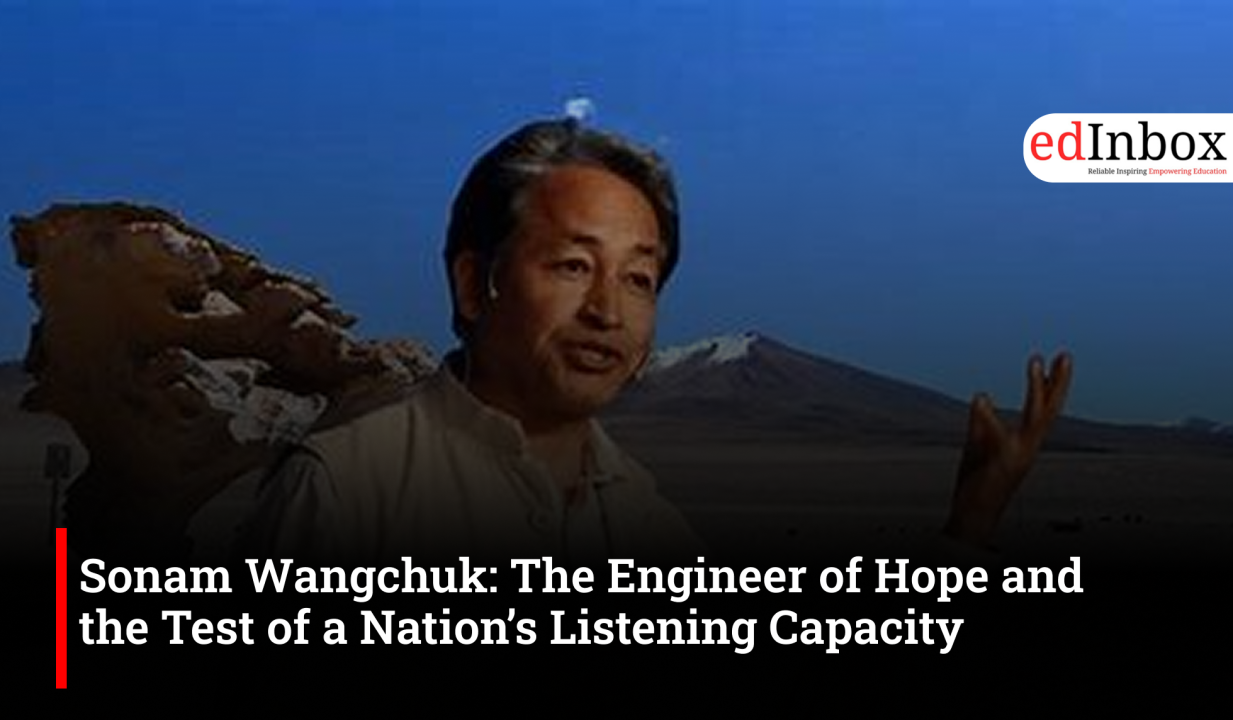
Sonam Wangchuk: The Engineer of Hope and the Test of a Nation’s Listening Capacity
Typography
- Smaller Small Medium Big Bigger
- Default Helvetica Segoe Georgia Times
- Reading Mode