
India is soon moving on to an era where technology and statistics would shape the future of society. More and more people becoming conscious about quality and rights; it is social justice that has become more of a prime concern than ever before. Along with social justice and coordination between the government and other institutions for proper delivery, forensic science labs have come to be a part of social justice and social services. It is no longer merely a procedure but a part of overall processes that demand awareness about science and ethics.
Today, there is a clear demand for education, which goes beyond textbooks, being more relevant to equipping students with the capacity to deal with real-life situations. Forensic science is not a subject that acts as a means for people to make a living but a useful tool for improving truth and justice in the country. This is why forensic education in India has seen so much development in the past ten years.
As of 2010, it was reported that there were only nine universities in India that offered degrees in forensics. There were ten National Forensic Sciences Universities (NFSUs) established after 2009. Since 2020, there has been increased expenditure and number regarding this discipline. Also, there are more than 165 private universities and colleges conducting courses in forensic science.
Although the increase in the number of institutions has solved the issue in terms of availability, the truth remains that the situation on the ground still remains challenging. The vacancy rate above 40 percent in terms of scientific manpower, despite the fact that there are 26 forensic labs in India, creates an imbalance in education and the demand for the workforce.
In addressing this problem, there are three levels of solutions that the institutions can use. First, the trained students can be employed to undertake internships with the goal of addressing the labor gap that currently exists in the laboratories. Second, the trained graduates need to be hired with the aim of providing a long-term solution with regard to the problem. Third, the expertise of the retired forensic specialists can be utilized with the goal of providing stop gap solutions before the hiring of employees in the positions that have been sanctioned.
India presently has a total of 806 districts, state forensic science labs of 27, about 80 R-FSLs, and nine CFSLs. Due to the increased number of cases of crimes, cyber evidence, and complicated matters, a tremendous rise in the development of special institutions and labs is required in the present scenario, otherwise, it will be difficult to handle the burden on the justice delivery system.
Certain universities like Centurion University are also emerging as very good models of education by their emphasis on effective forensic training. Universities based on skills must have extensive collaboration with state police forces. By doing this, the gap that exists between universities and police forces can be reduced.
This would help the students tackle real-life cases in expert labs and police stations. The first-hand experience would also help equip them with competent skills. This would also help the police reap benefits from the well-equipped young minds. The police would then get to meet their forensic manpower needs in no time.
The number The lack of qualified faculty members for forensic sciences is another major issue. To overcome this challenge, the university could employ PhD scholars or academicians belonging to their department, while scientists, doctors, or retired police officers could be appointed as visiting or adjunct faculty members. In addition to this, the development of faculty members for the younger faculty members of the university could also be required for improving the laboratory or research capabilities of the young faculty members.
International collaboration or virtual labs can also play an equally vital role in such an endeavor. Such platforms can provide an opportunity to the student to have mentorship from someone who may have academic excellence along with experience in this area. The Road Ahead The future will translate to better opportunities for students interested in going beyond the normal degree program in terms of working on the practical understanding. The industries as well as the justice system need professionals with knowledge as well as practical understanding. This will impart strength to the students’ careers. It will also translate to imparting a renewed strength to the justice systems in India.
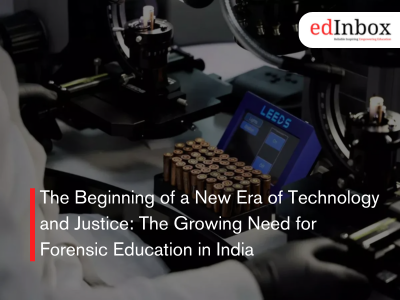
The Beginning of a New Era of Technology and Justice: The Growing Need for Forensic Education in India
Typography
- Smaller Small Medium Big Bigger
- Default Helvetica Segoe Georgia Times
- Reading Mode