
On the one hand, the world has become more and more opinion based, outraged, and quick to form conclusions without thinking. On the other hand, forensic science remains a silent and calm partner, emphasizing patience, precision, and evidence. It is the discipline which draws a clear line between speculation and facts, and between faith and proof. In India, the role of forensic science is no longer marginal or occasional. It is turning out to be a key element of the justice system, governance, and accountability, as courts demand scientific clarity and technology generates evidence which is impossible to be ignored.
For students who are fond of patterns, logic, and the profound gratification of doing things the right way rather than the fast way, forensic science offers a very special kind of mission. The job is tough, the burden of responsibility is great, and the effects are genuine. However, so is the faith in those who perform the practice.
When it is a matter of absolute truth, society calls for forensic experts.
Choosing an Evidence Mindset, Not a “Crime” Career
Forensic science is often mistaken for a crime centric profession only. Actually, it is an evidence ecosystem. Every step in the process of material from the point of collection at the scene through its analysis in the lab to its explanation in the court must be documented, work in the repeat, and be experimentally demonstrated. Even the strongest finding can be undermined by a single procedural slip.
The field incorporates several different areas of studies such as crime scene management, forensic biology and DNA, chemistry and toxicology, ballistics, questioned documents, trace evidence, forensic anthropology, behavioural analysis, and more frequently, digital and cyber forensics. Today, digital evidence is not a luxury anymore; it exists in nearly every investigation, physically linking the reality with the unseen data trails.
The First Real Choice: Life Sciences or Tech
The most important decision is not the college or job title, but the foundation you choose. Generally speaking, students start forensic science from two main engines.
The Life Sciences track is perfect for those who are interested in chemistry, biology, and laboratory meticulousness. It opens up the way to DNA analysis, toxicology, narcotics testing, and chemical examination, where scientific discipline is the pillar of the justice system.
The Tech and Cyber track is for those who are at ease with systems, data, and a logical approach to problem solving. It leads to digital forensics, cyber investigations, fraud analysis, and electronic evidence examination, the latter being one of the fastest, growing sectors due to the explosion of digital footprints.
Both paths require depth. You can cross over later, but early focus builds confidence and competence.
What the Work Actually Looks Like
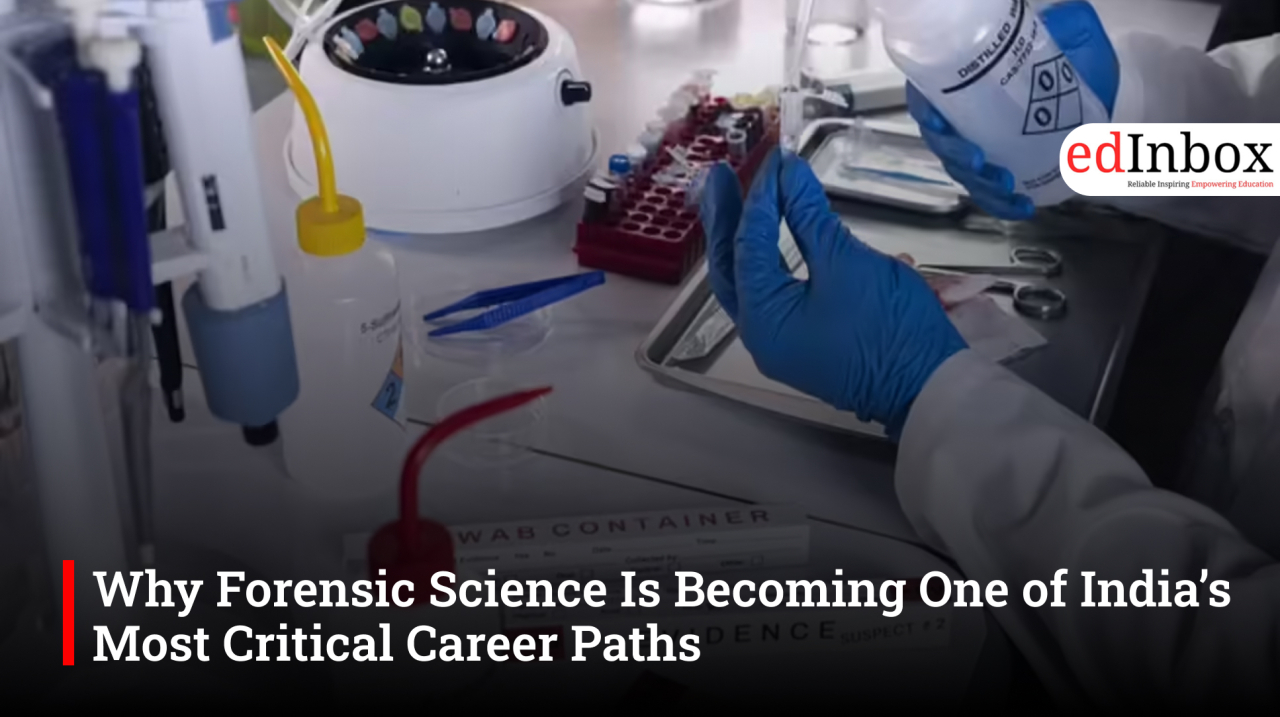
A forensic professional almost never has a dramatic day. In the labs, mornings start with checking verification, making sure seals are intact, confirming details of the case, calibrating instruments.
Without a proper procedure, the results are essentially meaningless. Reports are equally significant as analyses; the results should not only be exact and careful, but also capable of standing up to legal scrutiny.
In cyber forensics, the discipline is similar. Devices are treated not as gadgets but as containers of fragile proof. Every action is documented. The goal is not discovery for excitement, but reconstruction that can withstand scrutiny in court.
Across both paths, credibility is the core skill. On both routes, the central skill is credibility. Forensic experts are trained to speak truthfully and not to overstate, to recognize their limits, and to stand firm against pressure. Gradually, their trustworthiness turns into their brand.
Getting Ready for the Future
For kids at school, its more important to have solid basics in science, math, computer studies, and written communication than to be swayed by the hype. Being observant, making records, and having a clear mind are early habits that will be very beneficial in the long run.
At the undergraduate level, the focus moves from grades to methodology. Work placements, getting a feel of the lab, forensic, related projects, and regular report writing all make a big difference. The top notch applicants are the ones who have a neat process and whose reasoning is well organized.
Why This Decade Matters
Forensic science in India is becoming more institutional, more relied upon, and more demanded—across courts, policing, corporate investigations, and regulatory systems. It is not a flashy career. But it is a future-proof one.
For students who want proof over noise, discipline over drama, and purpose over popularity, forensic science offers something rare: the chance to make truth clearer in a world that increasingly struggles to agree on what truth is.
Why Forensic Science Is Becoming One of India’s Most Critical Career Paths
Typography
- Smaller Small Medium Big Bigger
- Default Helvetica Segoe Georgia Times
- Reading Mode