
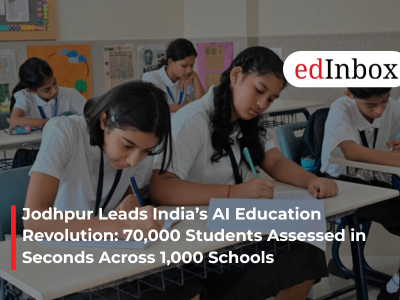
In a landmark step towards digital education reform, Jodhpur has emerged as a pioneer by deploying Artificial Intelligence (AI) for large-scale student assessment. In a first-of-its-kind initiative, over 70,000 students across 1,000 schools were evaluated within seconds—transforming a process that once took weeks into a highly efficient, data-driven system.
The project, part of the Competency-based Census Assessment and School Reporting Pilot, covers Classes 6 to 9 and evaluates students in five core subjects—English, Hindi, Mathematics, Science, and Social Science. Powered by AI, the system has generated over 3 lakh individual assessments, offering detailed insights into each student’s strengths and learning gaps.
Unlike traditional report cards, the AI-generated evaluations go beyond marks. Students are graded on a scale from “learning” to “excellent,” giving a nuanced picture of their conceptual understanding. For instance, a Class 8 student may excel in statistics and civics while needing improvement in language comprehension or numerical problem-solving—insights that were previously difficult to capture at scale.
The initiative marks a significant shift from manual to automated evaluation. Earlier, checking a single answer sheet could take up to 5–7 minutes, but with AI, grading now happens in seconds. Teachers simply scan answer sheets through an app, and the system analyses even subjective responses—a breakthrough in India’s education technology landscape.
Officials say the biggest advantage lies in accuracy and objectivity. The AI-driven system ensures a bias-free assessment process while generating detailed analytical report cards for students, teachers, and schools. These reports help educators design targeted remedial strategies, focusing on specific topics where students lag behind.
At a broader level, the system introduces school-level accountability. Each institution receives a performance score on a scale of 1–10 across subjects, presented in a ladder format. This allows comparisons with top-performing schools, offering parents a transparent view of school quality—something that was largely missing earlier.
The initiative is aligned with the vision of the National Education Policy 2020, which emphasises competency-based learning and continuous assessment. By integrating AI into evaluation, Jodhpur is effectively operationalising NEP’s goal of shifting from rote learning to skill-based education.
The project was initially launched under former District Collector Gaurav Agrawal and is now being scaled under current administrative leadership, with support from key partners such as the Central Square Foundation, EdOptimize, and Central Electronics Limited. Their collaboration aims to balance academic rigour with technological robustness.
Education officials highlight that one of the biggest gaps earlier was the lack of uniform assessment standards and limited parental awareness about school performance. The new AI system addresses both issues by providing comprehensive, easy-to-understand data that empowers parents to engage more meaningfully with schools.
The results of the latest assessment cycle will be shared during upcoming Parent-Teacher Meetings, giving families unprecedented insight into their child’s academic journey and their school’s overall performance.
As India pushes towards tech-driven education reforms, Jodhpur’s AI-powered assessment model could well become a national template—demonstrating how scalable, low-cost technology can revolutionise learning outcomes, reduce teacher workload, and bring transparency into the education system.
Jodhpur Leads India’s AI Education Revolution: 70,000 Students Assessed in Seconds Across 1,000 Schools
Typography
- Smaller Small Medium Big Bigger
- Default Helvetica Segoe Georgia Times
- Reading Mode