
The Delhi High Court on Thursday said that banning or restricting children's access to social media is a policy matter for the Central government and not something the court can mandate through judicial directions. The court disposed of a Public Interest Litigation (PIL) seeking restrictions on children's social media use and stronger measures against Child Sexual Abuse Material (CSAM).
A bench of Justices V Kameswar Rao and Manmeet PS Arora directed the Centre to treat the PIL as a representation and consider the concerns and suggestions raised by the petitioners. The court also said the government should consult all relevant stakeholders, including social media intermediaries, before taking a decision.
The bench, however, declined to prescribe a deadline for the Centre to complete the exercise.
“Those views have to be taken and then it is in the realm of a policy. It is not for a court to give a direction that you should ban this, or that you should ban that,” the bench observed.
What Did the PIL Seek?
The petitioner sought directions to the Centre to consider framing a law or guidelines to restrict social media access for children below 13 years of age.
The PIL also sought a regulatory framework for social media content accessible to children aged 13 to 16 years, citing concerns over children's online safety and exposure to harmful content, including CSAM.
Central government counsel Nidhi Raman told the court that regulating or restricting children's access to social media is a policy issue that may require a new law. Such a decision would have wider implications and therefore requires consultation with stakeholders, she submitted.
The Centre said the petition could be treated as a representation and that the appropriate authorities could take a decision after considering the issues raised.
Digital Personal Data Protection Act Cited
During the hearing, the court asked whether any steps had been taken following an earlier Supreme Court order concerning children's online safety.
The Centre's counsel pointed to the enactment of the Digital Personal Data Protection Act, which includes provisions aimed at protecting children's personal data and privacy online.
The petitioner's counsel, however, highlighted the continuing availability of Child Sexual Abuse Material on social media platforms and urged the government to take a decision on the representation within a reasonable timeframe.
The court reiterated that these matters involve broader policy considerations and declined to impose a specific timeline.
Meta Reports Removal of More Than 8 Lakh CSAM Posts
During the hearing, Meta's senior counsel informed the court that the company had taken measures to detect and remove CSAM from its platforms.
According to the submission, more than six lakh CSAM posts were removed from Facebook last year, while more than two lakh such posts were removed from Instagram.
Meta also claimed a 99% proactive detection rate for CSAM on both platforms.
The company's counsel said a large number of accounts associated with such content had also been removed, while acknowledging that despite technological safeguards, some harmful material can still evade detection and subsequently circulate online.
The hearing comes amid growing global debate over children's social media use, online safety, age restrictions and platform accountability.
For now, the Delhi High Court has made it clear that any decision to impose a social media ban or age-based restrictions on children in India must come through the government's policy and legislative process, following consultation with affected stakeholders.
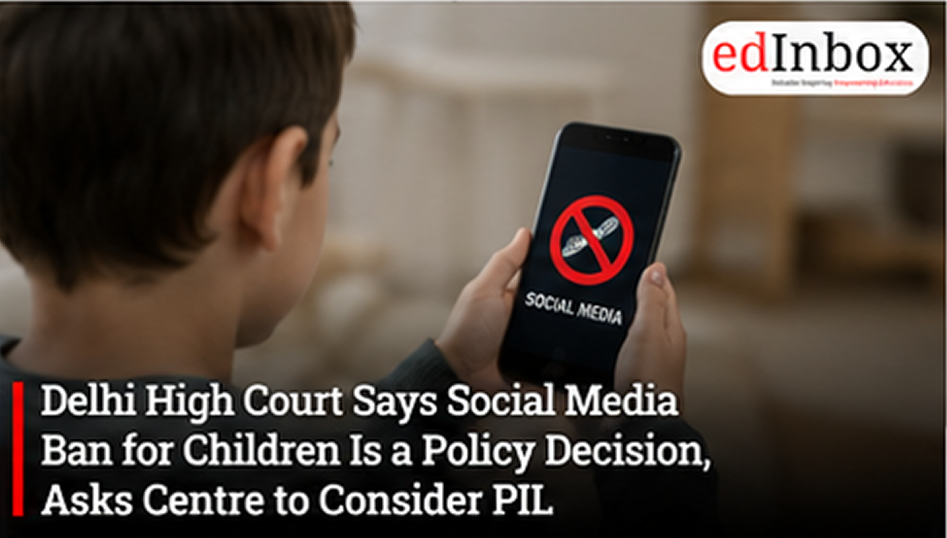
Delhi High Court Says Social Media Ban for Children Is a Policy Decision, Asks Centre to Consider PIL
Typography
- Smaller Small Medium Big Bigger
- Default Helvetica Segoe Georgia Times
- Reading Mode