
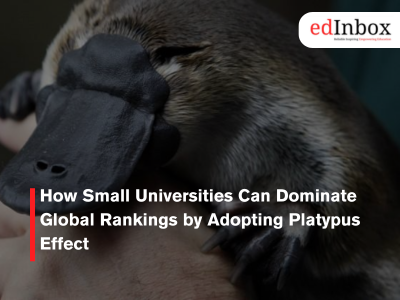
When scientists first saw a Platypus in 1799, they named it a hoax. Duck bill on a beaver body with venomous spurs? Absurd. Yet this evolutionary odd ball has survived 110 million years - through asteroid strikes and ice ages that killed giants. Secret? Perfect niche mastery. It preys when it's blind, by just using electroreceptors, swims where predators can't follow and combines reptile-mammal characteristics no one else has. That’s exactly what a small university dominating global rankings is– a Platypus.
Your small university or tier-2/tier-3 college in Lucknow, Coimbatore or Jaipur has similar skepticism. Less funding than IITs. Smaller faculty pools. No global brand. But the Platypus Effect is the proof of small wins through ruthless specialisation.
Global Rankings Don't Reward Size, They Reward These 5 Metrics
QS World University Rankings 2025 (1,500+ institutions): 40% academic reputation 20% citations per faculty 20% faculty-student ratio. Times Higher Education 2025: Teaching quality 29.5%, weight heavily on research impact. NIRF India 2025: Teaching resources (30 points), Research Productivity (30 points), Graduate outcomes (20 points).
So, how do small universities climb the rankings in the world? The truth is that all three measure current output and not historical prestige or what your university has achieved earlier. NIRF 2025 data shocked everyone because 42 Universities crashed India's top 100, mostly from ranks 51-200. A jump in score of 3.99 = 40 rank position gained. Small universities are faster when they work on focusing exactly like a platypus would usually do.
Small Universities Must Become a Platypus
We all know about Phineas and Ferbs, and you are surely aware of how their pet platypus kept being their lucky charm, right? Perry was a detective in the show who was thought to be a quiet animal but did things no one expected. That’s exactly what these creatures did in the real world!
Have you ever thought how could this species defy the law of nature and survive? Experts believed these creatures couldn’t last longer in this evolving world but Platypus Perry is a dopey looking pet that somehow outsmarts supervillains every day. Tier-2/3 colleges have Perry's agility advantage. You teach 80% of India's graduates in cities building real infrastructure and resources in defense, agriculture, manufacturing, not just Bengaluru’s IT unicorns.
UPES has climbed 250 QS positions owning energy engineering. Graphic Era University specialized in niches of hill states of tech. Madan Mohan Malaviya University (Gorakhpur) leaped NIRF bands by focused research. These aren't flukes, they're Platypus Effect Execution.
How Can a University Improve its Ranking: 5-Steps to Take
Instead of accepting your fate of being an autonomous or local university and googling things like “how small can a university be,” start acting like a platypus and gradually become Perry the Platyus defying all the perceptions of growth, and achieve global recognition. It is not an impossible task; you need to take just 5 fundamental steps:
Pick Your Driver (Niche Dominance That Crushes Giants)
Forget about copying IIT curriculums. Search "university niche specialization success" - same story everywhere. Rural university? Own agri-biotech where there is no elite to bother? Industrial city? Rule advanced manufacturing. Tier-2 tech hub? Fintech, drones, cyber security.
UPES proves the math: Target 5 publications per department annually in your niche. Launch 1-2 research centers. Citations are on balloons within 18 months, pulling all the ranking metrics up. Giants spread thin across 50 disciplines. You go deep in 3-5 where you can actually win. This isn't theory, it's how small universities actually beat others in world rankings.
Smart Global Moves (International Clout Without Millions)
QS/THE international outlook = 10% of score. You beat lumbering giants here.
How?
- Email 10 professors worldwide doing adjacent niche work
- Propose co-authored papers (they want Indian collaborators too)
- Host 2-3 funded international PhDs in your research center
- Your deal closes in 3 months. IITs take 2 years.
Result: International co-authorship metrics skyrocket across all systems
3. Faculty = Your Rocket Fuel (Research Productivity Blueprint)
NIRF data: Phd faculty share jumped 28% (2017) to 48% (2025) in climbing universities. Small unis make rockstars faster than tier 1 inherits them.
Execute:
- Biweekly journal clubs (acquaint students with research talk)
- Conference travel grants ($1K/each moves metrics)
- Writing groups + editing support (most papers die here)
- Publication bonuses (25K/paper works)
- HODs: Start by your top 3 researchers. One department's progress drives the institution.
4. Graduate Outcomes: Your Invisible Weapon
All rankings obsess over placements. Recruiters ask "Can they deliver Day 1?" not "IIT or tier-3?" Your local advantage dominates here. Map district-level hiring needs. Secure 5-10 employer pipelines for live projects and internships. Track alumni 3 years out, publish their success stories aggressively. Tier-2 placement rates hit 60-70% through relationships, boosting NIRF graduation outcomes (20 points) dramatically.
5. Data Dashboard or Die
Assign two staff to track monthly NIRF score calculators, QS citation trajectories, 3-year alumni employment rates, and international paper pipelines. Calculate your exact NIRF/QS/THE scores today. Set department targets. Conduct quarterly reviews. Cambridge University of Kashmir's 2025 plan proves this math works.
Will Local Universities Get Rankings Even If Gen Z Skips Daily College?
Ranking disregards the number of students in the classroom - they are pursuing what students attain after getting their degrees. The 20 point graduation outcomes section of NIRF addresses median salary, PHD admissions, and employer response 3 years later. The QS employer reputation surveys also place one question to the hiring managers, which is whether they would re-hire their graduates again. Halls of lectures that are empty do not enroll.
Years ago physical attendance as a measure was killed. The Choice-Based Credit System created by NAAC already includes the exposure hours in the industry, online modules, and capstone projects as equals to the classroom time. Your student of mechanical engineering in Coimbatore who spends his mornings at a local plant of TVS and afternoons writing automation systems That is all academic credit according to the 2023 rules.
There is a latent advantage to the tier-3 colleges. Students are local residents who have to commute over short distances and are employed on part-time basis by local employers. The B.Tech final-year student who was working night shifts with the district pharma unit as he studied theory online? NAAC gives those hours of practice 3 times the credits on outcome-based learning.
Reorganize Gen Z reality
Introduction of "Work-Learn Degrees" that will have students attending partner companies 60 percent of the time, and campus 40 percent of the time. Local steel mills, garment factories, automobile parts, they must have good juniors at once. One semester of actual productive line work is equal to three years of textbook knowledge on the scores of employer perception.
District-level hiring maps beat national placement cells.. The graduate of your local civil engineering school doing the bridges on the state PWD has exponentially more NIRF weight on him than an attendee at a daily meeting. VCs: recruit one placement officer that will be familiar with all the owners of the factories within 50km. Publicize alumni wages on a per company basis, rather than percentage basis. Earnings information is more reputable than attendance certificates.
Gen Z skipping routine classes hands you outcome-based ranking dominance. Everyday college was no longer possible because employers began recruiting through GitHub profiles and LinkedIn projects. Construct the system that rewards them on what they actually accomplish. Rankings are after graduate success stories and not roll call sheets.
What Deans, HODs, VCs of Local Universities Need To Do For Dominating Rankings?
HODs begin with the department meeting at 9 AM. Assign clear paper quotas by discipline - Computer Science gets five Scopus papers this year, Biotech wants to have four Q1 journals. Schedule weekly biweekly research huddles in which faculty share paper drafts and receive immediate feedback. Before lunch: One targeted email to a professor overseas who is working on related research. One department doing so generates institutional momentum. NIRF research scores jump 15-20 points if faculty are serious about it.
Deans declare money for research seed funding Monday afternoon. Launch dashboards for citations, international work and alumni placements by department. Faculty growth trumps new buildings for QS, THE and NIRF rankings. Recruiters hire graduates that deliver rather than campus architecture.
VCs dedicate 5% of the operating budget to research operations immediately. Personal one international partnership calls your position an opening door. Celebrate first publications through public assemblies and press releases. Visible ranking improvements come in 24 months through execution, not aspiration. NIRF 2025 showed 42 universities got into the top 100 through focused action.
Rankings are for doers, not dreamers. HODs create momentum. Deans are engine builders of research. VCs deliver results. Small universities move upward by acting Monday morning.
How to Apply for World Rankings (As Small/Local University) (Do This NOW)
Stop waiting for "prestige." Rankings reward action. Download QS Stars rating system (perfect for small universities) - they rate niche excellence even if you're unranked. Submit THE Impact Rankings (1,500+ small universities qualify)—your agri-tech center scores high. NIRF registration opens up in March - upload teaching metrics, research output, even starting from zero. ARWU (Shanghai Rankings) accepts research-focused submissions using publication records only.
Week 1 action: Assign two staff to calculate some existing NIRF/QS scores using the public methodology documents.
Week 2: Sign up for QS Stars + THE Impact.
Week 3: Launch niche research center 5 paper target
Small universities witness between 20 - 40 jumps in positions Year 2 when they treat rankings as operations not dreams. And universities searching "how small universities apply QS rankings," same steps are to be followed everywhere.
Your River Is Waiting, Dive-in Or Let Others Rule It
Gladwell proved that underdogs win 64% with adapted strategy. NIRF 2025's fastest climbers? Tier-2/3 universities. Nazarbayev University gained World Recognition from the same focus. 2025 saw small universities jump when they were focused. 2026 is execution time.
The Platypus Effect isn't theory. It's biology. It's rankings math. It's UPES jumping 250 QS positions. It's 42 NIRF universities are in the top 100.
Leaders googling “how small universities dominate global rankings” are seeking for hope and you are now holding the playbook. So, stop apologizing for being small or local. Rule your river. Execute without mercy. Rankings will follow!
Rankings ke piche mt bhago, kabil bano aur rankings apke piche bhagengi! (Rancho, 3 idiots)
How Small Universities Can Dominate Global Rankings by Adopting Platypus Effect
Typography
- Smaller Small Medium Big Bigger
- Default Helvetica Segoe Georgia Times
- Reading Mode