Career growth used to follow one clear route: work hard, get promoted, lead a team, move to senior roles. It's a story that Gen Z seems to rewrite. According to the recent survey conducted by global recruitment firm Robert Walters, there is a shift in preferences that many employers probably did not see coming.

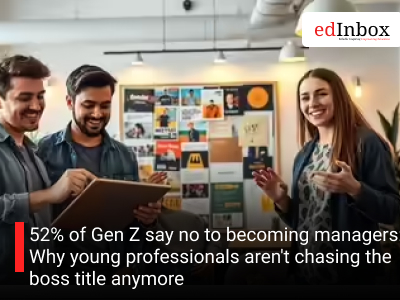
In fact, 52% of the professional members of Gen Z don't want to take up middle management positions. That brings another popularly known emerging term: conscious unbossing. It simply reflects the choice not to be a manager, not for lack of talent or hard work but because success is perceived differently.

Being the boss isn't the goal anymore.

The generation has watched as many of their older colleagues in middle management level jobs have had to put up with long hours and restructuring, along with people problems, and a great number seem to think that it's just not worth it. A survey by Robert Walters underlines the fact that 69% of the workforce from Gen Z consider middle management jobs to be high stress and low reward, which influences how they actually think about the future.

Many also prefer roles centered on their own work. The same survey points out that 72 percent of the employees in Generation Z want to grow as individual contributors; thus, they want to build skills, strengthen their expertise, and work with independence. Leading a team is not always part of the plan.

Dual career tracks are one option. This means employees can progress either as managers or as experts with no requirement to supervise others. Giving younger employees responsibility for projects early in their careers is another idea. It's not a flight from leadership but a search for leadership, which may not be about people management. What actually matters to Gen Z is influence by knowledge, creativity, and results; this is the kind of thing that benefits organizations. The future of careers is flexible. If you are planning your career, this moment offers room to think. Success may not appear the same for everyone. Some may enjoy team building and coaching. For some, deep focus on a skill might work best. You can also go ahead and ask during an interview or internship how growth is designed at the organization. Is there a route that promotes and rewards your strengths? Are you able to lead through your work independently without necessarily managing a team? In India, the typical view is that a manager title is proof that one has grown within a family or workplace. Students may find themselves needing to explain why another path suits them better. The nature of work is changing in every sector. Hybrid work, short project roles, and startup cultures all give new meanings to the idea of progress. From climbing ladders to building them. The career ladder is slowly turning into a set of choices. Gen Z is asking a simple question: "Do I need to be a boss to succeed?" The survey by Robert Walters suggests that many feel the answer is no. Organisations that can recognize this shift early will tap into new forms of leadership. Students who understand these changes can plan careers that match what they truly want. This trend does invite both sides to rethink the structure of work. The next generation is not avoiding ambition; it is choosing a different shape for it.

About the Author: 


Bio: Nibedita is an independent journalist honoured by the Government of India for her contributions to defence journalism.She has been an Accredited Defence Journalist since 2018, certified by the Ministry of Defence, Government of India.  With over 15 years of experience in print and digital media, she has extensively covered rural India, healthcare, education, and women’s issues. Her in-depth reporting has earned her an award from the Government of Goa back to back in 2018 and 2019. Nibedita’s work has been featured in leading national and international publications such as The Jerusalem Post, Down To Earth, Alt News, Sakal Times, and others

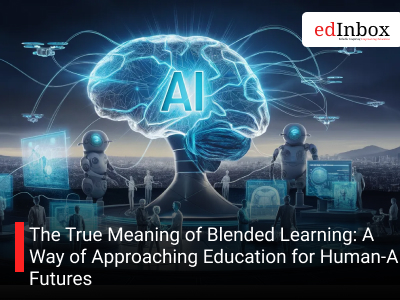
It's time to retire that worn-out debate on higher education: classroom learning versus online learning. The debate has been a race between two camps, as if education needs to declare a winner. In truth, such framing itself is outdated. Sometimes, it may be in a late-night online module, sometimes in a heated classroom discussion, and often in an offline real-world project testing the theory.

Appropriately mixed, these ingredients make for a truly flexible, engaging, deeply human learning ecology. This would replace the passivity of lectures and the isolation of online courses with an integrated experience based on trust, collaboration, and respect for the personality of the learner. In the noisy world, in which information overflows everywhere, this is not a luxury-it's survival for the mind.

The Learner Becomes the Driver

With blended learning, the power dynamic gets turned on its head. It's flipped: learn the basics online and use in-person time to create, debate, code, simulate, build, and solve.

The Mentor Evolves — Not Fades

While critics fear that technology is substituting for teachers, the reality is it liberates them. Today, teachers design learning journeys, interpret data for intervention, and facilitate deep human learning experiences impossible to be supplanted by any AI. In return, their time is dedicated to what truly matters: sparking curiosity, instilling values, guiding teams, and mentoring individuals.

The Three-Part Harmony

Blended learning works because elements of the online, on-ground, and offline reinforce one another:

Online builds knowledge - the "what" On-ground builds understanding-the "so what". Offline build application and reflection -- the "now what". This balance also protects mental wellbeing, which is acutely needed in today's post-pandemic screen-saturated world. The Next Leap: Human + AI Blended learning is the bridge to this new frontier of the human-AI partnership in education. AI will provide personalized learning pathways, AR/VR will facilitate safe and immersive practice, while wisdom, empathy, ethics, and creativity remain the distinctly human strengths which the mentors focus on. The Editorial View The universities that will thrive will not be the ones which digitalize but the ones which humanize intelligently. Blended learning, powered by technology but anchored in human connection, is the model that shapes wiser, capable, more empathetic citizens. The question for the institutions is no longer "Should we blend?" It's: Will we have the courage to redesign, rebalance, and rehumanize learning for the world that is rapidly approaching?

Discipline

Core Blended Strategy

Key Advantage

Illustrative Application

Emerging Tech

 Flipped Classroom + Virtual  Labs

 Safe, scalable skill   practice

 Learn AI theory via MOOCs; apply it in   collaborative  on-campus hackathons.

Management

Asynchronous Modules +  Simulations

 Real-world decision-m  aking

 Study business frameworks online; compete in live   virtual business games.

Wellness

 Online Theory + Mentored   Practicum

 Balancing knowledge  and empathy

 Learn behavior change psychology online; practice   coaching skills in live, evaluated sessions.

Design

 Digital Toolkits + Studio   Critiques

 Global collaboration &   tactile creation

 Learn software via online tutorials; engage in   intensive, in-person prototyping and critiques.

Sustainability

 Virtual Field Trips +   Community Projects

 Bridging global data  with local action

 Analyze global climate data online; design and   implement a local water conservation project.

Media & Comms

 Online Content Analysis +   Production Workshops

 Integrating theory and   craft

 Analyze narrative structures in online case studies;   produce a multimedia news package in a studio.

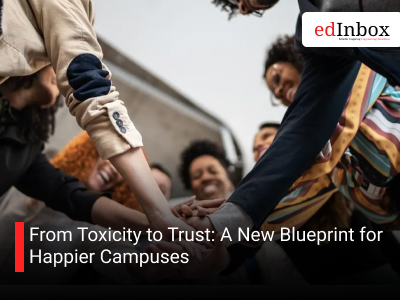
Consider a young PhD scholar hunched over her bench in an Indian university laboratory late into the night. She is a first-generation learner and one of the brightest minds on campus. Yet, her day was defined not by research breakthroughs but by the public humiliation meted out by a supervisor-ideas dismissed, confidence eroded. In her inbox lies an offer from a European university: better funding, yes, but more importantly, a culture of respect, mentorship, and intellectual freedom. She is ready to leave-not for money but for dignity.

Her story is not an exception but a mirror to Indian academia.

We see a slow-burn crisis: casual caste and regional slurs brushed off as "jokes," closed-door decisions benefiting favourites, and ad-hoc rulemaking that shifts with power centres. Instead of curiosity, fear; instead of initiative, compliance. It is devastatingly unfortunate. Between 60,000–75,000 highly trained graduates—including IIT engineers and specialised researchers—leave India every year, draining $35–50 billion worth of talent and public investment annually. Even within the system, attrition is high, with the same individuals rotating in leadership roles to maintain the same insular circle.

This is not an accident; this is engineered through campus culture. And culture is a leadership choice.

It is now time for India to reverse this trajectory by turning away from punitive, hierarchical models of leadership and embracing Positive Leadership: a research-led, values-driven approach that creates "heliotropic campuses"-institutions that attract and retain talent the way a sunflower instinctively turns toward the sun.

The Shadow Campus: Understanding the Roots of Toxicity

Toxicity on campus is not an act; it's a system. It has an architecture that can be mapped across five dimensions:

Structural toxicity means lack of clear SOPs on admissions, hiring, grants or grievances that allows arbitrariness and favouritism.

Behavioral toxicity: micro-aggressions, public shaming, 'gotcha' emails, and unprofessional WhatsApp groups which humiliate rather than guide.

Incentive Toxicity: Rewarding loyalty to authority and not integrity or ingenuity. Neglecting mentorship and community-building work.

Process Toxicity: Paperwork for grievance mechanisms, delayed redressal, and informal punishment for speaking up.

Information Toxicity: Hoarding, rumour-driven communication, and opacity that breeds mistrust and silence.

Both these patterns emerge from the dominator culture that starts with student ragging and goes right up to senior academic bullying-two faces of the same disease: un-contained power. The worst brunt of this is suffered by marginalized students, particularly those from SC, ST, and OBC communities that face subtle and overt discrimination masquerading as meritocratic evaluation.

The most tragic consequence is the loss of future mentors. Those who leave-ethical, globally exposed scholars-are the very people who could have transformed Indian academia. And their absence creates leadership vacuums filled by people who run and support the toxic system. India is losing not just talent but reformers.

The Turn Toward the Sun: The Case for Positive Leadership

Positive Leadership represents a shift in focus-from faultfinding to strength-building, from fear-based compliance to purpose-driven excellence. Rooted in behavioral science, it is inspired by the heliotropic effect: the inborn tendency of living systems to move toward sources of nourishment and away from harm.

Positive leaders make a conscious effort to gratify the three basic psychological needs that undergird motivation: autonomy, competence, and belonging. This approach rests on four pillars:

Positive Climate: There is a culture of compassion, gratitude, and forgiveness; failing is an opportunity to learn.

Positive Relationships: High-trust networks across hierarchy that foster collaboration over competition.

Positive Communication – Public appreciation, private correction, transparent dialogue.

Positive meaning: daily activities linked to a higher purpose that inspires excellence beyond the job description.

From Day One to Year One: A Blueprint for Change

Change doesn't have to be about massive budgets; it needs committed leadership and small, continuous actions:

Immediate Actions (First 30 Days): Stop the Harm

Acknowledge past issues openly.

Ensure safe and confidential reporting channels.

Freeze discretionary decision-making. Require written justification.

Start every meeting with genuine appreciation.

Day 31–90: Embed Equity in Systems

  • Publish transparent SOPs on hiring, appraisal, grants, and grievances.
  • Replace annual performance "judgments" with coaching-based growth plans.
  • Introduce mentor pairs for junior faculty in order to avoid supervisory misuse.

Day 91–180: Default to Positivity

  • Establish a common mission statement to which the team goals are aligned.
  • Measure psychological safety: publish results and actions.
  • Recognize invisible emotional and community labor.

6–12 Months: Ensure Change Outlives the Leader

  • Track early-warning culture indicators publicly.

Commission third-party culture audits annually. Create "belonging moats" of opportunities for growth, sabbaticals, micro-grants, and gratitude rituals. Conclusion: India needs to be a sun and not a sieve. India is at an inflection point. Will its institutions remain sieves, filtering talent to enrich other countries? Or will they be suns, spreading safety, dignity, and intellectual joy? Positive Leadership is not a soft ideal; it is a strategic national imperative. It is cost-effective, human-centred, and innovation-led. Cultures change not by memo but through rituals, systems, and everyday choices that privilege respect over fear. A campus becomes a sun the day its leaders choose fairness over favour, coaching over criticism, and purpose over power. It all begins with one act: choose trust.

Some resources for self-reading:

The 7 Habits of Highly Effective People by Stephen R. Covey: A classic on personal and professional effectiveness that is fundamental for good leadership.

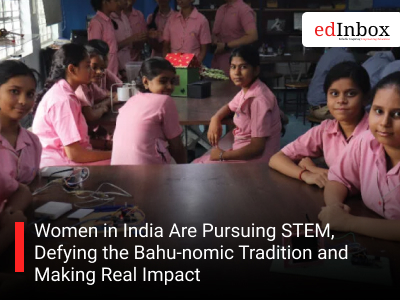
Indian women are creating a new history about science, technology, engineering, and mathematics (STEM), silently yet boldly breaking Bahu-nomic culture which is a social and cultural construct that historically defined women as creatures who are primarily at home, are married, have babies and do every labour for the family rather than pursue careers and independence. Today, Indian women are shattering these barriers and actually making a difference in the areas that were considered male-dominat, especially in advanced spheres such as artificial intelligence (AI).

The "Bahu-nomic Tradition": A Modern Demand 

The term Bahu-nomic is derived by combining the word Bahu (daughter-in-law) and economic. This is a new trending word used on social media by people who value the efforts of an unpaid househelp (married woman). Most Indian families believed that the ambitions of women other than housework came second. Early marriage, homemaking and subordination were greatly valued by the cultural norms and education was mostly restricted to that which could be regarded as fitting a housewife or educator. As society evolved, the demands increased. Women are now asked to earn as well as take care of the family. Once when women were only bothered for dowry has now transformed into being bullied and forced to manage kids, office, and house, and also split the expenses like electricity bill, EMIs, etc. 

India surely changed its behaviour towards women after invaders did their best to promote their culture and beliefs. This deeply ingrained social structure influenced the society, producing a palpable gap in female education and employment, particularly in elite and male-dominated professions like engineering or technology. Women in science, technology, and engineering were exceptional cases, and those who were able to venture into these areas were not received with trust, were looked down upon, and were not supported by the institutions.

Changing Tides: Women seeking STEM in India

Today, the whole scenario is changing fast. India now boasts one of the highest percentages of women STEM graduates globally which is approximately 43% according to the latest surveys. This is a great turn around of a nation that used to be miles behind. The girls of all social and economic backgrounds including rural and semi-urban are now taking up science and mathematics streams in schools with government programs, scholarships and a new attitude towards parents. 

Even after this progress, there is a paradox that is critical. It is only 27% of these graduates who are able to work in STEM industries. This is because of work prejudices in the workplace, pressures in the society concerning marriage and child care, rigid work settings, which fail to support women with their special needs, and the Bahu-nomic thinking that demands women to earn as well as take care of home! The other problems aren’t as concerning as the last one due to the fact that women are Shakti, the creator, who doesn’t complain instead creates a way for herself. Someone said it correctly, the giver is always exploited. However, these barriers are being overcome by the sheer force of will of numerous women, who are making their career in AI, robotics, biotechnology, and other high-tech STEM industries. 

Women in Artificial Intelligence and New Technologies

The technological future of India is artificial intelligence, which is the epitome of the modern era of innovation. The AI industry was traditionally dominated by males, nowadays women are proliferating in top positions, inventing disruptive algorithms, and startups that solve societal issues are being launched.

In India, the women AI practitioners are building solutions that go beyond healthcare diagnosing to language translation, providing work opportunities, and helping the world as a whole to develop technologically. They are not symbolic but substantive, influencing the discussion of AI ethics and AI policy with a lens that is, in most cases, an expression of inclusiveness and  empathy.

Consciously developed educational programs on AI, machine learning, data science, and related areas have been developed to ensure that more women enrol and this has been achieved through the involvement of universities, industry leaders, and the government. These are attempts to close the leaky pipeline -the expression of the loss of women over time through STEM education to work.

Breaking the Leaky Pipeline: Organizational and Social Action.

In addition to personal determination, it is necessary to solve the gender gap in STEM on a system level. Gender friendly policies are being adopted by institutions: flexible work schedules, better maternity leave, a harassment-free environment and safe workplace, and mentorship programs that are specifically designed to suit women.

Stereotypes that present the division between women and men work are being demolished at the community level. The reforms in education have brought on concrete, investigative based STEM learning in education that has involved girls in equal measure as boys. Inclusive STEM skills are developed in government schemes such as Atal Innovation Mission and Rashtriya Avishkar Abhiyan

The Greater Effect: Women Bucking the Conventional Story.

The emergence of female scientists in STEM is a social uprising that questions the principles of the Bahu-nomic tradition, re-defining womanhood as a state of intellect, independence and professional ambition. Such women are role models to their communities where they motivate families to equally appreciate education and where they motivate girls to dream of a life beyond the normal duties.

These women are changing policy and culture as they rise the ladder in leadership, pushing the agenda of greater gender equality. Their achievements draw attention to the economic and social advantages of diversity - more innovative and more efficient in finding solutions and growing more inclusive.

Women Beyond STEM 

Indian women across diverse fields are also breaking free from the Bahu-nomic tradition that confines them to unpaid domestic labor and undervalued work. Traditionally, much of women’s contributions inside households like cooking, cleaning, caregiving, have remained invisible and uncompensated, perpetuating economic and social dependency. Today, women are gaining greater economic and social control by penetrating formal working environments, business start-ups and top management positions, requiring acknowledgement and suitable payment..

This shift not only challenges deep-rooted stereotypes but also redefines the value of women’s labor in society. By balancing both paid careers and household responsibilities, women are disrupting centuries-old norms of unpaid labor, creating a ripple effect that moves toward equitable gender roles at home and in the economy.

Moving from Bahu-Nomic to Bias-Phobic Society 

India is at a critical point of becoming gender equal in the STEM sectors. Although many pockets of society continue to be influenced by societal norms with their basis in Bahu-nomic traditions, the wave of women becoming scientists, engineers, engineers, and mathematicians gives hope and promise. Not only are they swamping classrooms or laboratories but they are literally carving out the technological future of India proving that talent is not limited to gender or tradition overcomes tradition.

With this change evident to educators, policymakers, students, and society overall it is obvious that women empowerment in STEM is not just an issue of equality but a strategic requirement to the development of India in the 21st century. 

As more women rise, inspire, and lead, the ripple effect will continue to break old norms & boundations, and build a future where every woman can dream big and achieve even bigger. 

What do you think? Share your thoughts in the form of a blog and get a chance to be featured on our site.

About the Author


Kanishka, a versatile content writer and acclaimed poetess from Jabalpur, Madhya Pradesh, combines her passion for creativity with a strong commitment to education. Beyond crafting compelling narratives, she is dedicated to enlightening readers by sharing insights and knowledge they often don’t encounter elsewhere. She has been featured in several national and international online magazines, and anthologies. Her talent and dedication to literature have earned her two national records— one for composing the longest reverse poem and another for compiling an all-female anthology that celebrates women’s voices. Her love for storytelling, philosophies, and mythologies fuels her mission to inspire and educate, shaping minds through the power of words and knowledge.


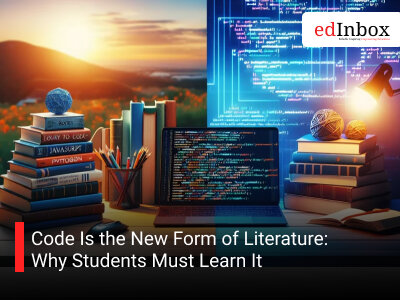
Literacy in the 21st century is beyond reading and writing. Code, the secretive programming that is in charge of everything from mobile applications to Mars rovers, has silently assumed the role of this new literacy. In order to navigate and shape the digital world, students and teachers must learn to think in code, rather than simply consume technology. 

The focus of coding is not only to make one a software engineer. It educates on managing problems, expressing ideas and thinking logically in a world that is data-driven. Nautaro (2018) once quoted a saying by author and investor, Naval Ravikant, who said, Coding is the new literacy. Individuals who read and write using this logical language will define what is to come and what is about to happen.

The New Literacy of Digital Era 

Earlier, civilizations and societies were able to share stories and build their societies using written languages in the form of poetry, novel, novella, songs,  etc. In the modern world, the purpose of code is the same, allowing ideas to become digitalized. Across industries, coding is directly shaping art, science, finance, and even politics. For instance, AI editing tools are used by filmmakers, Python scripts are used in the analysis of DNA by biologists, and the creation of interactive online lessons is done by a teacher, all with the help of code (directly or indirectly).

Code learning is not just a way to know how computers work, but it also provides an understanding of how thought processes work. Coding demands accuracy, patience and ingenuity, which is crucial in contemporary learning. When students debug a simple program, they are exposed to a training of logic and persistence to learn to keep repeating until they detect solutions.

Coding Is an Art of Expression

Code seems to most people to be mechanical, even cold. However, the reality is that coding is also one more storytelling. Poets, as much as they reuse words to create emotions, are programmers who are arranging logic to make ideas come to life be it in the form of game, application, or even artificial intelligence. One of MIT professors, Mitchel Resnick, a founder of Scratch, goes on to explain that coding is not only about solving problems, but also about expressing yourself and making things that matter to you.

The student who creates a mobile app on clean water awareness is not any less an artist than the novelist or painter. They are narrating a story with a code change digitally.

Why Students and Teachers should Learn to Code

Coding fluency is emerging as an important issue as language fluency. According to the reports by the World Economic Forum, by the year 2030, 85 percent of the jobs of the future will need to be digital, and many will necessitate at least some rudimentary skill in either programming or some kind of computational thinking. However, the vast majority of students leave without having any coding experience.

It is time schools redefined the meaning of being literate. In the same way that reading and writing were breaking minds in the Industrial Era, coding can unleash power in students of the ⁙ AI revolution. Coding is already being made a main subject at the primary levels by governments such as the UK, Singapore, and even Rwanda. This change was also appreciated in the National Education Policy (NEP 2020) of India- the policy promoted the development of computational thinking at the earliest level.

To the educators, the adoption of coding does not imply that one should drop the old subjects, but enhance them. Algorithms make Math interactive. Data visualization makes history interesting. Even art is developing with digital design. A teacher who teaches students to code learns together with the students forming a strong classroom of creators rather than consumers.

The Human Code Behind the Machine

Still, coding education isn’t only about writing syntax, it’s about ethics, empathy, and inclusion. As AI systems increasingly influence decisions in hiring, law, and healthcare, understanding how algorithms work becomes a civic duty. If literacy once helped societies hold governments accountable, coding literacy helps us hold algorithms accountable.

By teaching students to code responsibly, we teach them to question how technology shapes our values, privacy, and fairness. That’s the essence of modern civic literacy.

Coding Is the Literacy of Empowerment

In the end, the ability to code is less about machines and more about empowerment. It enables students to bridge imagination and impact, to turn “What if?” into “I built this!” The democratization of coding tools means anyone, from rural India to Silicon Valley, can now create a digital footprint. That is revolutionary.

So, as we enter the era of AI, we should redefine the role of education: not only to teach students to use technology but how to create it. Remember the time when words and literature  changed the world? Now, code will! 

What do you think about it? Share your thoughts in the form of a blog and get a chance to be featured on our site.

About the Author:


Kanishka, a versatile content writer and acclaimed poetess from Jabalpur, Madhya Pradesh, combines her passion for creativity with a strong commitment to education. Beyond crafting compelling narratives, she is dedicated to enlightening readers by sharing insights and knowledge they often don’t encounter elsewhere. She has been featured in several national and international online magazines, and anthologies. Her talent and dedication to literature have earned her two national records— one for composing the longest reverse poem and another for compiling an all-female anthology that celebrates women’s voices. Her love for storytelling, philosophies, and mythologies fuels her mission to inspire and educate, shaping minds through the power of words and knowledge.


For decades, universities—particularly in the Global South—have been locked in a race that’s less about learning and more about labels. The chase for “world-class” status, dictated by Western ranking systems, has turned education into a numbers game. Citations, faculty–student ratios, and international visibility have become the currency of prestige. But what happens when the pursuit of prestige eclipses the purpose of education itself?

Enter Comprehensive Excellence—a transformative framework that promises to restore education’s lost soul. Conceived within the 10Square Model, it rejects the tyranny of metrics and replaces it with a philosophy that values people over parameters, and purpose over performance.

Redefining the Meaning of ‘Excellence’

Comprehensive Excellence doesn’t just stretch the definition of success—it rewrites it entirely. It envisions universities as ecosystems that cultivate intellect, empathy, resilience, and innovation across ten interconnected dimensions—from ethical leadership and emotional intelligence to social engagement and lifelong learning.

Unlike conventional models borrowed wholesale from the West, this approach is rooted in local realities. It acknowledges that the Global South doesn’t need to mimic Ivy Leagues to matter—it needs to humanize its own learning systems.

Dimension

Focus

Intellectual Rigor

 Academic excellence and critical thinking

Ethical Leadership

 Empathy, values, and responsibility

Practical Wisdom

 Application of learning to real-world challenges

Emotional Intelligence

 Resilience, teamwork, and self-awareness

Social Engagement

 Commitment to sustainability and citizenship

Innovation

 Problem-solving and creativity

Wellness

 Mental, physical, and emotional health

Employability

 Career readiness and entrepreneurial mindset

Cultural Literacy

 Global awareness and contextual   understanding

Lifelong Learning

 Adaptability and curiosity

This model moves beyond traditional liberal arts education—it localizes holistic learning for the Global South, making it a strategy for national development and human capital growth.

The Tyranny of Rankings

Global rankings like QS and Times Higher Education measure what’s easy to quantify, not what’s essential. Teaching quality, mental health, community engagement—none of these find space in their glossy charts. In chasing rank, institutions often forget their role as agents of transformation. They become factories of credentials, not catalysts of change.

Current global ranking systems like QS and Times Higher Education measure what is easy to count—not what truly counts. They reward privilege and prestige over purpose and inclusion.

Ranking Metric

Focus Area

Ignored Dimension

Citations per Faculty

 Research intensity

 Teaching quality

International Faculty/Students

 Global visibility

 Local relevance

Academic Reputation

 Historical prestige

 Innovation, social   impact

Faculty–Student Ratio

 Quantitative   measure

 Mentorship, engagement

These frameworks incentivize imitation, not innovation. They push Global South universities to chase superficial indicators instead of investing in teacher training, mental health, or community linkages—creating institutions that may look excellent but fail to transform lives.

The Post-Pandemic Imperative

The pandemic only deepened this realization. Universities that prioritized well-being and adaptability survived. Those that didn’t, didn’t. Resilience—not ranking—emerged as the true marker of excellence.

Who Will Lead the Revolution?

Transformation must be led by visionaries who see education not as administration but as a living organism.

  • University leaders must abandon compliance culture for trust-based leadership.
  • Faculty must evolve into mentors and innovators, not mere content deliverers.
  • Students should be treated as co-creators, exploring passions through projects like Organic Learning.
  • Industry and community partners must bridge classrooms and real-world laboratories.
  • Comprehensive Excellence is not an abstraction—it’s already transforming institutions worldwide.

Region/Institution

Key Practice

Outcome

National University of Singapore (NUS)

 NUSOne holistic framework integrating wellness and   experiential learning

 Cross-disciplinary empathy   and resilience

Ateneo de Manila University, Philippines

 Integrated Formation Program

 Ethics and service embedded     in curricula

IIT Bombay, India

 Centre for Liberal Education (LASE)

 Humanizing STEM education

Ashesi University, Ghana

 Ethical entrepreneurship & leadership curriculum

 95% graduate employability

Tec de Monterrey, Mexico

 Challenge-based Tec21 model

 Skill-based education for   innovation

University of Cape Town, South Africa

 Humanising Student Life initiative

 Holistic student success

These examples show that Comprehensive Excellence is not utopian—it is proven, scalable, and globally relevant.

From Idea to Implementation

The 10Square Model doesn’t stop at philosophy—it lays out a practical roadmap: learner-centric curricula, experiential learning, competency-based assessments, and a Dual Transcript System that values both academic and holistic growth.

The model even proposes a Balanced Institutional Scorecard—a new compass for governance that measures not vanity metrics but value metrics: student satisfaction, employability, innovation, and social contribution.

How Can Universities Implement It?

Transformation demands systemic change across curriculum, assessment, and governance. The 10Square Model provides a roadmap through five pillars of reform:

1. Learner-Centric Curriculum

Integration replaces silos through Major–Minor systems and core courses in:

  • Design Thinking
  • AI & Data Fundamentals
  • Financial & Legal Literacy
  • Human Rights & Sustainability

2. Experiential Learning

Mandatory internships, field projects, and research form the backbone of learning—turning graduates into thinkers who can do and doers who can think.

3. Organic Learning: Passion with Purpose

A year-long independent project allows students to pursue their passion under mentorship—building specialized portfolios and reducing the “brain drain” from developing nations.

4. Multi-Assessment Strategy

Evaluation shifts from rote exams to competency-based multi-stage assessment:

Stage

Purpose

Tools

Diagnostic

 Baseline understanding

 Quizzes, surveys

Formative

 Continuous   improvement

 Debates, case   studies

Summative

 Mastery demonstration

 Capstones,     portfolios

This inclusive approach recognizes diverse talents and reduces inequities of standardized testing.

5. The Comprehensive Excellence Scorecard

To quantify holistic growth, the model introduces a weighted scorecard:

Component

 Weightage (%)

Academics

 50

Leadership & Teamwork

 10

Research & Library

 10

Organic Learning Projects

 10

Employability & Digital Skills

 10

Social Work

 5

Sports & Health

 5

Total

 100

This feeds into a Dual Transcript System—one academic, one holistic—ensuring both cultural acceptance and global recognition.

Overcoming the Old Order

Reform is never easy. The biggest barriers—resources, cultural inertia, and faculty resistance—can’t be wished away. But the model offers evolutionary, not revolutionary, reform. It suggests low-cost, high-impact solutions, from blended learning to peer mentoring. Most crucially, it redefines merit: faculty promotions that reward mentorship and interdisciplinarity alongside research.

The Paradigm Ahead

At its core, Comprehensive Excellence is not just a framework—it’s a movement. One that unfolds across four levels: shaping ethical individuals, nurturing innovative institutions, driving national growth, and redefining global benchmarks.

Comprehensive Excellence is not a reform—it’s a movement that unfolds across four concentric circles:

Level

Transformation

Individual

 Learners develop ethical, cognitive, and emotional balance

Institutional

 Universities become ecosystems of innovation

National

 Education drives equitable, sustainable growth

Global

 The Global South redefines excellence on its own terms

This evolving cycle ensures that holistic learning → engaged alumni → institutional growth → national development → learner empowerment continues perpetually.

Long-Term Paradigmatic Shift

Old Paradigm

New Paradigm: Comprehensive Excellence

Knowledge Transmission

  Knowledge Creation & Application

Siloed Disciplines

 Interdisciplinary Problem-Solving

Degree as Destination

 Lifelong Learning Journey

Grades & Rankings

 Growth & Purpose

Elitism

 Inclusion & Empowerment

Comprehensive Excellence transforms education from transactional to transformational, renewing the social contract between universities and society.

In this vision, education is no longer transactional; it is transformational. It shifts focus from grades to growth, silos to synthesis, and elitism to empowerment.

A Humanistic Renaissance

Comprehensive Excellence isn’t anti-modern—it’s post-modern. It’s the next great leap for higher education systems seeking balance between intellect and integrity, innovation and inclusion.

If adopted widely, it could herald a Humanistic Renaissance—a renewal of purpose in universities where success is no longer measured by rank but by relevance.

The real question for policymakers and educators is not if this paradigm will take hold, but when. Because in the decades ahead, the institutions that survive will not be the most ranked—but the most human.

When the career paths were charted, print journalists wrote the country's first draft of history, broadcasters brought the globe into homes, and advertising creatives shaped culture through jingles, there was a time. Now, those so-safely trodden ways are disappearing fast. The media industry, once a mirror of power and stability, stands on shaky ground. Digital disruption, Artificial Intelligence, declining public trust, and crumbling business models have turned the profession on its head. And most media education in India still looks eerily the same as it did two decades ago.

The truth is painful but inevitable — Indian media education is out of date, disjointed, and perilously out of touch with reality. Unless colleges carry on using outdated textbooks and serial models of communication, they will be sending out young graduates unprepared for an industry already operating on data, algorithms, and crisis of credibility. The times require a new type of media professional: one who is flexible, moral, multi-tasking, and technologically skilled.

Then comes unlearning. The previous system was for the era when newspapers were the sole thing and Doordarshan dictated the national agenda. Advertising during that time meant full-page advertisements, and public relations meant faxed press releases. The course was tuned to that static reality — in tidy boxes of "Print Journalism," "Radio Production," or "Television Editing."

But that siloed paradigm doesn't exist anymore. News gets released first on X (formerly Twitter), gets amplified through rapid videos on Instagram, and analyzed on podcasts or YouTube in hours. Audiences no longer sit back to watch — they participate, ask, and create. But yet, our students are being taught to work for yesterday's newsroom, not the digital environment of tomorrow.

A 2025 course titled Print Media-I is not just old-fashioned; it's deceptive. It prepares students for a diminishing world, one in which print incomes have fallen off a cliff and linear television commercials have reached their peak. In its 2024 report, FICCI-EY had said digital media incomes overtook TV for the first time at INR 802 billion. That transformation isn't merely financial; it's societal. It is the beginning of a new order of information wherein attention of the audience, and not airtime, becomes the benchmark of worth.

To go on teaching print-focused curricula is to mislead young ambitions to acquire skills for a labor market that no longer exists — or exists in much smaller numbers. Universities need to see that the economy of the media has shifted online and with it the meaning of narrative, of promotion, and of credibility itself.

Artificial Intelligence hasn't merely automated the tasks — it's disrupted the value proposition of skills in every news desk and communications agency. AI can now produce first-cut drafts of reports, edit out video, create ad campaigns, and even monitor audience behavior patterns in real time. What it can't do, though, is replace human judgment — the skill to balance ethics, subtlety, and compassion.

It is exactly here that future media professionals need to carve their niche — not as replacement machines but as complements. Rather than teaching students how to carry out mechanical functions such as writing copy or building press lists, media schools should equip them to be strategists, analysts, and ethical decision-makers.

AI literacy needs to be as basic as language literacy. Not just how to operate AI tools but how to audit them — how to recognize bias, check facts, and run it through ethical filters. Technology-enabling journalism must remain grounded in human conscience. Tomorrow's newsroom will require editors who can navigate AI workflows and yet ask the most human question of all: "Is this true?"

The Crisis of Credibility

The issue isn't technological — it's ethical. Along the way, Indian media sacrificed most of its ethics. Clicks have become more significant than searching for the truth, and sensationalism has triumphed over content. It's not a crisis of reputation — it's a crisis of existence.

Audiences today are educated and jaded. They view vast amounts of content but trust little of it. That disillusion is why even the most popular online media struggle to monetize traffic with paid subscriptions. People simply will not pay for anything they do not believe.

For teachers of media, what this implies is that ethics cannot be anymore an option paper in the third semester. It has to be built as the foundation of the curriculum. Verification, transparency, and accountability have to be taught not as ethical values but as survival skills.

Future journalists will have to learn how to authenticate online evidence, detect deepfakes, and verify sources with forensic accuracy. Fact-checking and good AI policy have to be built into every assignment, every production pipeline, and every classroom conversation. Because without trustworthiness, no technology and design magic can salvage journalism.

The Acceleration Gap

As the industry grows at a breakneck pace, academia lags. The "acceleration gap" between education and the imperative has rendered thousands of graduates jobless. The India Skills Report 2024 was a chilling wake-up call: less than half of the young job seekers have skills that match prevailing market requirements.

In education for the media, this conflict is even more compelling. Colleges prefer memorization to creativity. Students are able to recite communication theory but are unable to create a digital campaign or decipher analytics dashboards. They are able to analyze 1980s-style newsroom ethics but are stumped when it comes to moderating disinformation on social media.

In order to fill the gap, Project-Based Learning (PBL) will have to displace rote learning. There should be less class time spent listening to lectures and more spent building — operating live campaigns, creating podcasts, authoring news apps, or starting up micro-media ventures. Experience of the world in the form of structured, credit-bearing industry projects must become the rule, not the exception.

Additionally, Industry-University Collaboration (IUC) needs to be institutional, not accidental. Media companies, start-ups, and communication firms' experts need to co-design and co-teach classes. Universities need to cease perceiving the industry as unknowns and convert them into co-creators of learning.

The New Media Professional: T-Shaped and Human-Centered

The future belongs to T-shaped professionals — broad, cross-platform skills (the horizontal bar of the T) and deep knowledge of a single or double specialty (the vertical stem). A student of the media must not only understand how to write or shoot but how to read audience measurement, how to optimize digital distribution, and how to build revenue models.

This emergent professional identity requires a radical transformation of media curricula. Silos of the past — Print, Radio, TV, Advertising, PR — need to be replaced by interlinked courses in Convergence, Digital Monetization, and Strategic Communication. Undergraduate education needs to stress storytelling across platforms — text, video, podcast, data visualization — and connect every creative exercise with its business result.

Postgraduate specialization needs to extend deeper into computational journalism, strategic media entrepreneurship, and AI-enabled communication. Graduates should graduate not as job seekers but as innovators who can create their own media enterprises.

And as technology becomes more adept at handling mundane work, the uniquely human capabilities — empathy, critical thinking, creativity, and moral judgment — are the true differentiators. Media literacy should focus on these H-skills, which teach students to think critically, hear with heart, and make well-informed decisions.

Reinventing the Classroom

That change won't happen by tweaking trivial courses or rebranded electives. We must transform how we teach. Classrooms must become newsrooms, studios, and incubators. Evaluation must be based on impact and creativity, not theoretical memorization.

Instructor training is imperative. Teachers have been trained in the pre-digital age and have not been retrained to educate students on AI, analytics, or cross-platform content creation. Compulsory continuous professional development (CPD) is a requirement. Teachers are not only required to teach but should mentor and work together with students on real projects.

Infrastructure must also be revitalized. The availability of broadband internet connectivity, production software, and data visualization packages is the bare minimum facilities, not the luxury of a few select institutions. Both the government and the private sector can play an important role in making such availability feasible.

Building a Sustainable Future

The new media landscape is risky but a rich one. With declining traditional ad revenue, the business has had to innovate with new models — membership programs, crowdfunding, native advertising, and individuals engaging. Media studies need to teach students about the economics of the new systems.

The students must be taught how to think entrepreneurially and locate market niches, and construct sustainable media products around them. Teaching in audience economics, content monetization, and startups can no longer be voluntary; it is a survival skill.

Most importantly, the curriculum needs to foster ethical entrepreneurship — creating spaces that prioritize truth, inclusion, and public dialogue over salaciousness. Because the future of media will not only be about who arrives first, but who arrives with a conscience.

From Instruction to Incubation

India's media teachers have a bleak option: adapt or perish. The NEP 2020 provides a policy rationale for interdisciplinarity and flexibility — but needs to be supported by more than paperwork.

Media schools need to shift from being teaching colleges to innovation incubators. They need to gear students towards a global landscape where the half-life of skills is not more than five years and lifelong learning is the only perennial.

If done properly, this reform has the potential to produce a new generation of communicators who are both technically competent and ethical — storytellers who can work alongside AI tools without sacrificing the human touch, brand builders who can establish brands without sacrificing truth, and journalists who restore the people's trust where they have lost it.

Indian media education stands poised on the edge of being remade. The question today is not whether it should be altered — but whether it can alter swiftly enough. The future of the craft, and indeed the health of our democracy, very well may hang in the balance of how we respond to that query.

More Articles ...