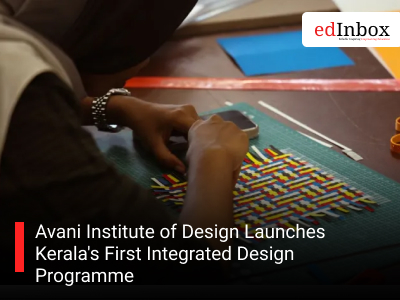
Avani Institute of Design inaugurated Kerala's first integrated design programme — a five-year dual degree course that combines B.Des and M.Des. The programme is a landmark as the institute is completing a decade of academic achievement.
Integrated Design Program has multiple points of entry and exit as per the National Education Policy (NEP). The students can graduate with a Bachelor's degree within four years or go on to obtain a Master's degree in five years and thus offer flexibility at the cost of depth.
Product Design and Interior Design specializations balance broad learning with specialized, advanced industry-specific skills and foundational learning and prepare students to meet India's design industry's shifting requirements.
"The education in design today must go beyond the conventional limits," asserted Tony Joseph, Chairman and Principal of Avani Institute of Design. "This program demonstrates the way Avani believes that design is not so much about creating things or buildings, but about affecting ideas and solutions that can assist in changing a positive impact on society."
As a not-for-profit institution of higher learning, Avani has defined itself as more than a campus. Its NEP-mapped and world-charged curriculum combines architecture and design with liberal arts, philosophy, culture, and technology.
Faculty note that the curriculum is designed such that it produces socially responsible designers, merging multidisciplinary learning with a value system that promotes community, culture, way of life, and economy. Balance between theory and practice, merging liberal studies, technology, and socio-cultural studies, the graduates become confident and possessing the skill set to succeed in rapidly changing industries.
Avani reiterates its dedication to the development of design leaders who are adept at creativity, critical thinking, and application in this revolutionary program in designing solutions that will matter tomorrow.
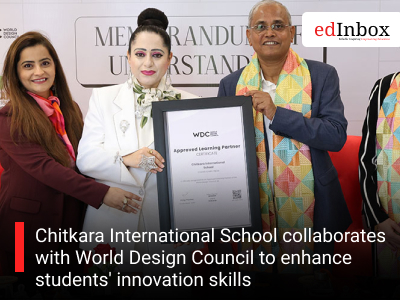
Through such an alliance, CIS becomes an official learning partner of the WDC, signaling a new era of learning design in North India.
The MoU was executed by the top-level management such as Philip Thomas, India country head, WDC, and Vanessa Meister, senior fellow, WDC. It reaffirmed the manner in which the leadership for creativity and design would be needed to redefine the future of education.
With this partnership, CIS will be able to reform its education curriculum through the incorporation of the Future Creative Minds Programme—a holistic, global skilling program created by WDC. The program will aim to impart to the students the most critical skills such as design thinking, innovation, problem-solving, data analysis, AI literacy, sustainable behaviors, communication, and ethics.
The area of specialization is in enhancing the CBSE curriculum, and the program also consists of higher-level modules of studies, faculty seminars, and experiential workshops. The students will also receive exposure to international forums, thereby making them familiar with the international world and allowing them to expose their creative skills.
Niyati Chitkara, school education vice-president, said, "This alliance once again demonstrates our vision of graduating students with transformational skills to succeed in an accelerating, fast-changing world economy. As a WDC-accredited learning partner, we look forward to preparing our students to be innovative problem-solvers, innovators, and world-changing makers."
"For students, the program will enrich their portfolios for greater opportunities in post-secondary education, scholarships, and other career opportunities. The collaboration also promotes interdisciplinary thinking, utilizing science, technology, arts, and society, and increased real-world readiness and creativity," she further explained.
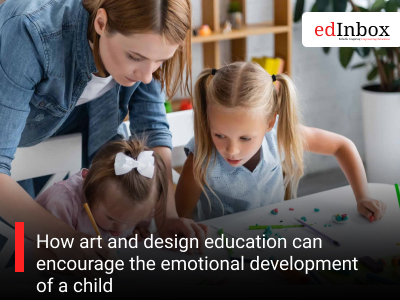
Art has been taught for numerous years. Yet in India, the subject has been sidelined for long and reduced to merely the basics of drawing or observational drawing, reappropriated by poorly trained educators into copying images or copying what the teacher him/herself does. The lack of an effective arts curriculum led to initiatives outside of school taken by private and public institutions, some to great benefit, but a majority yet failing to realise the full potential of arts for students. This article will not heed to the why of the situation, instead explore what arts are capable of doing for a child’s development. For arts are now making their way into Indian school curriculums much more effectively.
Indian boards such as the CBSE and State Boards have struggled to maintain an effective arts curriculum for school students. But the influx of international boards such as the IGCSE or the IB have given more opportunities to the ones who can afford. However, if you are a parent whose child goes to a CBSE or even State Board school, you may – or not yet – have started to hear about integrating arts into the curriculum. If yes, then that is because of the new National Education Policy that encourages the use of Arts to teach various concepts across subjects in a manner that is more experiential and perhaps, joyful. The policy also states that doing so will allow a greater connection between Indian culture and education. But why the arts? Dr. Elliot Eisner, a famous professor of art and education, stated numerous times in his speeches and conversations that the arts are capable of much more than merely assisting the learning of other subjects.
And he made a solid case for how the study of arts were capable of developing cognitive abilities that are crucial for any adult living in a civic society. Similarly, Sir Ken Robinson, yet another leader in the field of education and creativity, stressed the importance of creativity as a necessity as opposed to a luxury for children in schools. Engaging a child in learning of art and design exposes them to creative environments that encourage freedom, expression, risk-taking, experimentation, collaboration and more. All of which are capable of coming together to build skills that are now considered as 21st century skills by the World Economic Forum – Creativity, Communication, Collaboration and Critical Thinking.
This honest expression, when nurtured and guided by art and design educators, is also capable of boosting self-esteem in children. Children, more often than not, take pride in their creations and in the development of their skills which equips them with confidence to face challenges in their subjects, which eventually also reflects on their confidence in life. Art and Design education are also catalysts to building empathy and encouraging collaboration for students. Art as a field allows one to perceive another’s expression and design works towards solving problems for people.
Both enable a child to understand different perspectives and experience or understand other people’s views. This aids in the development of empathy within children. Additionally, both are capable of improving collaborative skills amongst students. Based on the nature or scale of the project, art may require a child to work with colleagues and design as a subject perhaps cannot function without the involvement of various stakeholders required to work together. Art and Design also nurture critical thinking and develop problem solving skills. If you have ever visited a museum and picked up an exhibition brochure or read any supporting descriptions on artworks, you would have noticed the many symbols, metaphors or meanings that can be embedded within an artwork.
Similarly, in design, the outcome always has a function that improves utility like the aerodynamics of a car for better fuel efficiency or the use of stretch fabric for more comfort in garments. While these examples may be far-fetched projects for young children, exposure to such projects and an awareness of the same nurtures critical thinking and develops problem solving skills. There are numerous educators, leaders and professors who have reiterated these points on several occasions. But the lack of awareness and the lack of available services often causes parents to misunderstand the importance of the arts in a child’s learning journey.
India’s education landscape has for long focussed on Science and Commerce for that was the need of the industry when we gained independence and when we became a liberated economy. Today’s industrial landscape demands for more creativity for the world is becoming increasingly volatile, uncertain, chaotic and ambiguous (VUCA). Some have also started to address the world as brittle, anxious, non-linear and incomprehensible (BANI). What kind of education then do you reckon will aid the future generation be better prepared? What kind of skills do you imagine the future generation will need to develop solutions to increasing global challenges?
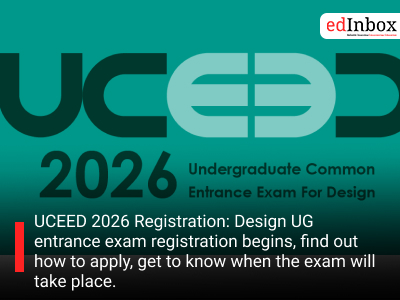
The Indian Institute of Technology, Bombay (IIT Bombay) has begun the registration of the Undergraduate Common Entrance Examination in Design 2026. The applicants, who want to get admitted in design, can submit their application without late fees up to October 31st. The applicants can submit their application with late fees up to November 7th. Let us find out when the entrance exam will be held.
The students can apply by visiting the official website, uceed.iitb.ac.in. IIT Bombay has released the complete schedule. Meritorious students can take admission in Bachelor of Design (B.Des) courses in IIT Bombay, IIT Delhi, IIT Guwahati, IIT Hyderabad, and IIITDM Jabalpur, etc. IIT Bombay conducts this entrance exam annually.
UCEED 2026 Registration: How to Apply: How to Register
Register by providing your email address, phone number, and other details.
Submit the application form after providing the details.
Upload your documents.
Pay the fees and submit.
UCEED Exam 2026 Date: When will the exam take place?
The entry test admit card to take admission in the Design UG course shall be out on January 2 at 1:00 PM as per the calendar released by the authorities. The entry test will be conducted on January 18, 2026, from 9:00 AM to 12:00 PM. The answer key of Part A will be out on January 20, and objections may be raised till January 22. The final answer key will be published on January 28.
The Feb 5 deadline will announce the cut-off for Part A, and the results will be announced on Mar 6.