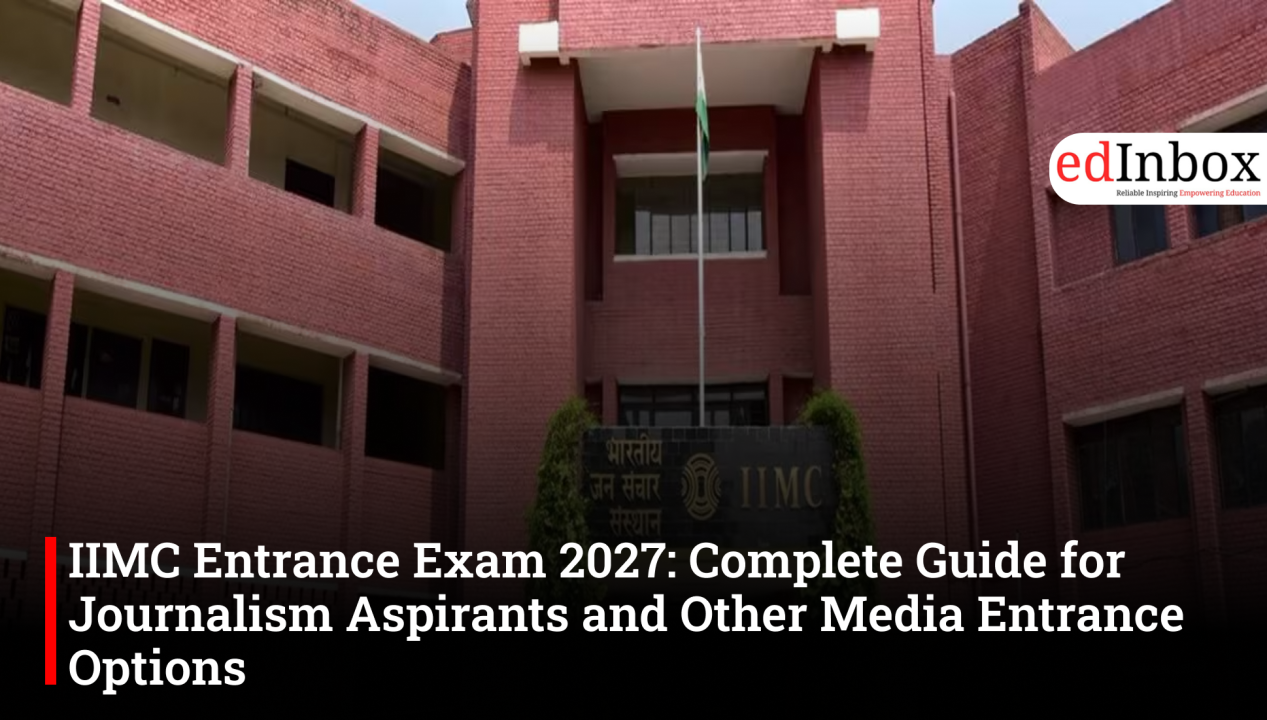
The Indian Institute of Mass Communication (IIMC) remains one of India's most prestigious institutions for journalism and mass communication education. Every year, thousands of media aspirants search for the IIMC Entrance Exam 2027, application dates, eligibility criteria, syllabus and admission process to secure a seat in its highly sought-after programmes.
However, one of the biggest changes in recent years is that IIMC no longer conducts a standalone entrance examination for most of its postgraduate diploma programmes. Instead, admissions are now based primarily on CUET (PG) scores, while separate entrance examinations continue only for certain regional language journalism programmes. Understanding this admission process is the first step towards planning your journalism career.
IIMC Entrance Exam 2027: Latest Update
Students often search for the "IIMC Entrance Exam 2027" expecting a dedicated examination for every course. However, according to the available admission information, most postgraduate diploma admissions are conducted through CUET (PG). Only select regional language journalism programmes continue to have separate entrance procedures notified by IIMC.
Candidates are advised to regularly check the official admission notifications for programme-specific requirements before applying.
IIMC Entrance Exam 2027 Important Dates
The official schedule for the admission process is expected to be announced by the concerned authorities. The important events generally include:
- Online application form release
- Last date to submit applications
- Application correction window
- Admit card release
- CUET (PG) examination
- Answer key publication
- Result declaration
- Counselling process
All dates are currently listed as "To Be Announced" in the available schedule.
IIMC Eligibility Criteria 2027
Candidates seeking admission through CUET (PG) generally need to fulfil the following eligibility conditions:
- A recognised bachelor's degree or equivalent qualification.
- At least 50% marks in graduation.
- Final-year undergraduate students may also apply, subject to completing their degree before admission.
For regional language journalism diploma programmes, separate eligibility conditions, including age criteria and nationality requirements, may apply depending on the course.
IIMC Application Form 2027
The application process is conducted online for admissions through CUET (PG), while certain programme-specific applications may have additional requirements.
Applicants should ensure that:
- All personal details match their academic records.
- The application is submitted before the deadline.
- Payment of the prescribed fee is completed successfully.
- Copies of the submitted application form and payment receipt are kept for future reference.
IIMC Entrance Exam Pattern
The examination pattern depends on the programme selected. For regional language journalism entrance examinations:
- Objective and descriptive questions
- Multiple-choice, short-answer and long-answer questions
- Three-hour examination
- Total marks: 100
For admissions through CUET (PG):
- Computer-Based Test (CBT)
- Multiple-choice questions
- Four marks for every correct answer
- One mark deducted for every incorrect response
IIMC Entrance Syllabus 2027
Although the syllabus varies across programmes, candidates are generally expected to prepare topics such as:
- Current affairs
- General awareness
- Indian political and economic environment
- Mass media and society
- Information and communication technology
- Language proficiency
- Translation (for regional language programmes)
- Social sciences
- Contemporary national and international developments
Consistent newspaper reading, editorial analysis and regular writing practice remain among the most effective ways to prepare for journalism entrance examinations.
IIMC Admit Card, Result and Counselling
Registered candidates will be able to download their admit cards online before the examination.
Following the examination, the answer key will be released, allowing candidates to estimate their scores before the declaration of results. Successful candidates will then participate in the counselling process, followed by document verification and admission formalities.
Best Preparation Tips for IIMC Entrance Exam
Students preparing for journalism entrance examinations should focus on developing both subject knowledge and communication skills.
Some effective preparation strategies include:
- Understand the complete syllabus and exam pattern.
- Read newspapers every day.
- Follow current affairs regularly.
- Solve previous years' papers and mock tests.
- Improve writing and comprehension skills.
- Prepare concise revision notes.
- Revise consistently before the examination.
Can You Join Journalism After Class 12?
This is one of the most frequently asked questions by media aspirants. Since IIMC primarily offers postgraduate programmes, students generally become eligible only after completing their bachelor's degree. Students who wish to begin their journalism journey immediately after Class 12 need not wait until graduation. Several universities across India offer undergraduate programmes such as:
- BA Journalism & Mass Communication (BA-JMC)
- Bachelor of Journalism and Mass Communication (BJMC)
- Bachelor of Mass Communication (BMC)
- Bachelor of Media Studies (BMS)
- Bachelor of Mass Media (BMM)
- BA Media & Communication
- BSc Media Technologies
- BSc Animation & Graphics
One common admission pathway for these undergraduate programmes is the Global Media Common Entrance Test (GMCET). Conducted for admissions to participating universities across India and South Asia, GMCET evaluates communication skills, logical reasoning and analytical ability, competencies that are essential for careers in journalism, digital media, broadcasting and public relations. For students looking to start a media degree immediately after school, it offers a structured alternative to institution-specific entrance processes.
Career Opportunities After Journalism
A degree in journalism or mass communication opens opportunities across traditional and digital media. Popular career options include:
- Journalist
- TV Correspondent
- News Anchor
- News Analyst
- Public Relations Officer
- Radio Jockey (RJ)
- Video Jockey (VJ)
- Photojournalist
- Feature Writer
- Digital Content Writer
- Multimedia Producer
- Social Media Strategist
- Broadcast Producer
- Corporate Communications Executive
With the rapid expansion of digital platforms, skilled media professionals are increasingly in demand across news organisations, OTT platforms, advertising agencies, corporate communication teams and content-driven startups.
What Must Students Know?
The admission process for IIMC has evolved, making it important for aspirants to understand whether their chosen programme requires CUET (PG) or a separate entrance examination. A well-planned preparation strategy, strong awareness of current affairs and clear communication skills remain key to securing admission.
For undergraduate aspirants, exploring common entrance pathways such as GMCET can help them begin their media education immediately after Class 12, while those aiming for IIMC can use their undergraduate years to build the academic and communication skills needed for postgraduate success.
Frequently Asked Questions (FAQs)
Is there an IIMC Entrance Exam in 2027?
For most postgraduate diploma programmes, admissions are based on CUET (PG). Separate entrance examinations may continue for certain regional language journalism programmes.
Is CUET compulsory for IIMC?
For most postgraduate diploma admissions, candidates are admitted through CUET (PG) as per the available admission information.
Can I join IIMC after Class 12?
IIMC primarily offers postgraduate programmes. Students interested in journalism immediately after Class 12 can pursue undergraduate media degrees offered by various universities before considering postgraduate study at IIMC.
Which entrance exam is best for journalism after Class 12?
Several universities conduct their own admission processes, while common entrance examinations such as GMCET provide access to undergraduate media programmes at participating institutions. Students should choose the route that aligns with their preferred university and career goals.
Should I start Prep for IIMC?
Yes, it is good to start preparing for the entrance exam early. Doing so will help ensure good ranking, adequate preparation time, and balancing study with life. However, if you aren’t sure about IIMC 2027, GMCET can be a good choice for admission into top media universities.