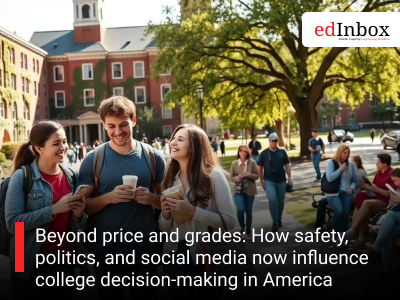
For decades, the calculus for selecting a college in the United States has appeared simple: Compare the quality of the education to the cost, and select the school that provided the best combination of prestige and affordability. Now that formula has been made more complicated by a host of additional factors, including politics, campus safety, and even TikTok.
Based on the 14th annual survey of Spark451, a Jenzabar company that focuses on enrollment management, the landscape of higher education decision-making is changing in real time. The 2025 report, drawing on feedback from over 1,800 graduating high school seniors and 1,400 parents, indicates that academic rigor and affordability continue to be the foundation of preference but that families are now examining institutions with a wider and, sometimes, more contentious framework. This is what the report indicates:
The lasting pillars: Quality and cost
Not surprisingly, quality of academics ranked first, followed by cost and scholarship availability. However, cost's primacy has a caveat: A revealing 59% of parents acknowledged that the college their child ended up attending wasn't the most affordable one. The fact speaks to how families are more and more willing to pay a premium for perceived quality, safety, and institutional commitment to their values.
The politics of campus gates
One of the most surprising changes disclosed by the survey is the politicization of the college selection process. Almost three-quarters of students (74%) responded that a university's political leanings affected their choice to attend, and an even higher percentage of parents, 78%, reported the same. In addition, 70% of parents mentioned a state government's political climate as a determining factor in whether or not they felt it was safe to send their child to study there.
In an age when college campuses are hotbeds of controversies surrounding free speech, diversity, and control, this information indicates that universities are no longer apolitical havens of education in the public psyche. They are seen as political ecosystems that influence not just career but also character and identity.
Safety trumps sports
The survey brings a sobering message to college officials still counting on athletics as a recruitment tool. Intercolligate athletics placed 15th of 17 factors, well behind campus security, which has increased heightened prominence amid national alarm concerning gun violence and psychiatric crises on campuses.
Academic quality, price, and value continue to be priorities for parents and students alike, but this year's results indicate increasing sensitivity to considerations such as campus safety, political climate, and values," said Michael McGetrick, Vice President of Creative and Interactive Services for Spark451, in a press release.
An arms race in applications
If this year's students are apprehensive, they are also prolific. A record number of more than half applied to 10 or more schools, from 45% in 2024 and 39% in 2023. The Common Application remains the champion, with over 80% of students opting for it as their application platform.
Application fee waivers were the tipping point for most: 65% of students applied to more institutions than they had originally planned on after being offered waivers. But for parents, such incentives barely registered: 63% reported that fee waivers did not influence their child's application plans.
Direct admissions: Intrigue without conversion
Direct admits—when colleges provide room without a full application—has been touted as a democratizer of access. The poll indicates 32% of students applied to at least one college through such a program, but only 41% actually enrolled in the institution that directly admitted them. The system piques interest but has yet to be a determining enrollment force. Parents are still interested, though: 78% indicated they preferred such arrangements, up from 73% last year.
The virtual battlefield: TikTok, AI, and the influence of a written letter
If safety and politics mark the emotional landscape of college selection, technology marks its pragmatic one. A staggering 93% of students utilized social media to seek information on schools, with Instagram (70%), YouTube (52%), and TikTok (49%) emerging as the most popular. Almost one in every three used AI tools like ChatGPT, with 62% of those using AI for admissions questions and affordability issues. Parents are less digital, however—only 4% said they used AI in searching for college.
Nevertheless, in the midst of digital saturation, the survey provides a near-paradoxical note: email (97%) and even direct mail (64%) still top students' lists for preferred modes of college communication. For a generation that is daily immersing itself in notifications, there is still something to the physical heft of a letter or a one-to-one email.
A new calculus for colleges
The Spark451 survey finally presents students and families as pragmatists increasingly operating in ideological mode, digitally adept but old-fashioned, price-sensitive but value-aligned and paying to be so.
The age-old question of "Which college is best?" no longer has one answer. It now hinges as much on the statehouse as on the classroom, as much on a school's position on social issues as on its academic standings.
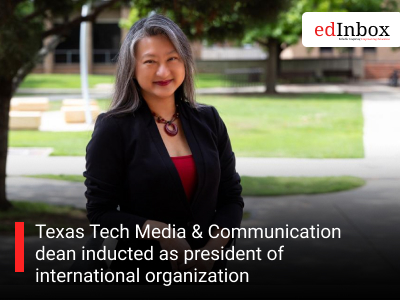
Bey-Ling Sha, dean of the College of Media & Communication at Texas Tech University, was recently inducted as president of the Association for Education in Journalism and Mass Communication.
Having been elected by the association's more than 2,300 members from around the globe, Sha held the position of vice president and then president-elect before taking on the presidency.
Sha is working to create a legacy of Texas Tech presidents who have held this role. Past Dean David Perlmutter was president of the organization in 2020. Texas Tech is part of an exclusive group of universities like Columbia University, New York University and the University of Texas at Austin that have had presidents serve as president of AEJMC.
Sha considers Texas Tech's appearance to be an endorsement of the outstanding work that is being done at the college.
Since joining Texas Tech in February, I have developed an even deeper appreciation for the degree of excellence of the teaching, scholarly and creative activity, and community engagement that is accomplished at the College of Media and Communication," Sha said. "I am pleased to be able to showcase that excellence and foster our sense of care among our faculty through this service to a professional organization within our field.
Though Sha can eloquently quote AEJMC's purpose, it's the feeling of support which the organization has extended that she enjoys the most. Having joined when a graduate student at the University of Maryland, Sha has continued on ever since.
The most important thing to me is the feeling of belonging AEJMC has provided," she said. "When I arrived, there were so many veteran scholars who were kind to me, either with their time or advice or scholarly criticism.
She wants her work and leadership to serve as an inspiration to students within the College of Media & Communication. The college offers access to over 10 student chapters of national organizations. Sha thinks students can get something out of being involved while at Texas Tech, making investments in communities that can benefit them well into their careers, as AEJMC has done for her.
“We live in a time when many people feel lonely and isolated,” Sha said. “Finding something bigger than yourself can be an antidote to that feeling.”
She encourages Texas Tech students to connect with peers who have similar goals.
"Dean Sha's peer recognition across the country for her vision and leadership emphasizes her dedication to promoting excellence in her discipline," said Ron Hendrick, provost and senior vice president. "Recruiting scholars like Sha – champions in her field – is at the heart of Texas Tech's quest for academic excellence."
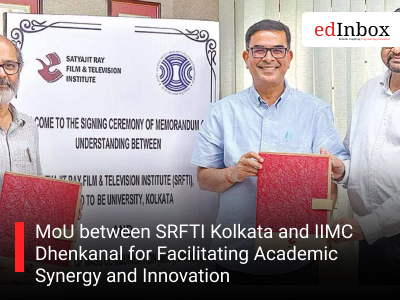
The landmark agreement is aimed at fostering academic collaboration, supporting mutual research and training, and creating for students a wider platform of industry-appropriate practice.
Prof Sukanta Mazumdar, Dean, SRFTI and Prof. Anand Pradhan, Regional Director, IIMC Dhenkanal signed the MoU in the presence of Dr. Nimish Rustagi, Registrar and Additional Director General of IIMC. Shri Deepak Singh, Registrar, SRFTI; Prof. Chandan Goswami, Dean (EDM Wing); Prof. SudiptaBhowmick, Head of the Department, EDM Management, among others were present.
IIMC Vice Chancellor, Dr. Pragya Paliwal Gaur appreciated the Dhenkanal campus for appreciating her on the MoU signing and instilling strong synergy among the two campuses.
Addressing the gathering on the occasion, Prof. Anand Pradhan highlighted the importance of institutional collaborations by stating, "This collaboration between two sister organizations of the Ministry of Information and Broadcasting will open new interesting avenues of opportunities for the students and personnel. It will become a dynamic platform for knowledge sharing, creative pursuit, and professional development."
Dr. Nimish Rustagi revealed that the strategic partnership would bring numerous opportunities. "This tie-up will yield joint academic programs, research projects, short-term skill enhancement, and common facilities and skills. It is our attempt to widen the gamut of media education and practice," he asserted.
Whitewashing the union bid, SRFTI Dean Prof. Sukanta Mazumdar said, "IIMC and SRFTI are both industry leaders in eastern India with contrasting strengths. The union will be entrepreneurial innovation and skill-based programs in fields of mass communications, media, and films."
This partnership will also be likely to particularly enrich journalism, film, and digital media as well as allied students with multidisciplinary learning and exposure to classical as well as changing tools of narration and communication.
The signing of MoU bears witness to IIMC Dhenkanal's continued efforts to forge meaningful academic alliances that allow students and teachers of Odisha and indeed the entire nation to empower themselves and enrich the country's media and communication education landscape even further.
In this article, students can download the full syllabus for Mass Media and Communication so that they can begin preparing for exams and achieve high marks. The syllabus has been especially updated and revised by the board authorities in order to fulfill the demands and needs of the generation now. We have presented before you the updated syllabus given by the board. Also, get familiar with the marking scheme distribution, exam pattern, course structure specified by the board, and more
1. To introduce a holistic awareness of the various types of Mass Media and their convergence.
2. To give an overview of the various media regulatory bodies and their goals.
3. To facilitate the understanding of technical and creative ideas related to the various Media production processes.
4. To engender an awareness of the role of the Media in instituting social change.
5. To sensitize and generate awareness of Online risks and Internet security.
6. To gain an appreciation of the Evolution of the types of Media and Communication.
ISC Class 12 Mass Media and Communication Project Work Syllabus
CISCE Board Class 12th Mass Media and Communication project work syllabus is given below.
Applicants are to have two projects from any topic/ allied area dealt with in Theory.
Project work may cover any of the following:
Script writing
Documentary/ video
Book review/ film review/ posters/ advertisements/ cartoon strip
Advertisement campaign, social media campaign
Case study
Field visit/investigation
ISC Class 12 Mass Communication & Media List of Suggested Assignments for Project Work
Following are some project work suggestions given to students by the board. Students can choose any of the suggested topics or get an entirely different idea, discuss it with their teachers, seek approval on the same, and then submit the project within the stipulated time.
Create a short comic tale. You can use a maximum of 4 characters to construct the tale. The cartoons can be drawn by you as per your choice. Good dialogues should be written. Colouring of the comics can also be done if you prefer. The tale should not be longer than five scenes or 15 drawings. candidates may provide them pasted in a chart or a book. No software is to be employed for this task.
Create a one-hour documentary on the subject "Life in School". The documentary should have video footage of different activities done in school as well as normal school life, including recess and dismissal. There should be a minimum of one interview with a student and one with staff. Narration should be crisp and suit the visual content. Any recording not in English should have subtitles.
Design an advertisement campaign on any topic concerning the protection of the environment. You may use any non-electronic medium for the campaign. For instance, pamphlets, placards, leaflets, etc. Draw up a report of the in-depth process along with photos of the campaign.
Make a PowerPoint presentation demonstrating the different Graduation courses a student can opt for upon completion of school. The PPT should include statistical information on the employment rates of adults who have done the courses, the quantity and nature of jobs which utilize the courses, and the level of the courses. Pie charts and bar graphs can be employed. There should be explanation given as to why the courses should be undertaken, as well as what are the benefits of some courses over others.
Select one social media campaign. Track it for a week. Analyse the campaign in detail in terms of its strategy, followers, comments/ likes, sharing and evolution over time.
Use any phone camera or mobile with video capability to produce a 1-5-minute fiction short story on any subject of your choice.
Write a critical review of a movie from any one of the following genres: Fantasy/ Sci-fi, comedy, musical.