It is a golden opportunity that Indian universities are losing out on by not offering criminology courses in India. With crime rates touching the sky and the huge demand for criminology jobs in India, university criminology programs can turn campuses into practical education hubs. Criminology courses in India assure very high employability; its graduates get forensic science education India roles at ₹3-11 LPA in CBI, NIA, and police forces. Student trends in Indian higher education show a desire for purpose-driven degrees amidst a rise in cybercrime and justice requirements. Offering criminology courses in India improves enrollment, ranking, and social impact. University criminology programs go hand-in-hand with the NEP 2020 and, thus, are one of the smart and profitable choices for progressive institutions today! Let's understand it in detail.

Increasingly Advanced Crimes Require Experts in Criminology

The crime rate in India is growing, with more than 44 lakh cases being reported every year, out of which there has been a rapid growth in cybercrime. This, in turn, is bringing forth an insatiable demand for trained criminologists who can analyze, investigate, and prevent crimes effectively. Indian universities have a unique opportunity to address this shortage by offering specialized criminology courses that produce job-ready graduates, directly contributing to safer communities and strengthening law enforcement agencies.

Expanding Career Opportunities in Criminology

Courses in criminology lead to a variety of job opportunities that are also well paid. A graduate can be employed as a forensic scientist, crime analyst, probation officer, or criminal lawyer in government agencies at the CBI, NIA, forensic laboratories, or NGOs. Salaries range from ₹3 to ₹11 lakh per annum, with many roles showing promising growth of around 20%. For students who look forward to challenging roles with positive social impact and financial stability, criminology becomes an attractive course of study.

High Student Interest and Enrollment Potential

With greater awareness of crime and justice, more Indian students are drawn towards courses in criminology. In this way, offering the course helps universities attract motivated learners looking for practical, purpose-driven education. Affordable course fees, generally ranging from ₹16,000 to ₹1.5 lakh, and a well-defined employability pathway make the course likely to fill seats and reach financial viability rather quickly.

Alignment with the national education policy and research grants 

Criminology fits well within the NEP 2020 framework of India, emphasizing skill development, research, and interdisciplinary learning. Alignment with the policy will help universities explore government grants to establish centers of excellence in forensic and cybercrime research. These courses raise the academic profile of any university while providing solutions for immediate, real-world challenges. 

Enhancing University Rankings and Industry Partnerships 

The addition of courses in criminology adds to the reputation of a university by reflecting its concern for relevance and demand. A high record of placements within police forces and forensic institutions improves the ranking and attracts further collaborations from law enforcement and private sectors. It positions the institution as a leader in emerging disciplines, helping it stand out among peers.

Social Responsibility & Impact 

Beyond academics and economic initiatives, criminology education enables universities to serve as agents of social change. Graduates who are trained to conceptualize and prevent crime contribute to societal well-being and justice. This also meets public expectations for educational institutions to create engaged, socially responsible citizens. 

Thus, Indian universities must consider offering this course because it is a strategic and value-laden decision with market relevance, student appeal, funding, and social benefit. Since crime is increasing and experts are less, only those universities that will now take advantage of this opportunity will be at the forefront of developing innovative solutions for public service in education.

If forensic science fascinates you and you dream of solving crimes with science, the next big step is choosing the right entrance exam. Two well-known pathways exist, one is the Government Forensic Science Entrance Test and second is the All India Forensic Science Entrance Test (AIFSET). Aspirants should not just consider government universities because private universities have their own advantages. 

What is AIFSET?

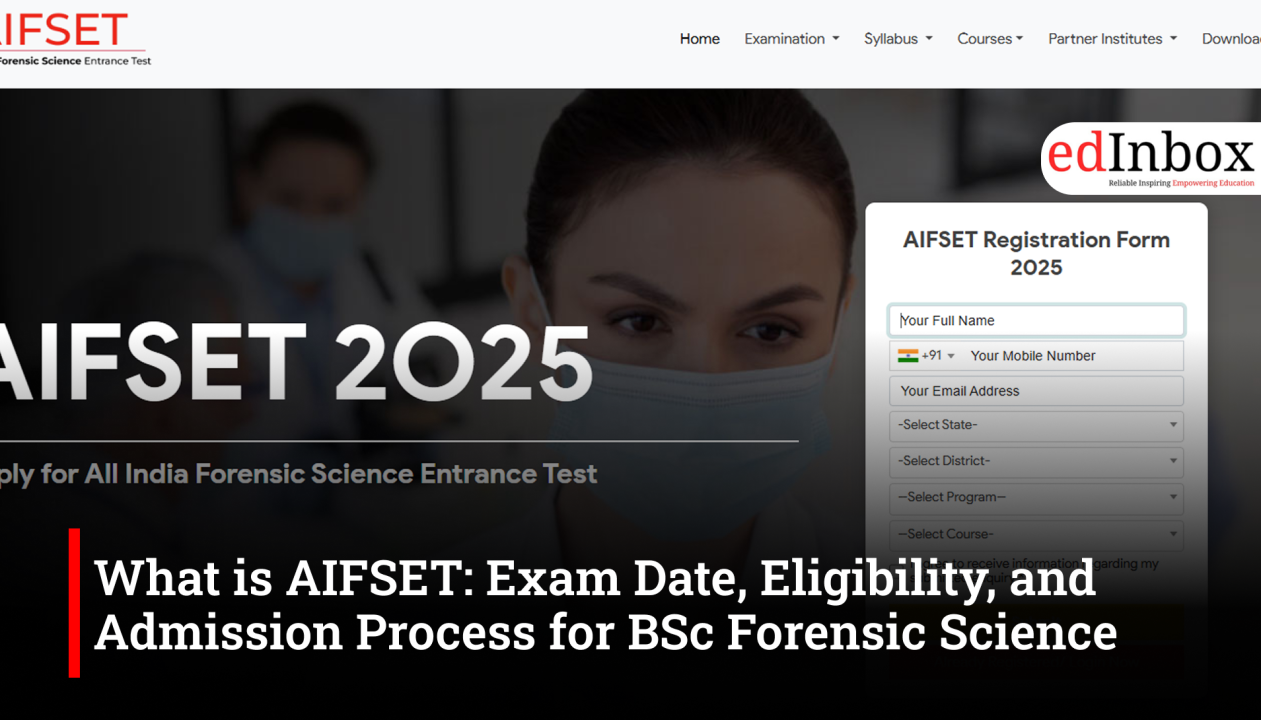
AIFSET is a national-level online exam designed to test your knowledge in forensic science, biology, chemistry, physics, and logical reasoning. It’s held once a year and accepted by over 180+ top universities across India, making it a gateway to quality education and exciting career prospects in forensic laboratories, law enforcement, and criminal investigation.

Is AIFSET Easy?

Unlike some government exams that can be highly competitive but limited in opportunity, AIFSET offers a transparent, straightforward process and examination tailored for students who want hands-on forensic learning. Its syllabus covers essential forensic topics such as crime scene investigation, physical evidence analysis, fingerprint detection, and forensic biology subjects that ignite curiosity and develop skills needed in real crime-solving scenarios.

What is the AIFSET Examination Format?

With an easy online format, you can take the exam from anywhere using a laptop or smartphone. The exam has 100 multiple-choice questions to be solved in 60 minutes, balancing challenge with accessibility. Also, AIFSET has no negative marking which makes it easier to score well. 

So, are you ready to join a field where your keen eye and scientific mind can make a life-changing difference? If you said yes, AIFSET gives you the best chance to build a career in forensic science with confidence and skills.

To conclude, choosing AIFSET means choosing a future where your talent helps uncover truth and justice without making the admission process challenging for the aspirants. So, don't just dream of becoming a forensic expert, make it happen with AIFSET 2026. Register now via its official website or call @8035018480 for free consultation.

Forensic science demand in India is skyrocketing like never before. As cybercrimes rise 63% yearly, and new laws such as the Bharatiya Nyaya Sanhita (BNS) are enforced to compel scientific evidence to be considered, universities are under tremendous pressure to initiate forensic science courses. India needs to train 30,000 forensic professionals annually, yet the provision is significantly less than that; therefore, it's time for universities to come forward.​ This article will help you understand why forensic science should be introduced in the top universities by deans and policymakers. 

Forensic Science Demand Surge

Forensic science demand is reaching record highs due to increased creative crimes like murdering and chopping the body, refrigerating the fragmented body, storing the body in a drum and cementing it, etc. Apart from this, social media crimes and AI influenced crimes are also increasing, making the demand for experts stronger. India's digital forensics market grows at 40% CAGR and is expected to hit ₹1.39 billion by 2029-30. Cyber frauds, financial scams, and terrorism cases need forensic science experts for DNA analysis, cyber tracking, and toxicology reports. BPRD reports a 30,000 forensic professional shortage; courts reject 12% cases yearly without proper evidence. States like Maharashtra (₹1,300 crore for 254 mobile vans) and Bihar (₹190 crore labs) invest heavily, which  is a clear sign of forensic science growth in India

New Legislations enhance Forensic Science Mandate.

Bharatiya Sakshya Adhiniyam 2023 requires video/digital evidence in the courts - forensic science becomes the legal support. BNSS puts pressure on zero FIRs and timely forensic reports, refusing manual investigation; mobile forensics alone captures half the market share. India cannot address judicial requirements without the courses of forensic science. To keep pace with the international standards, universities will have to educate specialists in AI-based triage, cloud forensics and quick DNA analysis.  

Driver

Impact on Forensic Science Demand

Stats 2025

Cybercrimes

63% rise yearly

40% CAGR digital forensics 

New Laws (BNS/BNSS)

Scientific evidence compulsory

12% cases rejected 

Govt Investment

Mobile vans, AI labs

₹2,080 crore national push 

Talent Gap

30,000 experts needed yearly

NFSU trains only 36,000

Why are Forensic Science Jobs High Paying?

The salaries in forensic science paths are the highest ones- 6-15 LPA on joining, 25 LPA on seniority. Posts in CBI, IB, NIA, cyber wings, banks, insurance, and private labs. Cyber forensics, wildlife forensics, and narcotics are some of the specialties such that 12% increase in jobs annually. The Indian talent is also pulled away to abroad. Toppers are attracted to BSc/MSc Forensic Science universities with placements reaching 95% at NFSU. Deans, that is revenue and reputation upsurge!​

Why Universities Must Establish New Forensic Science Departments

  1. Fill the Massive Expert Gap: By providing the talent pool that is much required, universities can serve the void of 40 percent vacancy rate and decreasing cases of forensic cases backlog, particularly in Tier-2 and Tier-3 cities.
  2. Align with NEP 2020 and Government Mandates: Implementation of forensic science lectures is a supplement of multidisciplinary approach that NEP applies to its work, which involves science, law, technology, and moral judgment.
  3. Boost the Revenue and Goodwill of the University: The provision of state of the art forensic science programs brings talented students, enhances the institution's ranking, and creates access to industry collaborations and government subsidies.
  4. Help National Justice and Security: Graduates contribute to the provision of faster and more precise evidentiary assistance that will maximize the efficiency of law enforcement and improve the fairness of the courts.
  5. Increase Research and Innovation Opportunities: New departments may also translate into native-forensic R&D, AI incorporation in solving crime and partnership with national crime labs and agencies.

Challenges & Solutions for Universities

  • Problem: Overburdened lab (e.g. 50,000 cases in Delhi?) 
  • Solution: AI labs, mobile units Partner NFSU/RRU. 
  • Faculty shortage? MHA training- Short term. 
  • High setup cost? Central schemes cover 70%. 

Deans, begin with BSc Forensic Science + cyber add-ons for ROI in just 2 years.​ However, if setting up this department and getting admissions is a lengthy process for you, partnering with AIFSET will be the best solution. It is one of the top forensic science entrance tests in India hosted by Edinbox, and our team will assist you from scratch. 

To conclude, in India, forensic science courses are not a requirement, but a national priority according to BNS/NEP 2020 to produce skilled forensic experts. Universities, deans, policymakers: Introduce forensic science classes now to close 30,000 professional gaps, place big, and bring justice. Maharashtra-Andhra models attest to that. NFSU contact ties-ups; safeguard the future of forensics in India! By 2030 India will require 1 lakh forensic pros and your university can be at the forefront.

An undergraduate degree in Forensic Science, B.Sc. (Hons.), is the gateway to an essential science which is both instrumental in the areas of criminal justice and safety. Forensic science is an amalgamation of biology, chemistry, and methods of investigation to examine tangible evidence at the crime scenes and assist law enforcement in resolving crime and administering justice. Government laboratories, police departments, private forensic firms, and research institutions require graduates with this degree as they are nimble in analytical abilities and scientific aptitudes. 

As technology improves and more and more people are in need of forensic professionals, the field has a bright employment future, a wide range of specialisations and it allows one to create a difference in the real world through their scientific discoveries. The following are the broad career prospects on graduation with a B.Sc. (Hons.) degree in Forensic Science at ITM University in a dynamic career building block. 

  1. Government Forensic Laboratories: After graduating, graduates are able to work in some of the most prestigious organisations like the Central Forensic Science Laboratory (CFSL), State Forensic Science Laboratories (SFSL), and other police crime laboratories. In this, they examine crime scene physical, chemical and biological evidence in order to support law enforcement agencies. 
  2. Law Enforcement Agency: Forensic Specialists are also found in the Central Bureau of Investigation (CBI), Intelligence Bureau (IB), National Investigation Agency (NIA), and local police forces in career positions. Duty encompasses investigation at the crime scene, collection of evidence, and witnessing in courts.
  3. Cyber Forensics: As cybercrime is on the rise, graduates are being hired to work in digital forensics departments and perform analysis of cyber-attacks, fraud, and data breaches. This new area has good growth and specialisation opportunities.
  4. The Opportunities in the Private Sector: The private forensic laboratories, security agencies, pharmaceutical companies (drug testing), insurance companies (detection of fraud) and law consultancy firms require the applicant to have expertise in forensic science. Examples of roles are Forensic Consultant, Crime Analyst, and Toxicologist. 
  5. Research and Academia: Graduates have access to higher education (M.Sc. Ph.D.), become university and research-institute lecturers and research scholars and are employed to drive innovation in forensic technologies and methodologies.
  6. Niche Roles: Various divisions such as forensic toxicology, forensic biology (DNA analysis), forensic anthropology, ballistics, and handwriting analysis provide niche career opportunities. Such specific abilities are required in different agencies and laboratories worldwide.

Salary and Job Prospect: The initial salary is usually INR 3.5 to 6 LPA in government and commercial laboratories, with individualised employees earning more than INR 10 LPA, particularly in cyber security and consultancy positions. It is projected that the forensic science field is going to expand at a high rate due to the available technology and the complexity of crimes, which will expand the job opportunities and pay rates.

Why Choose B.Sc. (Hons.) ITM University Forensic Science?

ITM University offers an advanced curriculum with practical lab work training, internship with police and forensic departments and professional faculty mentorship. The presence of an excellent placement network and industry partnerships also means that students are better exposed and equipped to work in the industry, which makes the graduates very employable in various fields.

Major in Forensic Science B.Sc (Hons) at the ITM University provides interdisciplinary scientific knowledge and investigative skills to students, which are essential when it comes to crime solution and delivery of justice. This degree is a strategically significant investment in a fulfilling and influential career in forensic science because of the increasing demand of forensic professionals both in the government and the private sector in India.

The degree not only provides a career but also an opportunity to serve law enforcement, safety and justice in a more complicated world- that is why it is the best career decision that science majors are able to make.

To find out more about course curriculum, internships, and the service of placement at the ITM University, future students may refer to the official university website.

Top Bloggers

  • Sample avatar

    Christian Hardy

    Joomla! core

  • Sample avatar

    Agnes Payne

    Joomlart's Co-Founder

  • Sample avatar

    Christian Hardy

    UberTheme's CEO