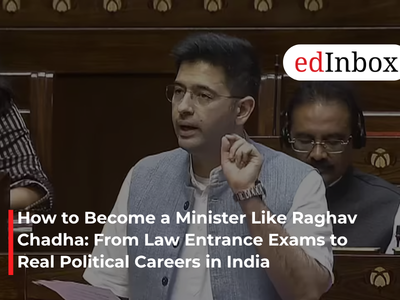
Over the past few years, Indian politics has seen the emergence of young and eloquent leaders who have transformed the way people view governance. One of them is Raghav Chadha, who is a prominent figure in this group, a sharp communicator with policy clarity, and early political entry into the national level politics with the Aam Aadmi Party.
As a student looking at his/her path, one would have a natural question, how does one become a minister or a policymaker in India like Raghav Chadha? Apparently, it is not an overnight success or a simple political affiliation. It is a stratified process that is built via education, skill-building, strategic entry, and ability to maneuver through a competitive and unpredictable system.
Why Education in Law and Policy Matters
Many of the contemporary political leaders are of academic backgrounds which are closely related to the field of governance and one of the most notable of them is law. The reason is structural. The fundamental aspect of politics is legislation, constitutional interpretation, and policy interpretation.
To aspirants, this is a very strategic point of entry into law. Examinations like CLAT (Common Law Admission Test), AILET, and AICLET (All India Common Law Entrance Test) are the gateway to Top Law Universities, where law aspirants learn not only legal systems, but also debates, discussions of public policy, and critical thinking. Such settings develop the power to argue, reason and interpret, which are invaluable in the legislative field.
Nevertheless, education does not make leaders. It constructs the vision through which leaders perceive problems.
Which Law Entrance Exam To Take as GenZ?
All India Common Law Entrance Test is the ideal option for gen z law aspirants. While traditional exams like CLAT still exist, they often follow rigid, outdated admission patterns. If you’re someone who wants to challenge systems and think ahead, your approach should reflect that. As a national-level entrance exam accepted by 100+ top law universities in India, it offers a more flexible, forward-thinking, and opportunity-rich pathway into legal education. When your goal is to step into a profession that shapes policies and questions norms, choosing a modern, widely accepted entrance route like AICLET is a strategic move.
The Skills That Make Political Careers
It is not only the academic background of individuals such as Raghav Chadha, but the mindset, the willingness to express the ideas clearly and with persuasiveness. Raghav Chadha surely has skills, but what makes him stand out from the crowd is his mindset. Till date we had 1000s of ministers but none with the earnest desire to fulfill their actual duty.
Additionally, any political career requires a set of skills that are hard to come by. One of the most apparent is public speaking, but behind it is the process of structured thinking, or the capacity to disaggregate complex problems into arguments that will appeal to policymakers and the general public. In parallel to this, knowledge of current affairs and the policy developments becomes necessary. A political candidate should not merely absorb information, but also be critical in his interpretation.
Also, but less talked about, is emotional intelligence. Human life is subjected to constant scrutiny in the public. Judgments are challenged, stories are externally crafted and rewards are not necessarily commensurate with work. It is usually the capacity to keep calm in such circumstances that can keep long-term careers alive.
How to become a minister in India?
To become a minister in India, you need to:
- Build a strong educational background (law, public policy, etc.)
- Join a political party
- Gain public and party support
- Get elected as an MP or MLA
- Be appointed as a minister by the government
The Ground Reality Of Politics
People tend to believe that a political career starts with being at the top, but the truth is , it starts with exposure. This happens by participating in student politics, campaigns, volunteering, and leading any event or college party. The experiences that come with these build the foundation of law aspirants willing to Be The Change.
Becoming a member of a political party, like the Aam Aadmi Party, or any other party, is a turning point. Here, individuals may work in research, strategy, or outreach roles before gradually moving into more visible positions. This step is not about gaining recognition but rather being familiar with the system internally.
Career Opportunities in Politics
It should be noted that the possibility of becoming a minister in parliament or elsewhere, isn’t the only career, there is more in this field. Here are some of the top as well as emerging careers in politics that one can opt for while still being as selfless as Raghav Chadha:
Top Career Options in Politics
- Civil Service & Public Administration: The IAS, IPS, and IFS programs offer administrative positions which execute government policies.
- Law & Litigation: Practicing law, which includes constitutional and civil and corporate law, enables lawyers to shape governmental decisions.
- Political Strategist & Consultant: The role involves creating campaign strategies while overseeing public perceptions and managing the political candidate's image.
- Policy Researcher/Think Tank Analyst: The analyst conducts research on policy matters while developing new laws and collaborating with organizations such as the United Nations.
- Journalism & Media Analysis: Journalists and media professionals work in news channels and digital platforms and political analysis to establish public conversation.
Emerging Career Options in Politics
- Political Digital Strategist: The professional is responsible for social media campaigns, digital presence management, and online reputation control.
- Data Analyst for Politics: The analyst employs data analytics to study voter patterns which enables them to improve campaign results.
- Lobbyist/Regulatory Specialist: The professional represents private sector interests to government policymakers, who are now increasingly essential because of the growing complexity in governance.
- International Relations Specialist: The specialist studies foreign policy together with diplomatic relations and worldwide partnership development.
- NGO Manager/Advocacy Officer: The professional uses non-profit organizations to create social change while emphasizing human rights and environmental protection.
There are many more roles one can pursue, all you need do is research a little, know about your willingness and your skills.
The Unspoken Reality of Power, Perception, and Instability.
Political careers are both influential and volatile. The public discourse changes rapidly, the relationships between parties change unexpectedly, and leaders/members are replaced suddenly without any prior notice at times. News cycles frequently show times when even competent leaders have had a bad day, have been criticized or rebranded in their parties.
AAP removed Raghav Chadha from Rajya Sabha recently and no one saw this coming. This is indicative of a more profound reality of the life of the people: fame is not always constant and talent does not always equate to continuous development. Sometimes, loud voices can be opposed, and the social mood is not always in line with the will.
However, the ones who give-up are the ones who fail. MP Raghav Chadha is opposing the step of AAP, boldly. He has shared a video saying he’s "Silenced, not defeated" and this shows why he is getting the support of the public. Some netizens are requesting him to join BJP because of the fact that many despise AAP but love how Raghav Chadha proves to be the ideal minister India needs.
To all law aspirants, this is no deterrence but a wake-up call. Politics needs a man of strength, deed, and character.
Building Personal Identity in the Digital Age
In the modern world, politics is not limited to a physical platform. Online presence has become a major contributor to the creation of social perception.
Future leaders are moving towards platforms such as LinkedIn and X to share views, discuss policies and develop thought leadership. This not only increases visibility but also provides a written account of their opinion and experience. But being visible without clarity may be counterproductive. It is not the frequency of expression but meaningful expression that counts.
The Psychology of Political Career
Choosing politics as a career is a psychological commitment. It requires patience and ability to keep working without validation at all times, to persist even when criticised, and to have a purpose even when the results are doubtful.
Political careers are influenced by many different factors unlike the traditional careers where hard work may result in a foreseeable development. This renders internal stability, clarity of purpose, emotional balance and long-term vision.
Aspiration to Execution
The road to becoming a minister like Raghav Chadha is not easy, never will be, and is not characterized by one law entrance exam, degree or opportunity. It is a result of a long term preparation, strategic positioning, and the capability to maneuver a complicated system with coherence and steadiness.
In the case of students, the journey starts with education, which can be in law or public policy, then development of skills, exposure on the ground, and finally, gradual entry into the political ecosystem. In the process, there will be challenges, yet there will be chances to make a difference.
This is after all a career built by understanding people, systems and self. And for those willing to commit to that journey, it promises the possibility of influence at the highest level.