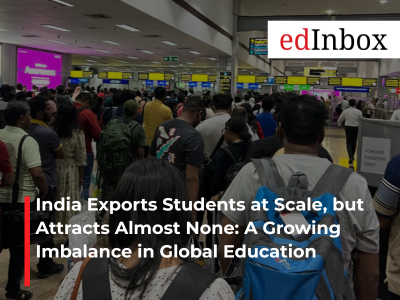
For decades, India’s higher education narrative has been dominated by a single aspiration: going abroad. From middle-class families stretching finances for overseas tuition to record-breaking visa numbers each year, studying overseas has become both a dream and a perceived necessity. Nevertheless, a contemporary NITI Aayog report on the globalisation of higher education, puts forward a challenging question: given India is one of the largest exporters of students in the world, why does it attract so few students from abroad?
Back in 2021, while only one international student was studying in India, 24 Indian students went abroad for higher studies. This disparity becomes even more glaring in the light of the government's very ambitious aim of accommodating 1.1 million international students by 2047, a target that seems very far away in the light of the present situation.
A Global Supplier of Students
India has firmly established itself as the world's top source country for students studying abroad. In the past ten years, more and more people have been going overseas, and the most favorite places to study were the United States, Canada, the United Kingdom, and Australia. After the pandemic, an enormous surge of outbound students was witnessed mainly due to the previous admissions of students and students waiting to be admitted to the next semester.
Most notably, the increase in numbers of students going out to study in 2020 and 2021from around 680, 000 to 1.15 million does not indicate a sudden physical move. This is, rather, a combination of enrolments, including those who started their courses online or delayed their travel due to Covid, 19 restrictions.
Whatever these technicalities may be, the fundamental trend is quite apparent: India's student mobility continues to be largely single, directional.
The Inbound Blind Spot
While concerns about “brain drain” dominate public discourse, inbound mobility to India has barely grown. For most of the past decade, international student enrolment has hovered around 45,000 to 50,000 annually—a marginal figure for a country of India’s size and academic history.
Despite its English-language advantage and vast institutional network, India attracts less than 1% of the world’s globally mobile students. This stands in stark contrast to countries that actively treat international education as a strategic economic and diplomatic sector.
Education as a Migration Pathway
The NITI Aayog report also highlights a shift in Indian students' choosing of destinations. More and more, education is regarded as a migration, related investment, and not merely a scholastic pursuit. Countries such as Canada and Australia are top of the list because the degree programmes there are combined with the rights of post, study work, the options of residency, and access to the labour market.
India, on the other hand, has not positioned its own education system within a similar global framework of opportunity.
The Economic Cost of a One-Way Flow
International students are not just cultural ambassadors—they are major economic contributors. In top destination countries, they generate billions through tuition, housing, local spending and long-term workforce participation.
India’s inability to attract foreign students at scale leads to:
Lost foreign exchange inflows
Reduced campus diversity
Weaker global university rankings
Limited research and academic cross-pollination
At the same time, the continuous outflow of Indian students represents a massive financial transfer abroad, deepening the asymmetry.
Why India Struggles as a Global Education Hub
The report identifies several structural barriers:
A limited number of globally ranked institutions
Curricula misaligned with international credit systems
Complex regulatory and visa processes
Weak global branding of Indian universities
Inadequate student support ecosystems
Most critically, internationalisation has not been treated as a system-wide priority, but as a peripheral ambition.
A Strategic Choice Ahead
Instead of blaming the imbalance as a mistake, the report rather sees it as an opening. Along with reforms under the National Education Policy, the establishment of foreign university campuses, and renewed global engagement, India could present itself as a serious education destination.
However, the facts are unambiguous: if there is no deep change in structure, India will continue to be what it is already a country sending students to others, but not a country attracting students for education.
At a time when the movement of talent is the main factor of a nation's competitiveness, this imbalance may be more expensive than it looks.