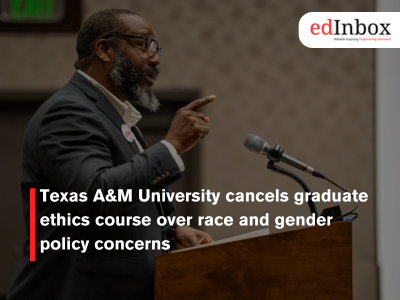
Texas A&M University has decided to cancel a graduate level ethics course only three days after the semester started. The university expressed that a major concern for them was whether the class was fully compliant with the newly revised very detailed standards for race, gender, and sexuality discussion in the classrooms.
The move initiated a discussion on academic freedom, the syllabus review process, and the consequences of policy changes for higher education in Texas.
The problem with the graduate course was that it was the first session of the class when the administration came to stop it, thus saying the decision was different from other cases when the classes were changed or checked before the term started.
Why the course was cancelled
The course Ethics and Public Policy (PSAA 642) was held by Prof. Leonard Bright at the Bush School of Government and Public Service. In a campus wide email sent by Bush School Dean John Sherman on Wednesday, he said the cancellation was a requirement of the Texas A&M system policy.
Sherman explained in the email that Bright didn't supply enough details on how topics like race, gender or similar would be handled in the class, even though the administration kept requesting this. Based on the information given, the institution said that it was not able to ascertain if the course was in line with the policy which forbids advocacy of race or gender ideology in classes unless they are specially exempted.
Classes with these themes must be reviewed and approved by the highest university authorities. A university spokesperson told AP News that departments have until Friday to send in courses for review and that the final decisions are expected before the January 28 add, drop deadline.
Professor disputes university’s claim
Professor Bright has challenged the university’s explanation. In an interview with The Texas Tribune, he said he clearly informed administrators that issues of race, gender, and sexuality would arise throughout the course rather than being limited to specific lectures.
“I told them it was going to come up every day,” Bright said, adding that discussions, case studies, and readings naturally involve these themes in ethics and public policy. “There is no one day. That’s how this class works.”
Bright also said students were not required to agree with his views and that the course encouraged discussion rather than advocacy.
What the course covered
According to the syllabus that AP News had a look at, this class discussed the impact that race, gender, religion, sexual orientation, and other social identities have on public policy, as well as the ethical obligations of public servants.
The formatting showed that teachers combined social equity and justice in one week of the public administration curriculum. They mentioned articles on diversity, equity, and inclusion (DEI), critical race theory, and the philosopher John Rawls' A Theory of Justice.
Bright said this was the only ethics class offered at the Bush School during that semester.
Impact on students
Initially, 10 students were enrolled in the course. After Bright informed the class that the course was under administrative review and could be canceled, two students chose to move to another class. The university has said it is assisting the remaining students in finding alternative courses.
University’s position on academic freedom
In his email, Dean Sherman said Bright’s course was one of two Bush School classes requiring exemptions from the vice provost of academic affairs. In the other case, administrators were able to seek approval because the syllabus contained sufficient detail, allowing that course to continue.
“I take no pleasure in canceling a course,” Sherman wrote, according to AP News. “I want us to continue to teach hard topics and engage with controversial issues. But I also expect us to follow the approval process. Transparency does not equal censorship.”
Emails obtained by The Texas Tribune show Bright was not asked to remove or revise any content before the course was canceled.
Broader impact across Texas campuses
The cancellation comes amid wider changes across Texas higher education. Last week, the dean of Texas A&M’s College of Arts and Sciences told faculty that around 200 courses could be affected by the new policy. In a separate case, a philosophy professor said he was asked to remove Plato readings related to race and gender or face reassignment, a claim the university later clarified by saying Plato himself was not banned.
Bright, who has taught the ethics course since 2018, is also president of the Texas A&M chapter of the American Association of University Professors, which has publicly opposed the policy.
Background of the policy
As reported by AP News, the policy was approved by the Texas A&M Board of Regents last year following backlash over a classroom discussion on gender identity that was secretly recorded and circulated online. The incident led to criticism from conservative activists and lawmakers and prompted reviews of course materials throughout several public university systems in Texas, including Texas Tech.
The topic of race, gender, or sexuality in college classrooms is not legally banned by either state or federal laws. However, Texas law requires universities to post their syllabi online. To address the recent controversies, a few institutions have added extra layers of administrative scrutiny for particular courses.
According to the university authorities, the resolution of course approval and cancellation issues will be done before the add, drop period ends, and there may be hundreds of courses that will be affected by the new regulations.