
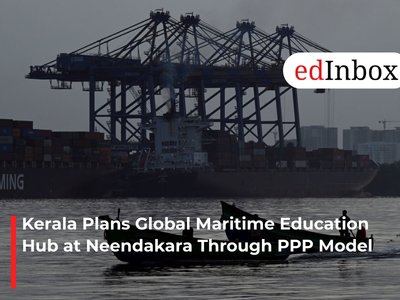
The Kerala Maritime Board has announced plans to transform the Neendakara Maritime Institute into a global maritime education hub through a public–private partnership (PPP) model, aiming to bring international standards of training and research to India’s coastal education sector.
Shine A. Haq, who is the Chief Executive Officer of the Kerala Maritime Board, said that through the use of the existing infrastructure at Neendakara, the initiative aims to convert this place into a world-class maritime institute that could serve as a bridge connecting Indian students with the booming global maritime economy.
The proposed centre is expected to provide expert courses in maritime navigation, port management, marine engineering, and logistics, thus grooming students for working in the international shipping and maritime services industry.
Officials mentioned that the project's main focus will be on technology transfer and extensive collaborations with top international universities, which should help the institute implement global best practices in maritime education. Infrastructure development, setting up of advanced training facilities, and forming international academic partnerships are expected to be bolstered by the involvement of the private sector.
This project aims to rebrand Kerala as a centre for maritime education in South Asia, leveraging the state's rich maritime tradition as well as its geographical advantage of being located on major international shipping routes.
The scheme also brings back to life an infrastructure that hardly saw any activity for almost 10 years. The building, which was first set up in 2015, had been left unfinished as it could not get the required permits under the Coastal Regulation Zone (CRZ) laws.
Officials, with their fresh plan of redevelopment based on PPP method, are looking to transform the long unused building into a world class maritime training centre where students not only from India but from other parts of the world will come. At the same time it will help in generating skilled manpower for the international shipping industry which is growing rapidly. Besides, a Vigilance inquiry was also carried out in the area following a report of mineral sand being smuggled through the construction activities. All these technical and legal problems were the main reasons why the site did not get transformed into a maritime institute. After a lot of discussion, the Request for Proposal (RFP) was done so as to maintain transparency and international standards. This included a Maritime Education Summit in Kochi with industry experts and discussions with the Union Government’s Director General of Shipping and international educators. The tender process was conducted via government’s e-tender portal. After an initial round saw limited participation, a re-tender with wider publicity was initiated to identify a suitable private partner with proven expertise in the international maritime sector. The selected partner is a consortium with established Memorandums of Understanding (MoUs) with prestigious institutions such as the Aberdeen Petroleum Institute in Egypt and Glasgow University in Scotland. They also hold placement agreements with various global shipping companies. Under the Public-Private Partnership (PPP) model, the land and building will remain under government ownership. The private partner will manage development for 30 years, after which all assets will revert to the government. This initiative is designed to be highly beneficial to both the State and the local community. The Maritime Board has ensured a steady revenue stream through a government-fixed lease rent and a share of the income generated from the institute and its associated tourism projects. Additionally, the board has secured scholarships for local residents and students from economically weaker backgrounds.
Kerala Plans Global Maritime Education Hub at Neendakara Through PPP Model
Typography
- Smaller Small Medium Big Bigger
- Default Helvetica Segoe Georgia Times
- Reading Mode