
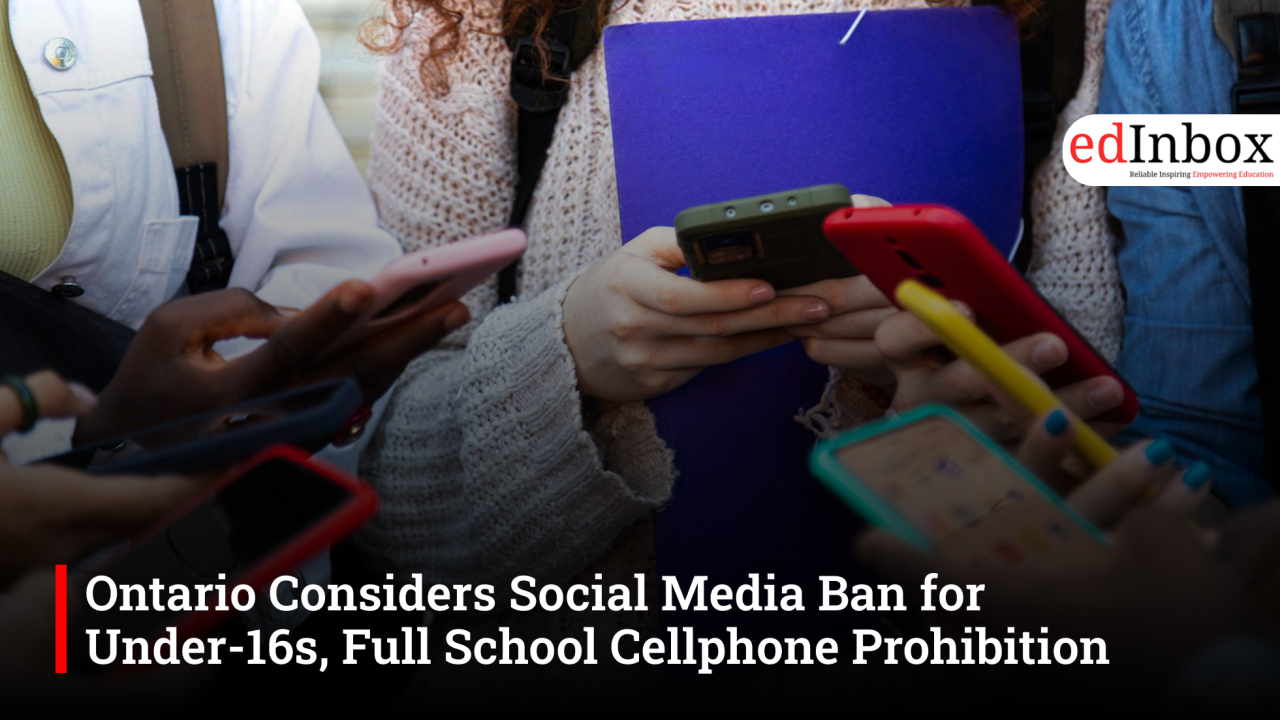
The province of Ontario is weighing sweeping new restrictions on student technology use, with Education Minister Paul Calandra confirming that officials are exploring a province-wide cellphone ban in schools alongside a potential social media prohibition for children under 16.
In an interview on Focus Ontario, Calandra said the proposal would build on existing classroom rules that require phones to be kept out of sight. “Potentially a complete cell phone ban in our schools,” he noted, adding that social media restrictions are also under consideration as part of the same policy direction.
The move reflects a growing international trend to curb digital distraction and online dependency among students. Countries like Australia have already taken legislative steps—passing laws to enforce age limits on social media—while governments in the United Kingdom and France are examining similar frameworks.
At the federal level in Canada, Culture Minister Marc Miller has also indicated that Ottawa is “very seriously” considering a nationwide ban on social media use for children under 16. Calandra confirmed that Ontario is closely studying these developments, including policy experiments in parts of the United States.
Educators have been among the strongest advocates for tighter restrictions. According to the minister, teachers and school staff have raised concerns about the impact of smartphones on classroom discipline, student focus, and even safety in school corridors. He added that feedback from jurisdictions that have implemented bans suggests improved behaviour and responsibility among students.
Public opinion appears to support stricter controls. A recent survey by the Angus Reid Institute found that 75 per cent of Canadians favour a full social media ban for those under 16, with support remaining high at 70 per cent among parents. Similarly, a global poll by Ipsos reported that 71 per cent of respondents across 30 countries believe children under 14 should not access social media, highlighting widespread concern over its effects.
However, enforcement remains a key challenge. Matt Hatfield of the OpenMedia pointed to methods being tested internationally, including government ID verification, AI-based age estimation, and account activity indicators. Each approach, he noted, raises questions around privacy, accuracy, and feasibility.
While no final decision has been announced, Ontario’s deliberations signal a significant policy shift that could reshape how students engage with technology—both inside and outside the classroom.
Ontario Considers Social Media Ban for Under-16s, Full School Cellphone Prohibition
Typography
- Smaller Small Medium Big Bigger
- Default Helvetica Segoe Georgia Times
- Reading Mode