
India's education system is facing a growing paradox—producing graduates who are academically qualified but inadequately prepared for the labour market. Despite record enrolment in higher education, employers across key sectors continue to report acute skill shortages, while millions of educated young people struggle to find meaningful employment.
The challenge, experts argue, is no longer just about creating jobs. It is about ensuring that India's education and skilling ecosystem prepares young people for the economy that is rapidly emerging.
A Growing Mismatch Between Education and Employment
According to the Periodic Labour Force Survey (PLFS) and the Economic Survey, India has 307 million people aged 15–29.
Of these:
- 166 million are outside the labour force.
- 141 million participate in the labour market.
- 14 million are unemployed.
- 127 million are employed.
However, only 15 million young workers hold regular salaried jobs with employment contracts and social security. The remaining 112 million are engaged in informal employment, including self-employment, gig work, family enterprises, agriculture, and micro, small and medium enterprises (MSMEs), where career progression and social protection remain limited.
The disconnect is particularly visible among graduates. While higher education is often viewed as the pathway to stable employment, graduate unemployment stands at 22.7%, nearly ten times higher than among people without secondary education. The intensity of competition for government jobs illustrates this imbalance: in 2024, nearly 20 lakh applicants competed for just 1,700 vacancies, reflecting the scarcity of secure formal employment.
Employers Need Skills, Not Just Degrees
Ironically, while educated youth struggle to secure jobs, employers across multiple industries report severe shortages of skilled professionals.
Critical gaps include:
- Healthcare: Approximately 2 million nurses, 5.7 lakh doctors, and large numbers of allied healthcare professionals, emergency medical technicians, and home healthcare workers.
- Education: Around 2.4 million teachers are required to meet demand.
- Technology: Growing shortages of AI engineers, data scientists, cybersecurity professionals, and semiconductor specialists.
- Construction and Energy: Demand continues to outstrip supply for electricians, renewable energy technicians, and other skilled trades.
- Logistics: An estimated shortage of 2–4 lakh truck drivers is affecting supply chains and economic activity.
These are not hypothetical future occupations but existing jobs requiring technical education, apprenticeships, certifications, and practical training.
Why the Current Model Falls Short
Much of India's higher education system evolved during the 1990s, when obtaining a university degree was widely regarded as the gateway to a secure salaried career. Today's economy, however, demands a far broader range of competencies.
Beyond traditional graduates, the country needs:
- Skilled technicians.
- Healthcare and elder-care professionals.
- Entrepreneurs and MSME owners.
- Digital workers.
- AI and semiconductor specialists.
- Certified tradespeople.
At the same time, the majority of young Indians will continue to work in the informal economy. For them, success depends less on academic credentials and more on practical capabilities such as financial literacy, customer management, digital tools, problem-solving, business operations, and entrepreneurship.
Demographic Opportunity Is Narrowing
India's current youth population represents what many economists describe as the country's last major demographic dividend before population ageing accelerates.
Over the next two decades, labour demand is expected to shift significantly as the country experiences demographic transition. Sectors likely to witness substantial growth include:
- Geriatric healthcare.
- Home healthcare services.
- Assisted living.
- Rehabilitation.
- Elder-care support.
- Digital technologies and advanced manufacturing.
Preparing today's young workforce for these future demands will be essential to sustaining economic growth and improving productivity.
Three Priorities for Education Reform
Experts suggest that India's education system should evolve along three complementary pathways:
1. Bridge Formal Sector Skill Gaps
Strengthen industry-linked technical education through apprenticeships, vocational certifications, employer partnerships, and hands-on learning in sectors facing documented workforce shortages.
2. Prepare the Informal Workforce
Since nearly seven out of every eight young workers are likely to remain outside formal employment, education should include entrepreneurship, financial literacy, digital skills, customer relations, and business management to support sustainable self-employment and small enterprises.
3. Anticipate Future Labour Market Needs
Education and skilling policies must align with emerging occupations such as AI engineering, semiconductor manufacturing, cybersecurity, renewable energy, logistics, healthcare, and elder-care services to prepare India for the next phase of economic transformation.
A Critical Decade Ahead
India's education challenge is no longer simply about expanding access to colleges and universities. It is about ensuring that learning translates into employability, productivity, and lifelong adaptability.
As the country's demographic window gradually narrows, the decisions taken over the next decade will determine whether India's largest generation of young people becomes a catalyst for sustained economic growth or continues to face the paradox of being overqualified in classrooms yet underprepared for the workplace. Building an education system that balances academic learning with practical skills, vocational pathways, entrepreneurship, and future-ready competencies will be central to unlocking the full potential of India's workforce.
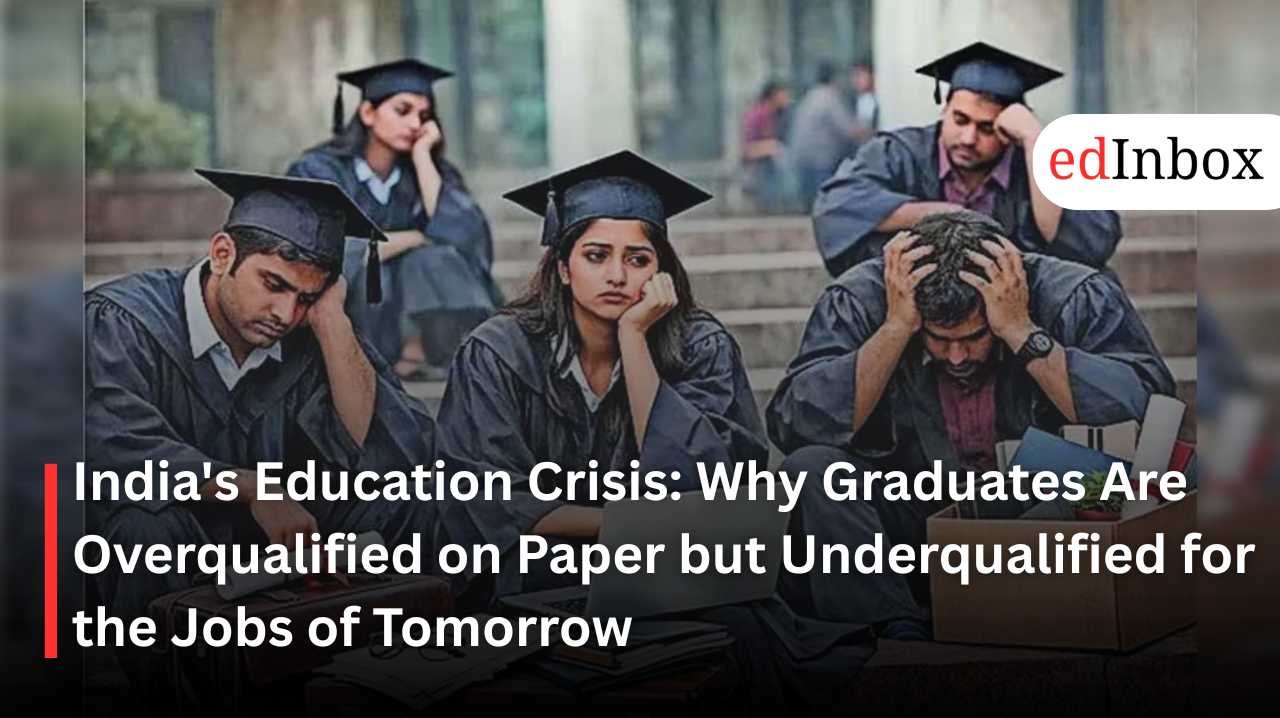
India's Education Crisis: Why Graduates Are Overqualified on Paper but Underqualified for the Jobs of Tomorrow
Typography
- Smaller Small Medium Big Bigger
- Default Helvetica Segoe Georgia Times
- Reading Mode