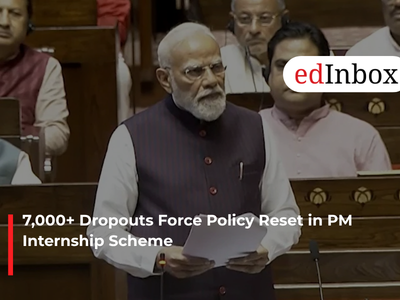
The Prime Minister Internship Scheme has seen a rise in dropouts which has forced the Centre to modify the programme by offering higher stipends and relaxing eligibility criteria to enhance retention and participation.
According to Ministry of Corporate Affairs figures, more than 7,290 candidates have left the scheme without completing it as on March 9, 2026. This happened even though the scheme, launched as a pilot in phases, still manages to get a large number of applications - thus revealing a growing disparity between enrolment and completion.
The first phase of the scheme, which was implemented in October 2024, got over 6.21 lakh applications but only 8,760 candidates joined. Up till now 3 605 have only completed the internship. The second phase, which was started in January 2025, got 4.55 lakh applications and more than 7,300 of the applicants joined.
Government sources say that the scheme was never meant as a job guarantee programme but rather a platform for creating industry-relevant skills and enhancing employability. Nonetheless, the number of exits indicates that maintaining engagement, especially in a year-long internship format, has become a major challenge.
In response, the government has introduced a series of course corrections. First, the monthly stipend has been raised from 5,000 to 9,000starting March 2026. Second, the scope of eligibility has been enlarged to include postgraduates and MBA students. Third, the age range has been changed to 18-25 years (it was 21-24 years).
On the supply side, norms for company participation have been loosened. Besides companies mandated to have corporate social responsibility (CSR) obligations, non-CSR companies can now take interns, and opportunities will be available throughout the year, not only at certain times. The scheme is also entering new sectors such as semiconductors, renewable energy, and global capability centres.
Above all, internship length has been made more varied, with 6- and 9-month choices offered after industry consultation.
The third phase is currently being planned for about 100,000 candidates, with over 15,500 job placements already recorded across sectors and states.
The change in policy reflects a well-known issue in India's skilling system: very desirous but uneven acquisition of skills. It remains to be seen whether the amended model can convert involvement to completion, and training to real employment, thus ensuring the programme's credibility in the long run.