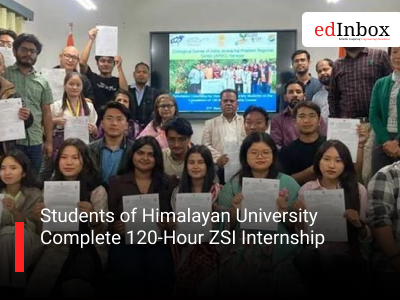
The first batch of students from of Himalayan University studying B.Sc. have completed a 120-hour NEP-2020 experiential internship at ZSI. They have earned skills in biodiversity science. These B.Sc. Zoology and Life-Science at Himalayan University, who have completed an internship for 120 hours at the Zoological Survey of India, Arunachal Pradesh Regional Centre, under the experiential learning component of NEP 2020. The program thus marks an important milestone in strengthening hands-on scientific training for undergraduate learners in the state.
A valedictory function was organized at ZSI, APRC, wherein D. Dalai, IFS, APCCF (WP&IT, NO CONS), Department of Environment, Forest and Climate Change, was the Chief Guest. In his keynote address, he congratulated the students for completion of the intensive training and also urged them to apply the scientific competencies acquired during the programme in emerging challenges related to biodiversity documentation and conservation.
Emphasizing that the internship forms the bedrock for early careers in wildlife biology, ecological research, and conservation policy, Dalai asked them to "compete with yourself," underlining continuous upskilling as part of the requirements within the fast-changing methodologies and technologies in the field. HoD, Department of Zoology, Himalayan University, Dr. Feroz A. Shergojri congratulated the students on their performance and thanked the scientists at ZSI for providing quality training to the students.
According to him, this programme reinforces the academic-research linkage envisaged under NEP-2020. Dr. S. D. Gurumayum, Scientist-E & Head of Office, while emphasizing the role of experiential learning during his welcome speech, said that structured internships equip the students with research orientation and technical capabilities relating to wildlife study in the Eastern Himalayas, considered one of the richest biodiversity zones in the country.
The welcome address was given by Smt. Ilona J. Kharkongor, Scientist-E. A technical overview presented the major skills imparted in the internship, such as field-survey protocols, scientific collection methods, specimen preservation techniques, and introductory DNA analysis, by Dr. Vikram Delu, Scientist-B. A Vote of Thanks by Dr. Temjenmongla, Scientist-D, concluded the programme, anchored by Mr. Yumto, Senior Research Fellow. Scientists, faculty, museum staff, research fellows, and students participated in it. This internship completion thus marks an important stride for Himalayan University in operationalizing the NEP-2020 emphasis on practical and research-driven education.